Cape Town Smart Traffic System Market Analysis: 16-Intersection 8m AI Pole Configuration Guide
Summary
Cape Town's 4.77 million residents and 42.1% congestion level make 16 signalized intersections a strong fit for approximately 64 8m AI traffic poles. The recommended BOT model uses 4K cameras, 77GHz radar, Jetson edge AI, and 5G/fiber links to TrafficGPT without claiming any past deployment.
Key Takeaways
For a 16-intersection Cape Town corridor, the recommended system centers on 8m L-arm poles, 64 baseline units, and sub-50ms edge decisions.
- A typical 16-intersection deployment would use approximately 64 primary 8m L-arm poles, assuming 4 approaches per junction.
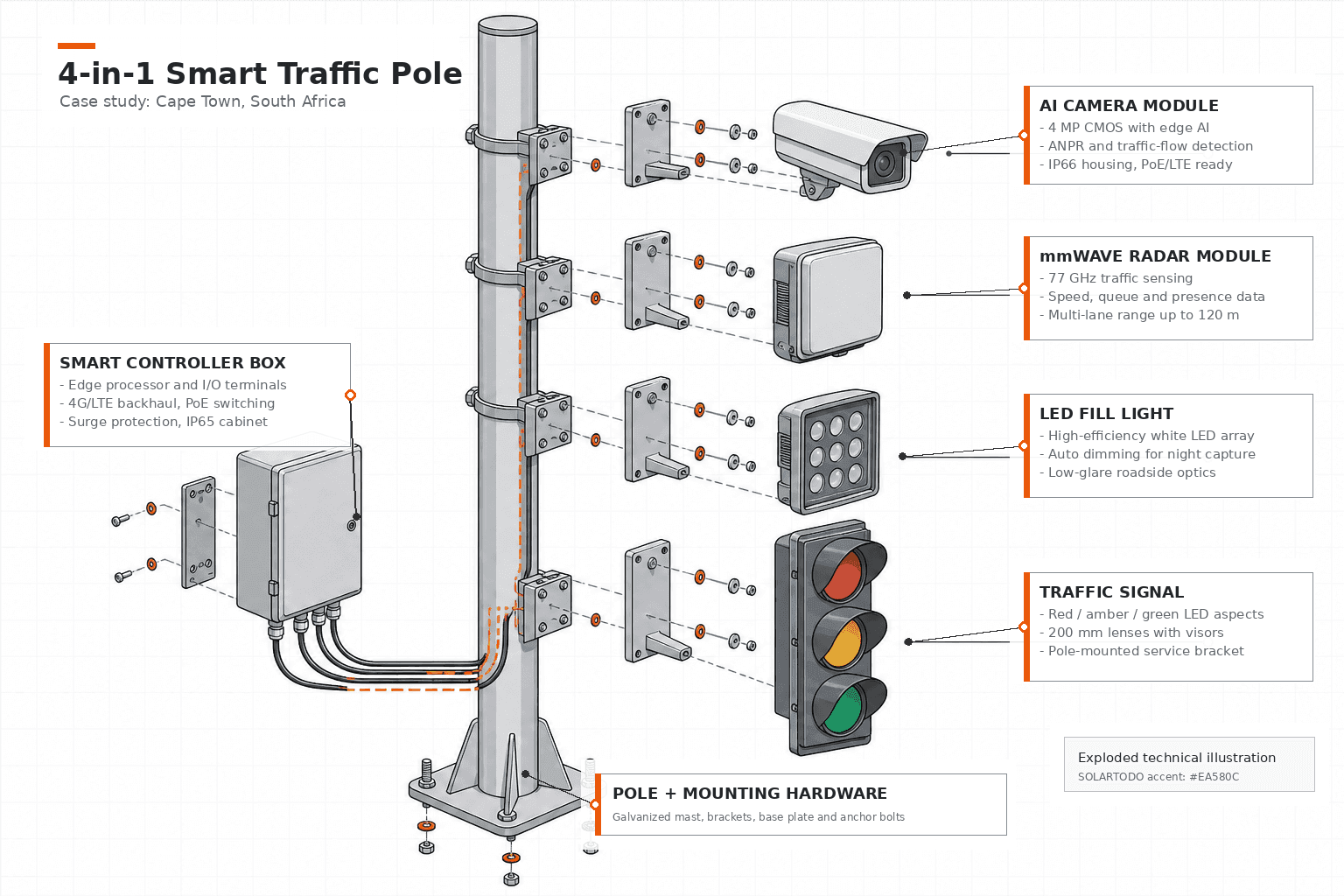
- Each pole integrates 4 always-on modules: 4K AI camera, 77GHz mmWave radar, LED fill light, and LED signal head.
- The perception stack supports 45+ detection types, 98% AI recognition accuracy, and less than 50ms local response.
- Cape Town's 2025 traffic profile shows 42.1% average congestion and 77 rush-hour hours lost per driver, according to TomTom (2026).
- 5G/fiber backhaul is recommended for all 16 intersections, with NVIDIA Jetson edge AI maintaining local control during network disruption.
- The preferred cooperation model is BOT, giving the city zero upfront equipment capex while preserving EPC and JV options for later phases.
- Standards alignment should include NTCIP for interoperable traffic control and GB 25280 for signal-controller conformance.
Market Context for Cape Town
Cape Town's road network must serve 4.77 million residents, a 2,446 km2 metro footprint, and 77 rush-hour hours lost per driver in 2025.
According to Statistics South Africa (2023), the City of Cape Town metropolitan municipality recorded 4,772,846 residents in Census 2022. That population is spread across a large coastal metro with dense commuting flows between the CBD, Bellville, the Cape Flats, Mitchells Plain, Khayelitsha, and the southern suburbs. For a Smart Traffic System, the critical market signal is not only population size but the number of mixed-use arterial corridors where buses, minibus taxis, private vehicles, pedestrians, and emergency vehicles compete at signalized intersections.
According to TomTom (2026), Cape Town's 2025 average congestion level was 42.1%, the average 10 km trip took 24 minutes 54 seconds, and rush-hour delay totaled 77 hours per driver. Evening peak conditions were more severe: TomTom reports 28 minutes 42 seconds for 10 km, 63.4% congestion, and 20.9 km/h average speed. These figures justify adaptive signal control because fixed-time plans are weakest when queue lengths vary sharply by hour, direction, weather, and incident conditions.
According to City of Cape Town transport planning materials (2024), the MyCiTi Phase 2A corridor is intended to connect roughly 35 suburbs and up to 1.4 million residents, with a target capacity of up to 100,000 passengers per day. That expansion increases the value of emergency vehicle priority, bus-priority logic, wrong-way alerts, and AI-assisted turning-movement counts at intersections. The system should therefore be specified as traffic infrastructure, not as a generic surveillance package.
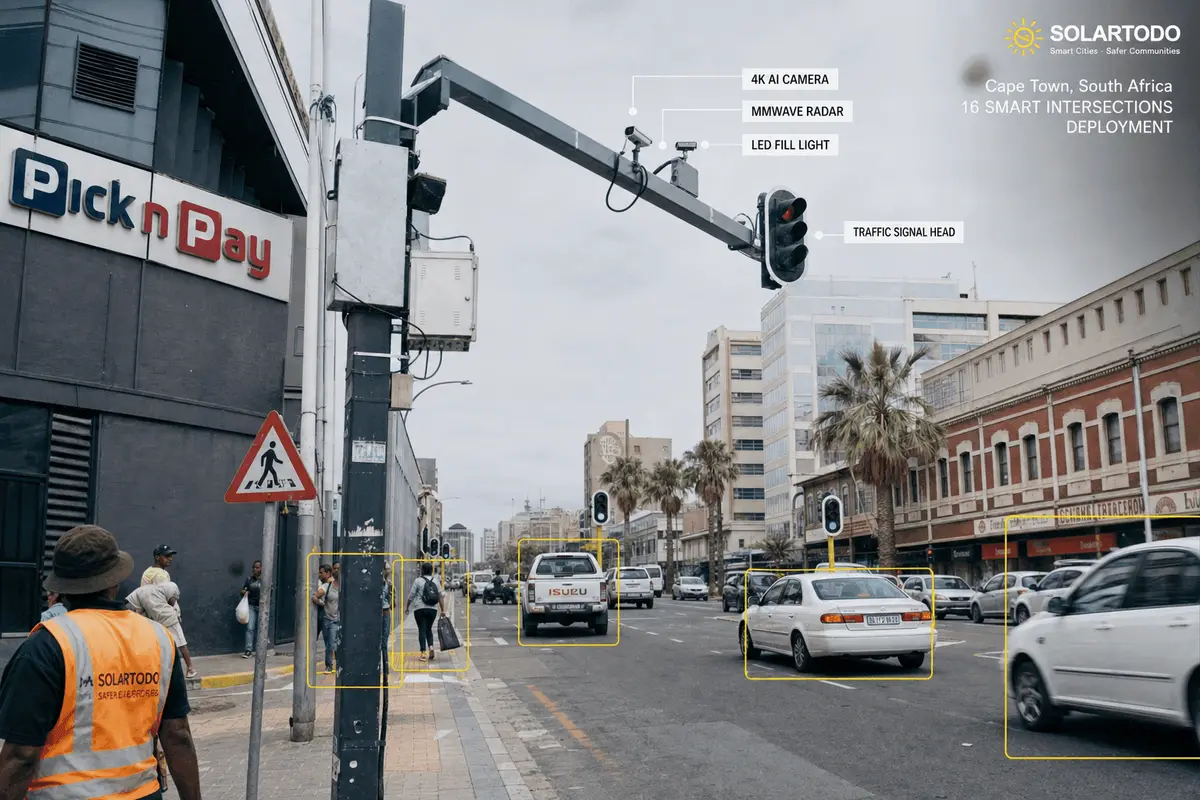
Cape Town's coastal climate also affects pole design. Wind exposure, salt-laden air, and winter rainfall make hot-dip galvanized steel a practical baseline for roadside assets. For this profile, SOLARTODO's dark grey L-arm pole form fits urban arterials because it keeps signal heads, cameras, radar, and LED fill lighting on one engineered structure rather than multiplying roadside cabinets and brackets.
Recommended Technical Configuration
A typical 16-intersection Cape Town configuration would use approximately 64 primary 8m smart poles, with auxiliary units added where turn lanes require coverage.
The recommended size class is the 8m L-arm hot-dip galvanized steel pole. SOLARTODO's 6m variant is better suited to compact intersections and pedestrian-heavy neighborhood junctions, while 10m to 12m structures are better reserved for highway gantries or wide multi-lane approaches. Cape Town's target use case is an urban arterial signal network, so the 8m variant provides the right clearance for signal heads, camera sightlines, and radar field coverage without overbuilding the foundation.
A typical N-unit deployment of this scale would consist of approximately 64 primary poles, based on 4 approaches across 16 intersections. Where intersections include slip lanes, BRT approaches, pedestrian refuge islands, or complex turning pockets, the design can expand toward 6 to 8 poles per junction; the product envelope allows 4 to 12 poles per intersection. These quantities are planning estimates, not statements of installed units.
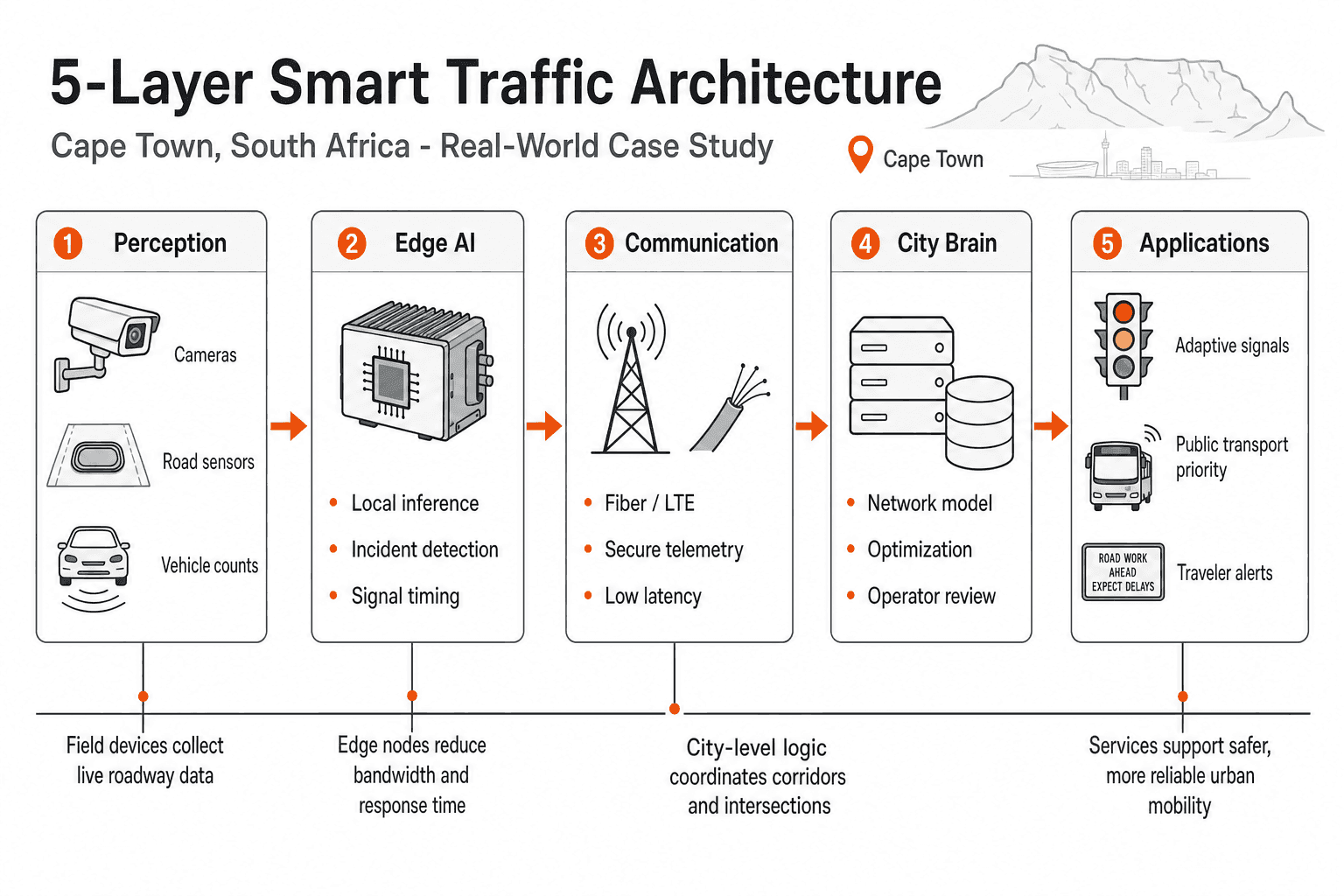
The recommended SOLARTODO configuration is the full 4-in-1 Smart Traffic System: 4K AI camera, 77GHz mmWave radar, LED fill light, and LED signal head integrated into the same 8m pole. The edge layer should use NVIDIA Jetson for local inference, with 5G/fiber backhaul to TrafficGPT for central visualization and natural-language traffic queries. The logic stack should follow five layers: Perception, Edge AI, Communication, City Brain, and Applications.
The cooperation model should be BOT because the specified project profile calls for zero upfront capex. Under BOT, SOLARTODO would finance and operate the system under defined service levels, while the city or concession partner pays through availability, data-service, or performance-linked mechanisms. EPC turnkey remains suitable where the buyer wants asset ownership from day 1, and JV is appropriate only when a local partner wants a shared operating company.
Technical Specifications
The Cape Town specification should standardize on 8m L-arm poles, 4 integrated sensing/control modules, 45+ detections, and NTCIP-compatible communications.
- Product: SOLARTODO Smart Traffic System for 16 Cape Town intersections.
- Pole form: single-base L-arm steel pole, dark grey finish, hot-dip galvanized for coastal corrosion resistance.
- Height: 8m recommended for the full intersection set; 6m and 10m variants are retained for future minor-road or highway extensions.
- Baseline quantity: approximately 64 primary poles for 16 intersections, with 4 to 12 poles per intersection depending on approach geometry.
- Camera module: 4K AI camera with 98% accuracy, 45+ detection types, and less than 50ms response.
- Radar module: 77GHz mmWave radar for queue, speed, presence, and adverse-weather redundancy.
- Lighting and signal modules: integrated LED fill light plus LED signal head on the same L-arm structure.
- Edge compute: NVIDIA Jetson for local perception, inference, event filtering, and fail-operational signal logic.
- Core functions: full 45-type detection, adaptive signal control, emergency vehicle priority, and wrong-way alert.
- Backhaul: dual 5G/fiber communication from intersections to the TrafficGPT central platform for natural-language queries.
- Standards: NTCIP for traffic-device interoperability and GB 25280 for traffic signal controller requirements.
- Local design check: SADC Road Traffic Signs Manual Volume 3 should guide South African signal display, placement, and driver-facing compliance.
According to ITU-R (2017), IMT-2020 performance requirements include 20 Gbit/s peak downlink and 1ms URLLC latency, which supports the use of 5G where fiber is not yet practical. NTCIP states, "The NTCIP standards do not prescribe any one media type over another." That is why 5G and fiber can coexist in the same Cape Town architecture.
Implementation Approach
A 16-intersection rollout would typically proceed in 5 phases: survey, design, procurement, installation, and TrafficGPT commissioning over 12 to 20 weeks.
Phase 1 is corridor survey and signal audit. Engineers would map approach widths, mast-arm conflicts, pedestrian crossings, cabinet locations, fiber availability, 5G signal strength, and emergency vehicle routes. This phase also defines whether each junction needs 4, 6, 8, or more poles, while keeping the planning basis at approximately 64 primary units.
Phase 2 is detailed engineering and factory configuration. The pole foundations, anchor bolts, arm lengths, cable routing, signal-head orientation, Jetson compute capacity, radar mounting angle, and camera fields of view should be checked before fabrication. For imported equipment, CKD or modular packing can reduce shipping volume and simplify on-site staging.
Phase 3 is civil works and pole erection. A typical sequence is foundation excavation, ducting, earthing, pole assembly, lift placement, signal head alignment, camera calibration, radar aiming, and LED fill-light test. Night work may be required on Cape Town arterials to reduce traffic disruption.
Phase 4 is communications, TrafficGPT integration, and user acceptance testing. Each intersection should be tested first in local edge mode, then in 5G/fiber connected mode, and finally as part of corridor-level adaptive timing. FHWA states, "Real-time management of traffic systems is proven to work." The practical requirement is to prove it locally through measured queue, delay, safety-event, and uptime data.
Expected Performance & ROI
Expected ROI depends on delay reduction, maintenance cost, and BOT service pricing; a 16-intersection system commonly models 3 to 6 years for payback.
The performance case should be modeled from Cape Town's current congestion baseline. According to TomTom (2026), drivers lost 77 hours in rush-hour traffic in 2025, and evening peak speeds averaged 20.9 km/h. If adaptive control reduces signal delay by even 5% to 15% on selected approaches, the avoided time cost can be material across a corridor serving buses, freight, commuters, and emergency vehicles.
The strongest technical benefit is data quality. Camera-only systems can miss speed and range certainty in glare, rain, or occlusion; radar-only systems lack classification detail. Combining 4K AI vision with 77GHz radar allows the controller to distinguish queue length, wrong-way movement, emergency vehicle approach, pedestrian presence, and lane-level demand with lower false-event risk.
The BOT model changes the ROI discussion. Instead of comparing only upfront equipment price, the buyer should compare availability payments against reduced delay, reduced manual traffic counts, fewer truck rolls, better enforcement support, and more reliable emergency response. SOLARTODO's 5-layer stack also lets traffic engineers query TrafficGPT in natural language, such as asking for the worst 5 turning movements by delay over the past 7 days.
Lifecycle cost should include cleaning camera lenses, checking radar alignment, testing signal heads, updating Jetson software, verifying NTCIP communications, and replacing damaged roadside components. A practical maintenance target is quarterly preventive inspection, monthly remote health review, and immediate dispatch for safety-critical signal faults.
Results and Impact
The expected impact is a measurable corridor upgrade across 16 intersections, not a claim that SOLARTODO has already deployed units in Cape Town.
A recommended impact dashboard would track 8 core metrics: average delay, queue length, cycle failure rate, pedestrian calls served, emergency priority events, wrong-way alerts, device uptime, and maintenance response time. Baseline data should be collected for at least 2 to 4 weeks before adaptive timing is activated. The same metrics should then be reviewed after 30, 90, and 180 days.
For Cape Town buyers, the strategic impact is interoperability. NTCIP alignment helps avoid locking the city into a single cabinet or controller vendor, while GB 25280 gives a defined reference for signal controller behavior. SOLARTODO's role in this configuration is technical fit, financing flexibility, and integration through the Smart Traffic System, not a fabricated local case-study claim.
Comparison Table
The recommended 8m 4-in-1 system offers 4 sensing/control modules per pole, while conventional or single-sensor options leave key detection gaps.
| Option | Typical pole height | Detection stack | Response target | Cape Town fit | Commercial model |
|---|---|---|---|---|---|
| SOLARTODO Smart Traffic System | 8m | 4K AI + 77GHz radar + LED fill + LED signal | <50ms edge response | Best for 16 urban intersections | BOT, EPC, or JV |
| Conventional signal pole | 6m-8m | Signal head only, loops optional | Controller-dependent | Limited adaptive value | EPC only |
| Camera-only analytics pole | 6m-8m | 4K video without radar redundancy | 100ms+ typical cloud/edge mix | Sensitive to occlusion and glare | Supply or EPC |
| Radar-only detection pole | 6m-10m | 77GHz radar without visual classification | <100ms typical | Strong speed/range, weak classification | Supply or EPC |
| Highway gantry system | 10m-12m | Multi-lane camera/radar on gantry | Project-specific | Better for freeways than arterials | EPC or JV |
Pricing & Quotation
Pricing should be evaluated across 3 commercial paths: FOB supply, CIF delivery, and EPC turnkey, with BOT retained for zero-upfront projects.
SOLARTODO offers three pricing tiers for this product line: FOB Supply (equipment ex-works China), CIF Delivered (including ocean freight and insurance), and EPC Turnkey (fully installed, commissioned, with 1-year warranty). Volume discounts are available for large-scale deployments. Configure your system online for an instant estimate, or request a custom quotation from our engineering team at [email protected].
For the Cape Town 16-intersection profile, BOT is the recommended cooperation model because it converts equipment capex into a service-backed deployment plan. EPC turnkey is still useful when a municipality, concessionaire, or road agency wants ownership at handover. For scope confirmation, buyers should contact us with intersection drawings, signal phasing plans, and preferred service-level terms.
Frequently Asked Questions
The 10 answers below cover the 8m pole specification, 16-intersection rollout, BOT financing, maintenance, warranty, and Cape Town installation constraints.
Q1: What is the recommended Smart Traffic System configuration for Cape Town? A typical Cape Town configuration would use approximately 64 primary 8m L-arm hot-dip galvanized steel poles across 16 intersections. Each pole integrates a 4K AI camera, 77GHz mmWave radar, LED fill light, and LED signal head. Edge AI runs on NVIDIA Jetson, with 5G/fiber backhaul to TrafficGPT for central monitoring and natural-language traffic queries.
Q2: Why is the 8m pole height recommended instead of 6m or 10m? The 8m height best fits Cape Town urban arterials because it provides practical camera sightlines, signal visibility, and radar coverage without using highway-scale structures. A 6m pole is more suitable for smaller neighborhood junctions. The 10m to 12m class is better reserved for highway gantries, wide expressway approaches, or multi-lane overhead detection.
Q3: How long would a 16-intersection deployment typically take? A typical schedule is 12 to 20 weeks after survey approval, depending on civil works, permits, shipping, and traffic-management windows. The sequence normally covers site survey, detailed design, procurement, foundation work, pole erection, module commissioning, 5G/fiber integration, TrafficGPT configuration, and acceptance testing. Complex intersections may extend the program.
Q4: What ROI or payback period should Cape Town buyers model? For planning, a 3 to 6 year payback range is reasonable under EPC, while BOT shifts the analysis to monthly service cost versus avoided delay and maintenance savings. The main value drivers are reduced queue delay, fewer manual counts, better emergency vehicle priority, wrong-way alerts, and improved data for signal retiming.
Q5: How does this compare with a conventional traffic signal pole? A conventional pole mainly supports signal heads and may depend on loops or manual timing updates. The SOLARTODO Smart Traffic System combines 4K AI vision, 77GHz radar, LED fill lighting, edge AI, and communications on one pole. That makes it more suitable for adaptive control, event detection, and real-time corridor analytics.
Q6: What maintenance is required for the 4-in-1 smart pole? Maintenance should include quarterly field inspection, monthly remote health checks, lens cleaning, radar alignment verification, LED signal testing, cabinet and grounding inspection, and software updates for Jetson edge devices. Coastal Cape Town conditions make corrosion checks important. Safety-critical faults should trigger immediate dispatch under the agreed BOT or EPC service level.
Q7: What warranty applies under EPC turnkey pricing? The EPC turnkey tier includes a 1-year warranty covering supplied equipment, commissioning, and agreed installation workmanship. Warranty scope should be confirmed in the quotation because civil foundations, vandalism, utility damage, and third-party fiber faults may need separate terms. Extended warranty and operation support can be structured under BOT or maintenance contracts.
Q8: Can the system work if fiber is unavailable at some intersections? Yes. The recommended architecture supports 5G/fiber backhaul, so intersections can use fiber where available and 5G where trenching is delayed or uneconomic. NVIDIA Jetson edge AI keeps local detection and response active. For critical intersections, dual-path communications are preferred to maintain TrafficGPT reporting during carrier or fiber outages.
Q9: Does the system support emergency vehicle priority? Yes. The project-specific configuration includes emergency vehicle priority as a core feature. The system can combine camera classification, radar tracking, and signal-controller logic to prioritize qualifying approaches. Final behavior should be configured with Cape Town traffic engineers so preemption rules, pedestrian safety intervals, and cross-street recovery timing meet local operating policy.
Q10: Which standards should be specified in procurement documents? Procurement documents should reference NTCIP for interoperable traffic device communications and GB 25280 for signal-controller requirements. For South African roadside layout and driver-facing signal design, engineers should also check the SADC Road Traffic Signs Manual Volume 3. These references help align international equipment with local road authority expectations.
References
The 7 references below anchor the Cape Town configuration in population data, traffic evidence, telecom standards, signal protocols, and local road-sign guidance.
- Statistics South Africa (2023): Census 2022 reports the City of Cape Town metropolitan population at 4,772,846 residents.
- TomTom (2026): Cape Town 2025 Traffic Index reports 42.1% average congestion, 24 min 54 s per 10 km, and 77 rush-hour hours lost.
- City of Cape Town (2024): MyCiTi Phase 2A planning materials describe a major public-transport corridor serving roughly 35 suburbs and up to 1.4 million residents.
- ITU-R (2017): Recommendation ITU-R M.2410 defines IMT-2020 technical requirements, including 20 Gbit/s peak downlink and 1ms URLLC latency.
- NTCIP Joint Committee (2018): NTCIP standards include traffic signals, CCTV cameras, transportation sensors, and transit priority communications.
- SADC / South African Department of Transport (2012): SADC Road Traffic Signs Manual Volume 3 covers traffic signal design for South African and regional road environments.
- Federal Highway Administration (2012): Every Day Counts adaptive signal control guidance identifies real-time signal management as a proven traffic operations method.
Equipment Deployed
- Approximately 64 x 8m L-arm hot-dip galvanized dark grey steel poles for 16 intersections
- 4K AI camera module with 98% accuracy, 45+ detection types, and <50ms response
- 77GHz mmWave radar module for queue, speed, and presence detection
- Integrated LED fill light for low-light traffic perception support
- Integrated LED signal head mounted on the L-arm pole structure
- NVIDIA Jetson edge AI compute per configured intersection node
- 5G/fiber backhaul to TrafficGPT central platform with natural-language queries
- Adaptive signal control, emergency vehicle priority, and wrong-way alert feature set
- NTCIP-compatible traffic communications and GB 25280 signal-controller alignment
- BOT cooperation model with zero upfront capex option