Cairo Smart Agriculture Monitoring Market Analysis: 178-Hectare 4G LTE Configuration Guide
Summary
Cairo-area farms near 30.04,31.24 face 10% climate-related crop-yield risk by 2050, making a 178 ha Smart Agriculture Monitoring design with 2 weather stations and 18 soil nodes technically suitable.
Key Takeaways
A 178 ha Cairo-area farm fits the medium size class, requiring 2-3 weather nodes, 15-25 soil nodes, pest monitoring, disease sensing, and solar off-grid power.
- A typical 178 ha configuration would use 2 x 7-sensor weather stations with +/-0.3 degrees C and +/-2% RH accuracy.
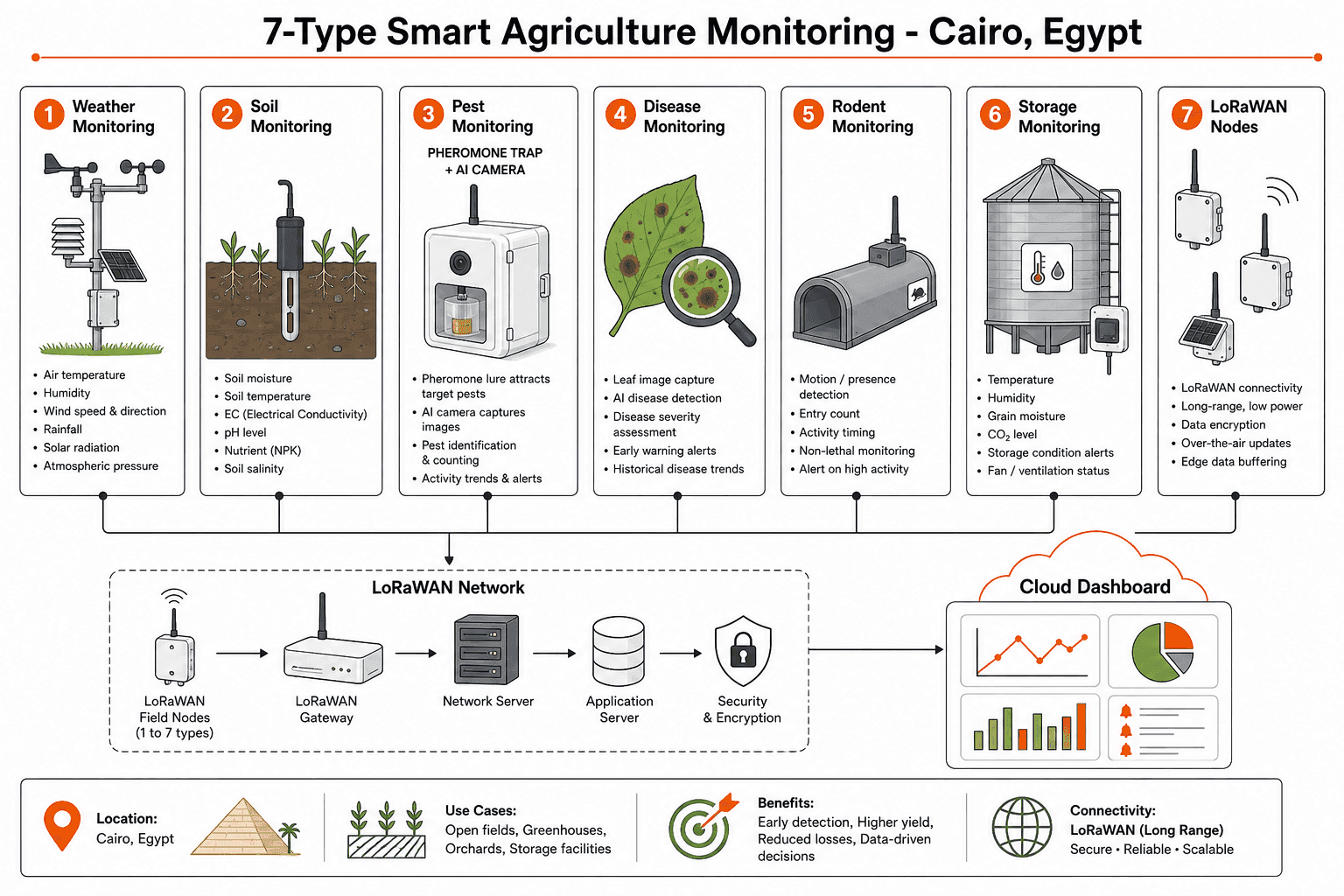
- Approximately 18 x 7-param soil sensors at 15-30 cm depth would track moisture, temperature, EC, pH, and NPK.
- Approximately 18 pheromone + AI photo-counting smart traps would cover up to 36 ha of targeted pest-pressure zones at 2 ha per unit.
- A 4G LTE architecture with 10-100 Mbps node connectivity is appropriate where image-based pest monitoring requires video-capable uplink.
- Two volumetric air-sampling spore-capture units would support early disease-risk alerts in high-value crops around Greater Cairo.
- Medium solar kits using 80 W panels and 400 Wh batteries support 25 W loads and off-grid operation for distributed nodes.
- Expected agronomic lift can be modeled as weather +3%, soil +8%, pest +5%, and disease +7%, subject to crop, irrigation, and farm discipline.
Market Context for Cairo
Greater Cairo's 22.18 million-person metropolitan market and Egypt's 86% agricultural freshwater use make precision monitoring relevant for peri-urban farms supplying high-demand food channels. Cairo is not a broad rural governorate, but its surrounding agricultural belt, Giza edge farms, Nile corridor plots, and controlled farms serving the capital face a dense demand environment. According to UN-based Greater Cairo estimates (2023), the metropolitan area had about 22,183,000 residents, while Cairo Governorate alone had about 10.2 million residents in January 2023. This population concentration increases pressure on vegetables, fruit, herbs, nursery crops, and protected agriculture that require tighter irrigation and pest-risk control.
According to the World Bank Climate Change Knowledge Portal and USAID climate profiles summarized for Egypt (2024), Egypt faces heat stress, water scarcity, and climate exposure that directly affect agriculture. According to Egypt climate-risk summaries (2024), domestic food-crop yields are projected to decline by about 10% by 2050 under climate pressure. According to water-resource data commonly cited for Egypt, agriculture accounts for about 59 km3 of freshwater withdrawal and about 86% of total freshwater use, which makes soil-moisture and salinity visibility commercially important.
Cairo's climate profile also changes the communications and power logic. Weather stations and soil nodes must tolerate hot, dusty, high-radiation conditions, while pest and disease sensors need reliable uplink for images and alerts. According to Egypt ICT market reporting (2024), Egypt had about 106.2 million mobile subscriptions by December 2023 and about 82 million internet users in early 2024, supporting the use of 4G LTE where farm managers need image-capable pest monitoring. For SOLARTODO Smart Agriculture Monitoring, this supports a recommendation centered on sensor density, pest imaging, disease capture, and off-grid solar autonomy rather than grid-dependent field cabinets.
Recommended Technical Configuration
A medium-class 178 ha Cairo deployment would typically use 2 weather stations, 18 soil nodes, 18 pest traps, 2 disease units, and 4 rodent traps. The project-specific configuration aligns with SOLARTODO's medium farm class because the area sits within the 100-500 ha band. The sizing is also proportional: 18 soil sensors over 178 ha averages roughly 1 soil node per 9.9 ha, which is realistic for a mixed field block where irrigation zones, soil texture, and crop value determine exact placement.
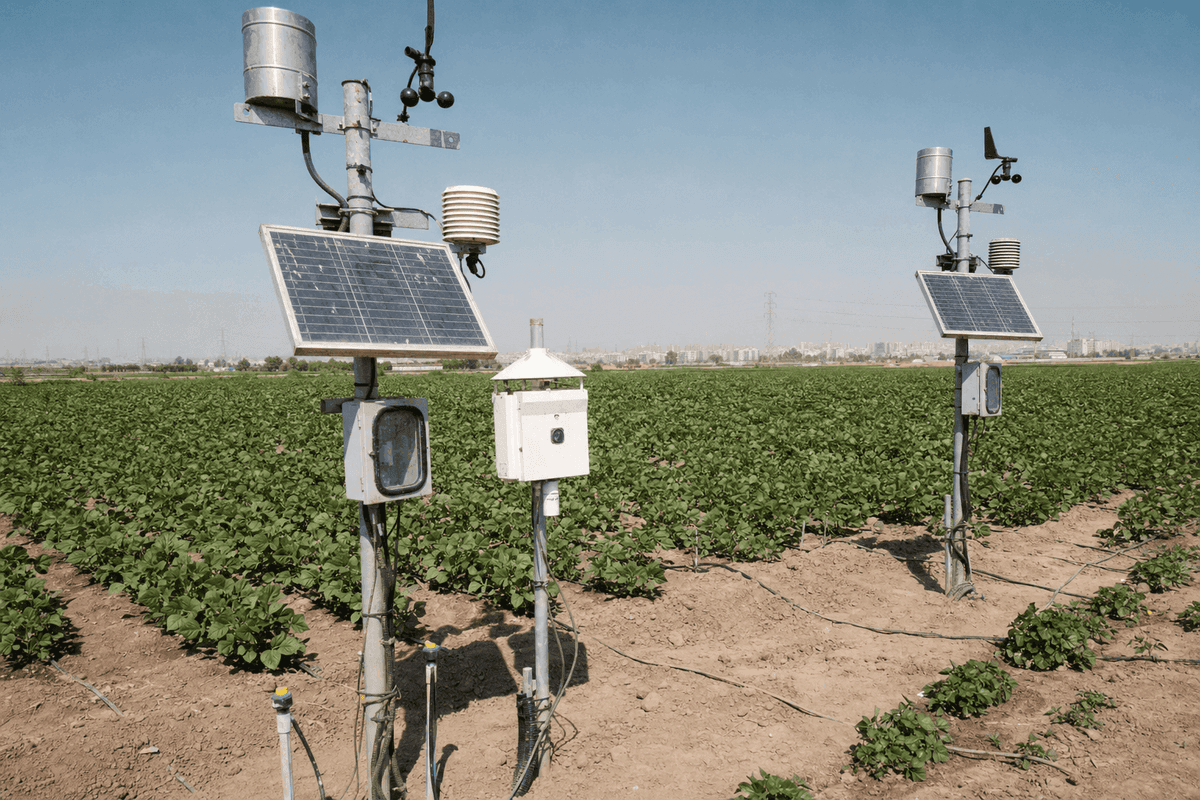
A recommended configuration is 2 x Standard 7-sensor weather stations measuring temperature, humidity, rain, wind speed, wind direction, pressure, and solar radiation. Soil sensing should use 18 x 7-param probes for moisture, temperature, EC, pH, and NPK at 15-30 cm depth, which is the agronomic root-zone band specified for this product line. Pest monitoring should use 18 x pheromone + AI photo-counting smart traps, not insect-killing lamps, because the objective is pressure detection, trend analysis, and intervention timing.
The 2 x volumetric air-sampling spore-capture devices are most suitable for disease-prone crop blocks, humid microclimates, and zones near irrigation canals or dense plant canopy. Four smart rodent traps with activity sensors provide edge monitoring near storage, canals, and farm perimeters. Communication should use 4G LTE nodes with video-capable 10-100 Mbps connectivity, and all nodes should use medium solar kits with 80 W panels and 400 Wh batteries supporting 25 W loads. SOLARTODO would position this as a technical recommendation for a Cairo-area farm profile, not a statement that any deployment has already been completed.
Technical Specifications
The 178 ha specification uses 2 weather stations, 18 soil sensors, 18 AI pest traps, 2 spore units, 4 rodent traps, 4G LTE, and 80 W solar kits. According to WMO observing guidance, standardized weather observations are essential for comparable meteorological records; WMO states, 'free and unrestricted' data exchange is a core principle of international meteorology. For agricultural monitoring, the practical implication is consistent sensor siting, calibration logs, and data quality checks before weather-based irrigation or pest decisions are automated.
- Product: SOLARTODO Smart Agriculture Monitoring for a 178 ha Cairo-area farm profile.
- Weather: 2 x Standard 7-sensor stations with temperature, humidity, rain, wind speed, wind direction, pressure, and solar radiation.
- Weather accuracy: +/-0.3 degrees C and +/-2% RH, suitable for irrigation scheduling and microclimate trend alerts.
- Soil: 18 x 7-param probes measuring moisture, temperature, EC, pH, nitrogen, phosphorus, and potassium.
- Soil installation depth: 15-30 cm, matching the specified root-zone band for the SOLARTODO sensor configuration.
- Pest: 18 x pheromone + AI photo-counting smart traps, each with 2 ha coverage for target pest-pressure monitoring.
- Disease: 2 x volumetric air-sampling spore-capture devices for early fungal-risk surveillance.
- Rodent: 4 x smart trap + activity sensor devices for perimeter and storage-zone monitoring.
- Communication: 4G LTE nodes with video-capable 10-100 Mbps throughput.
- Power: all devices solar-powered and off-grid capable, using 80 W panel + 400 Wh battery kits where medium power is required.
- Cloud platform: Basic tier with dashboard, SMS alerts, and 30-day history.
- Standards basis: WMO weather-observation practice and ISO 11461 soil-quality water-content determination principles.
ISO states, 'Determination of soil water content' in ISO 11461, which is directly relevant to soil-moisture measurement traceability. Field calibration should compare sensor readings with soil samples by block and crop stage, especially where Nile alluvial soils, reclaimed desert soils, and fertigation zones differ sharply.
Implementation Approach
A typical Cairo implementation would be phased over 6-10 weeks, moving from agronomic survey to commissioning, calibration, and dashboard handover. The first phase is block mapping: crop type, irrigation valves, soil texture, drainage, pest history, and existing mobile signal strength are recorded. A 178 ha farm should then be divided into functional monitoring zones rather than equal geometric grids, because a single high-value greenhouse block may justify denser monitoring than a uniform open-field plot.
The second phase is procurement and configuration. Devices are preconfigured with sensor IDs, LTE SIM profiles, alert thresholds, and dashboard permissions before shipment. For international supply, CKD-style packing can reduce shipping risk and simplify customs inspection, while batteries, panels, poles, sensor probes, and camera assemblies are labeled by installation zone.
The third phase is field installation. Weather stations should be installed in representative open locations, away from buildings, tree lines, and pump-house heat plumes. Soil probes are placed at 15-30 cm in irrigated root zones, with at least one calibration reading taken after installation. Pheromone + AI photo-counting traps should be located by pest species, crop phenology, and prevailing wind, not simply by a square grid.
Commissioning should validate three items: sensor readings, network uptime, and alert behavior. A basic SOLARTODO cloud platform setup would include dashboard views, SMS alerts, and 30-day data history. Handover should include sensor cleaning instructions, pheromone lure replacement intervals, battery inspection checks, and escalation rules for disease-spore alerts.
Expected Performance & ROI
Expected performance for this configuration can be modeled as +3% weather, +8% soil, +5% pest, and +7% disease improvement factors. These figures should be treated as planning assumptions, not guaranteed yield outcomes, because crop genetics, irrigation discipline, fertilizer program, labor response time, and pest thresholds determine final results. For Cairo-area farms, the strongest ROI driver is usually avoided loss from water stress, salinity drift, delayed pest intervention, and disease spread.
According to FAO AQUASTAT-style water-resource reporting, Egypt's agriculture relies heavily on irrigation, which makes each unnecessary irrigation cycle a measurable cost and water-risk event. According to climate-risk summaries for Egypt (2024), water scarcity and heat stress can raise crop water requirements, shortening response windows during hot periods. Soil EC and moisture trends therefore provide practical value: managers can detect over-irrigation, under-irrigation, salinity accumulation, and fertigation imbalance before visible stress appears.
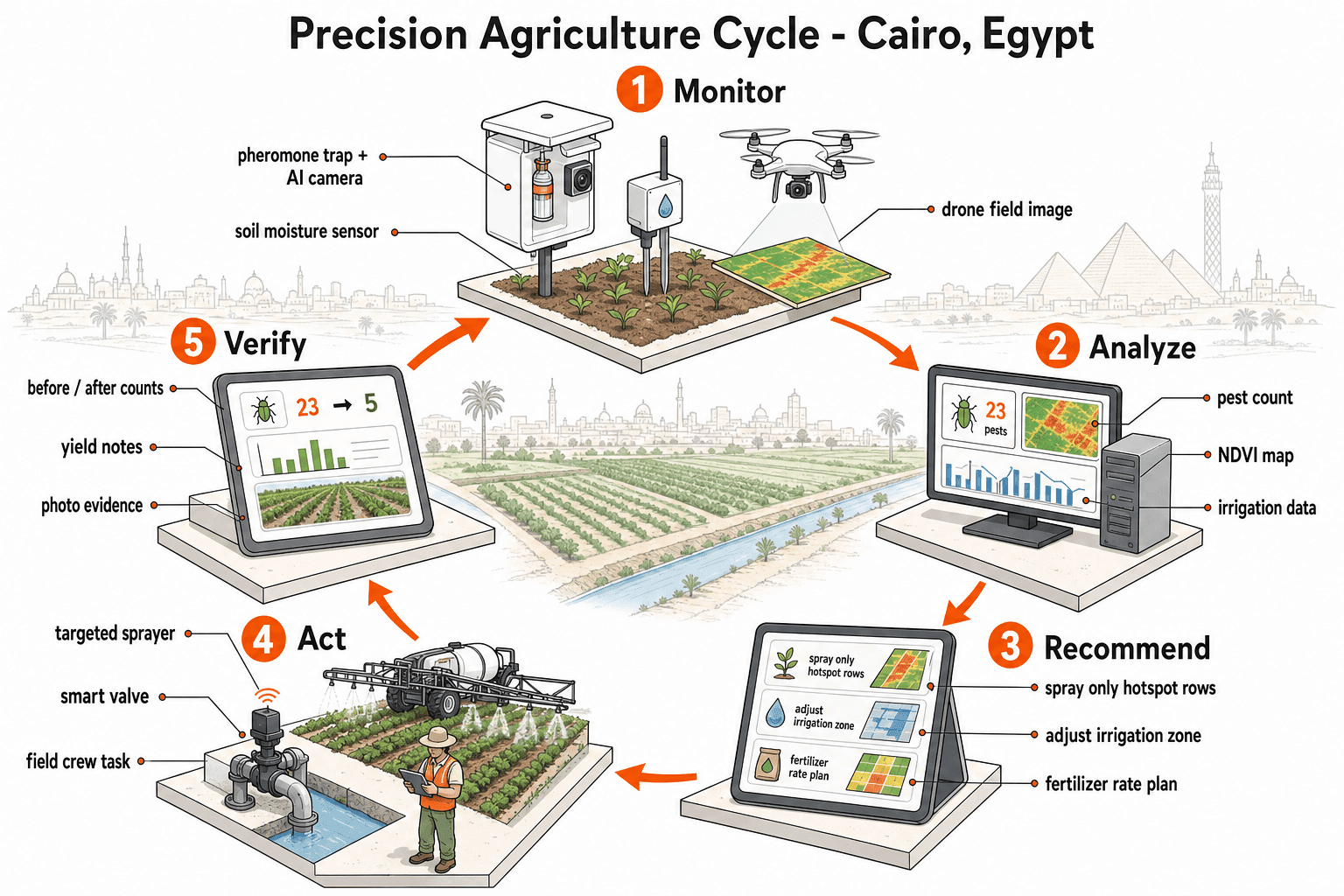
The pest and disease layers add a second performance pathway. Pheromone + AI photo-counting traps provide count trends rather than a binary trap inspection note, allowing spray decisions to be linked to threshold movement. Volumetric spore capture supports earlier disease-risk warning where humidity, canopy density, and wind patterns increase fungal pressure. For a 178 ha farm, a 2-disease-unit design is a practical balance between coverage, sampling discipline, and maintenance workload.
Results and Impact
A 178 ha SOLARTODO configuration would mainly improve decision speed across 18 soil zones, 18 pest-monitoring points, and 2 disease-sampling locations. The expected impact is operational visibility: the farm manager receives weather, soil, pest, disease, and rodent data in one dashboard rather than separate manual logs. With SMS alerts and 30-day history, the basic platform is best suited for farms that need daily action support without a complex enterprise integration project.
The highest-value result is earlier intervention. Soil moisture and EC readings can trigger irrigation or leaching checks before plant stress is visible. AI pest counts can show whether a pest population is rising after a weather change or declining after treatment. Spore capture can indicate when disease pressure is moving from background risk to active intervention risk.
Comparison Table
This 178 ha configuration sits between the standard medium-size table and a large-farm architecture, with 18 soil nodes and 4G LTE instead of LoRaWAN. The table below compares the project-specific recommendation against the standard SOLARTODO size classes.
| Farm profile | Typical area | Weather nodes | Soil nodes | Pest monitoring | Disease monitoring | Communication | Best fit |
|---|---|---|---|---|---|---|---|
| Small | <30 ha / 200 mu | 1 | 5-8 | 1 pest unit | Optional | LoRaWAN gateway | Demonstration farms, orchards, small protected farms |
| Cairo recommended | 178 ha | 2 | 18 | 18 pheromone + AI photo-counting traps | 2 spore-capture units | 4G LTE, 10-100 Mbps | Medium farm with image monitoring and off-grid nodes |
| Medium standard | 100-500 ha | 2-3 | 15-25 | 2-3 pest units | 1-2 disease units | LoRaWAN backbone | Broad-acre monitoring with lower image bandwidth |
| Large | 1000+ ha | 5+ | 50+ | 5+ pest units | Multi-disease | 4G mesh + control room | Estate farms, integrated command centers |
Pricing & Quotation
SOLARTODO offers three pricing tiers for this product line: FOB Supply (equipment ex-works China), CIF Delivered (including ocean freight and insurance), and EPC Turnkey (fully installed, commissioned, with 1-year warranty). Volume discounts are available for large-scale deployments. Configure your system online for an instant estimate, or request a custom quotation from our engineering team at [email protected].
Frequently Asked Questions
The 178 ha Cairo configuration usually requires 2 weather stations, 18 soil probes, 18 AI pest traps, 2 disease samplers, and 4 rodent units.
Q1: What makes this Smart Agriculture Monitoring configuration suitable for Cairo? The design fits Cairo's peri-urban agriculture because it combines irrigation visibility, pest imaging, and disease-risk alerts in a hot, water-constrained environment. A 178 ha farm falls inside the 100-500 ha medium size class, so 2 weather stations, 18 soil probes, and 18 pheromone + AI photo-counting traps are proportionate rather than over-specified.
Q2: Why use 4G LTE instead of LoRaWAN for this 178 ha profile? LoRaWAN is efficient for low-bandwidth soil and weather data, but this configuration includes AI photo-counting pest traps and video-capable nodes. 4G LTE with 10-100 Mbps throughput better supports image upload, remote diagnostics, and faster alert delivery where mobile coverage is available across the Cairo-area farm.
Q3: How long would installation typically take? A typical 178 ha installation would take about 6-10 weeks from survey to commissioning, depending on customs, site access, and SIM provisioning. Field work usually includes station mounting, probe installation at 15-30 cm, trap placement, spore-sampler setup, solar kit checks, dashboard configuration, and operator training.
Q4: What ROI should a farm expect from the system? ROI should be modeled from avoided losses and better input timing, not from a fixed promise. The planning assumptions are weather +3%, soil +8%, pest +5%, and disease +7% improvement potential. Actual payback depends on crop value, irrigation cost, pest history, disease pressure, labor response, and fertilizer discipline.
Q5: What maintenance is required for the equipment? Maintenance includes cleaning weather sensors, inspecting 80 W panels, checking 400 Wh batteries, replacing pheromone lures, cleaning camera lenses, validating soil-probe readings, and servicing spore-capture consumables. A practical schedule is monthly visual inspection, seasonal calibration review, and immediate inspection after dust storms or irrigation-system damage.
Q6: How does this compare with manual scouting? Manual scouting remains useful, but it is periodic and subjective. This configuration adds 24/7 weather data, 18 continuous soil locations, AI pest-count trends, and 2 spore-sampling points. The best operating model combines sensor alerts with agronomist verification before chemical, irrigation, or fertigation decisions.
Q7: Does SOLARTODO provide EPC pricing for Cairo projects? SOLARTODO can quote FOB Supply, CIF Delivered, or EPC Turnkey tiers, but this guide intentionally does not publish prices. A technical quotation should confirm quantities, installation scope, SIM requirements, civil works, warranty terms, commissioning support, and whether the buyer wants only equipment supply or fully installed service.
Q8: What warranty structure is typical for this product line? The EPC Turnkey tier includes a 1-year warranty according to the specified quotation paragraph. Buyers should confirm coverage for sensors, solar kits, communication nodes, batteries, and cloud access. Warranty performance also depends on correct installation, surge protection, physical security, and documented maintenance.
Q9: Are the pest traps insect-killing lamps? No. The specified pest devices are pheromone + AI photo-counting smart traps with 2 ha coverage per unit. They are designed to attract target pests for image-based counting and trend analysis, not to operate as insect-killing lamps. This distinction matters for integrated pest management and data quality.
Q10: Can the system work fully off-grid? Yes. The specified configuration is solar-powered and off-grid capable. Medium solar kits use 80 W panels and 400 Wh batteries supporting 25 W loads. Site engineering should still verify shading, dust accumulation, battery autonomy, panel angle, and the power draw of camera-enabled LTE nodes.
References
These 7 references support Cairo demographics, Egypt water constraints, mobile connectivity, weather-observation practice, and soil-measurement standards used in this guide.
- World Bank Climate Change Knowledge Portal (2024): Egypt climate-risk profiles describe heat stress, water scarcity, and agricultural vulnerability. https://climateknowledgeportal.worldbank.org/country/egypt
- USAID (2024): Egypt Climate Change Country Profile summarizes water scarcity and agricultural climate risks affecting yields and food security. https://www.usaid.gov/climate/country-profiles/egypt
- FAO AQUASTAT (2020): Egypt water-resource data identifies agriculture as the dominant freshwater user and irrigation as central to production. https://www.fao.org/aquastat/
- World Meteorological Organization (2023): WMO observing guidance supports standardized meteorological observation for comparable weather and climate data. https://wmo.int/
- ISO (2001): ISO 11461 specifies soil quality determination of soil water content, relevant to soil-moisture measurement validation. https://www.iso.org/standard/20886.html
- International Telecommunication Union (2024): ICT indicators support assessment of national mobile and broadband readiness for connected monitoring systems. https://www.itu.int/itu-d/reports/statistics/
- CAPMAS / Egypt population estimates (2023): Cairo Governorate and Greater Cairo population figures support market-density analysis for peri-urban food systems. https://www.capmas.gov.eg/
Equipment Deployed
- 2 x 7-sensor weather stations with wind direction, pressure, solar radiation, +/-0.3 degrees C and +/-2% RH accuracy
- 18 x 7-param soil sensors for moisture, temperature, EC, pH, and NPK at 15-30 cm depth
- 18 x pheromone + AI photo-counting smart traps with 2 ha coverage per unit
- 2 x volumetric air-sampling spore-capture disease monitoring units
- 4 x smart rodent trap + activity sensor units
- 4G LTE video-capable nodes with 10-100 Mbps connectivity
- Medium solar kits with 80 W panel and 400 Wh battery supporting 25 W load
- Basic cloud platform with dashboard, SMS alerts, and 30-day history