Summary
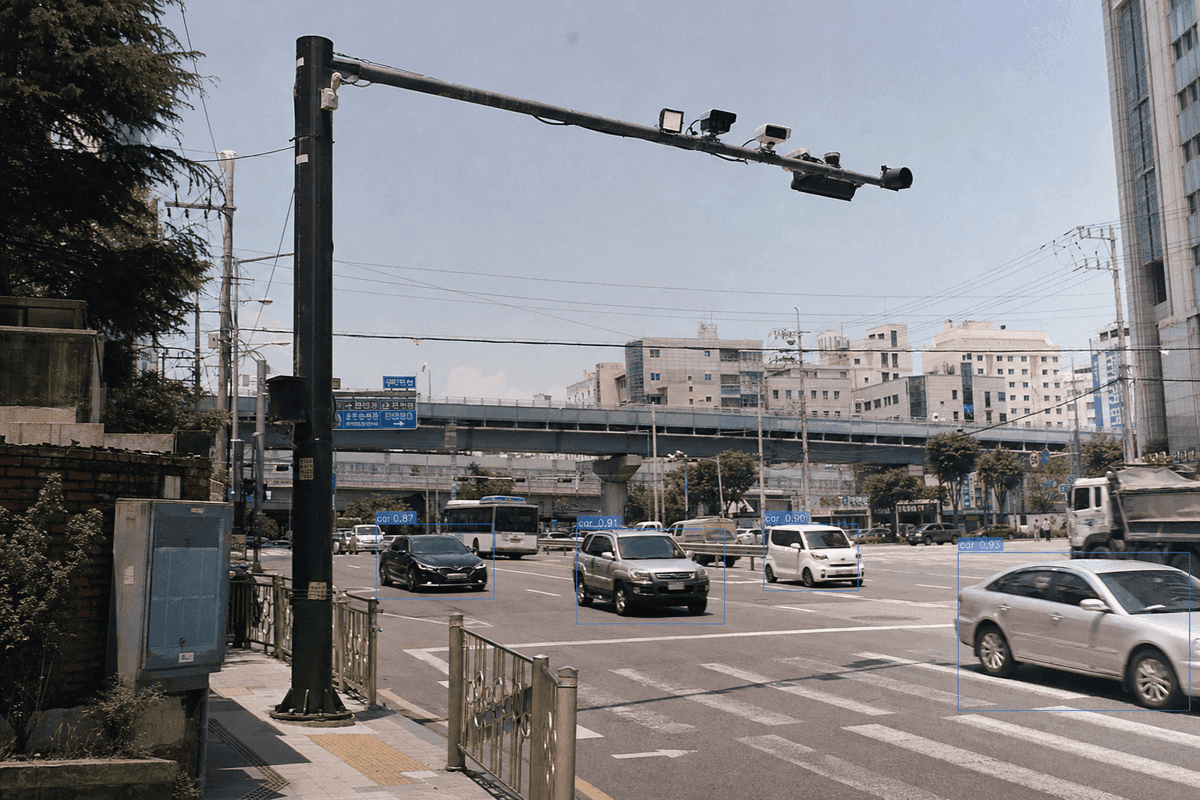
Busan’s 7-intersection SOLARTODO plan fits a city with 3.24 million residents, 223 smart intersections, and July rainfall of 326.8 mm, using 8 m L-arm poles, 4K AI cameras, 77 GHz radar, and 5G/fiber backhaul.
Key Takeaways
A 7-intersection Busan Smart Traffic System should combine 28-84 poles, sub-50 ms edge response, and standards-ready controller integration.
- Specify 7 intersections with 4-12 poles per intersection, giving an estimated 28-84 smart traffic poles.
- Use 8 m dark-grey hot-dip galvanized L-arm steel poles for dense urban intersections, not highway gantry layouts.
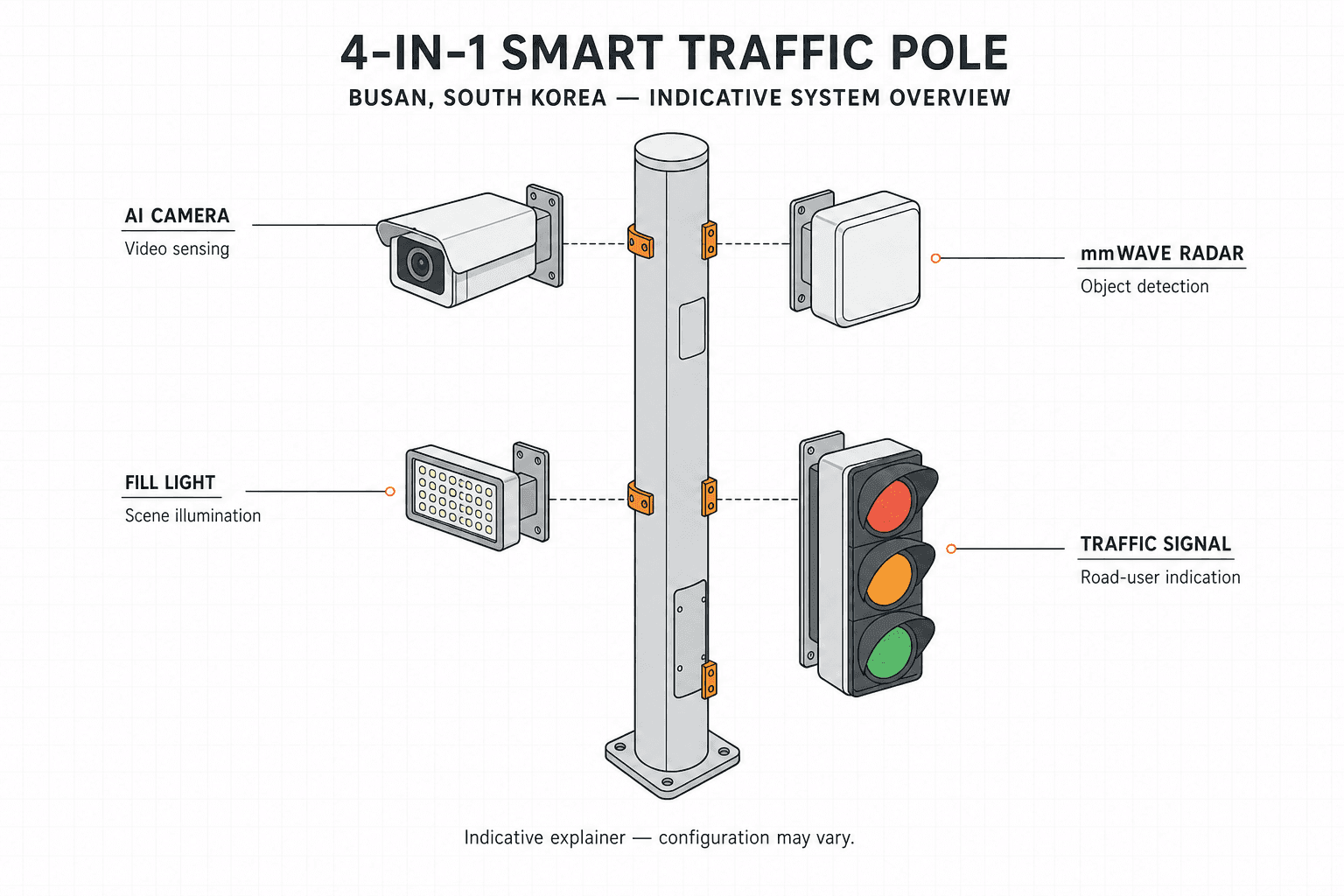
- Integrate 4 modules per pole: 4K AI camera, 77 GHz mmWave radar, LED fill light, and LED signal head.
- Target less than 50 ms local edge response using NVIDIA Jetson before forwarding events to TrafficGPT.
- Plan for Busan’s climate: WMO/KMA normals show 326.8 mm July rainfall and 266.5 mm August rainfall.
- Align with Busan’s existing ITS base: Busan reported 223 smart intersections and 20 more major intersections planned in 2026.
- Use Korea’s connectivity advantage: OECD reported 90% fiber share of fixed broadband connections in Korea in 2025.
- Treat SOLARTODO’s role as an advisory configuration, not a completed Busan deployment claim.
Market Context for Busan
Busan is a mature ITS upgrade market, with 3.24 million residents, 223 smart intersections, and active AI signal expansion in 2026.
According to Busan Metropolitan City (2026), Busan’s population briefing listed 3,235,361 residents in May 2026, creating dense commuter, freight, tourist, and pedestrian demand. According to Busan Metropolitan City (2026), the city already operated 223 smart intersections and planned 20 additional major intersections under a real-time intersection information service. This means a SOLARTODO proposal should be framed as integration with an existing traffic-management environment, not as a greenfield pilot.
According to WMO and Korea Meteorological Administration climate normals (1991-2020), Busan records 326.8 mm mean rainfall in July and 266.5 mm in August. Roadside AI equipment should therefore prioritize sealed electronics, corrosion-resistant pole coating, stable grounding, surge protection, and reliable rain-night detection. Coastal wind, bridge access routes, port freight, and tunnel approaches make radar-plus-camera sensing more credible than camera-only enforcement.
According to OECD (2025), Korea’s fiber share reached 90% of fixed broadband connections, one of the highest levels in the OECD. According to OECD (2024), Korea had 63 5G connections per 100 inhabitants and 593 5G base stations per 100,000 inhabitants. For Busan, this supports a dual-path architecture using fiber where civil works permit and 5G for redundancy, faster commissioning, or temporary corridor expansion.
Recommended SOLARTODO Configuration
The recommended SOLARTODO package uses 8 m L-arm poles, 4-in-1 sensing, Jetson edge AI, and TrafficGPT for 7 intersections.
For a Busan seven-intersection planning scenario, SOLARTODO should specify approximately 28-84 dark-grey hot-dip galvanized L-arm steel poles. The final count should be determined by lane count, approach geometry, pedestrian crossings, turning pockets, stop-line visibility, and auxiliary signal requirements. This keeps the recommendation engineering-based and avoids claiming that SOLARTODO has already deployed the system in Busan.
Each pole should integrate a 4K AI camera, 77 GHz mmWave radar, LED fill light, and LED signal head. NVIDIA Jetson edge AI should process vehicle counting, speed detection, plate recognition, lane behavior, queue length, and 45+ detection types locally. The target response should remain below 50 ms for detection-to-control event handling before structured events are sent to TrafficGPT.
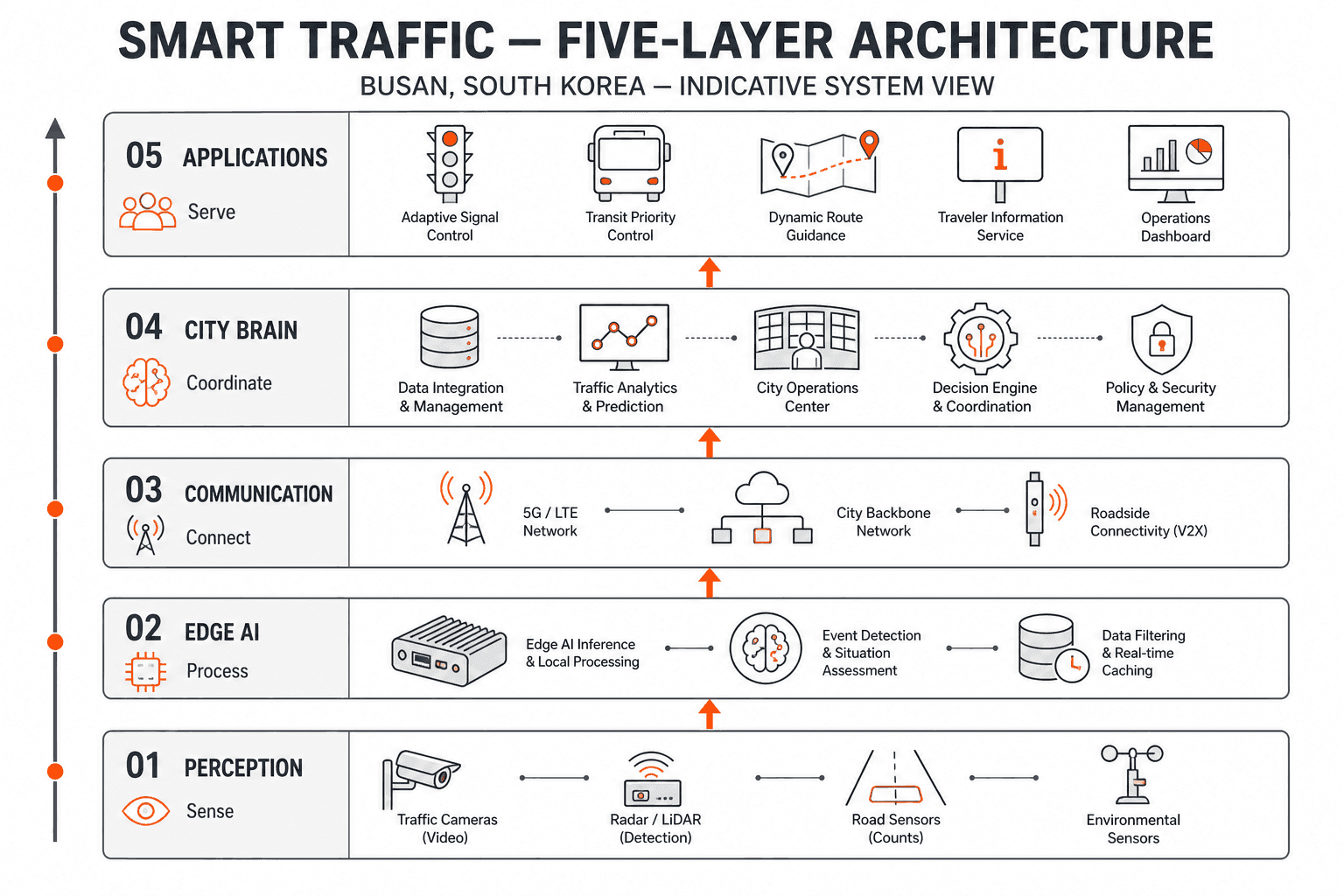
The communications stack should follow five layers: perception, edge AI, communication, city brain, and applications. Fiber should be preferred for permanent signal corridors, while 5G should support resilience, rapid commissioning, and backup routing. TrafficGPT can then support natural-language traffic queries, operations reporting, incident summaries, and corridor-level signal optimization.
Technical Specifications
The technical baseline is a 7-intersection, 8 m smart-pole package with 4K vision, 77 GHz radar, Jetson edge AI, and dual backhaul.
| Layer | Recommended Busan Specification | Why It Matters |
|---|---|---|
| Intersection scope | 7 intersections | Practical corridor-scale phase for municipal review |
| Pole quantity | 28-84 poles | Based on 4-12 poles per intersection |
| Pole type | 8 m L-arm steel pole | Fits signalized urban intersections |
| Surface treatment | Hot-dip galvanized, dark grey finish | Supports coastal corrosion resistance |
| Vision sensor | 4K AI camera, 98% stated recognition accuracy | Plate, lane, pedestrian, and vehicle classification |
| Radar sensor | 77 GHz mmWave radar | Speed and presence continuity in rain or glare |
| Edge compute | NVIDIA Jetson | Local inference before central analytics |
| Response target | Less than 50 ms | Low-latency event handling |
| Backhaul | 5G/fiber dual path | Redundancy and commissioning flexibility |
| Platform | TrafficGPT | City-brain analytics and natural-language operations |
According to IEC (2013), IEC 60529 defines degrees of protection for electrical enclosures using the IP Code and applies to equipment enclosures up to 72.5 kV. That supports specifying weatherproof cabinets, sealed connectors, and roadside electronics protection for Busan’s high-rainfall months.
According to IEEE (2022), IEEE Std 802.3-2022 is the active Ethernet standard family for wired LAN communications. For SOLARTODO, this supports standards-based cabinet networking, fiber termination, PoE planning where appropriate, and maintainable integration with municipal ITS rooms.
According to NREL (2024), 5G features such as edge computing, network traffic prioritization, and private slicing supported distributed controls in resilience testing. For Busan, this reinforces using 5G as a managed resilience layer, not merely a convenience link.
Standards and Procurement Alignment
A Busan procurement package should reference at least 5 standards or authority sources before pricing, shipment, installation, and acceptance testing.
NTCIP should be specified for traffic-signal controller interoperability, especially where actuated signal controllers and central systems exchange structured data. GB 25280-2016 can be referenced for road traffic signal controller requirements where Chinese-standard equipment is acceptable in the buyer’s procurement scope. Local Korean requirements for electrical safety, wind load, grounding, privacy, and ITS data governance should be added by the municipal engineer or local EPC partner.
According to IEA (2023), grid modernization requires upgrades not only to physical infrastructure but also to how networks are planned and managed. That is relevant because smart traffic poles depend on stable power, resilient communications, and operational procedures, not just sensors. According to IRENA (2023), smart electrification planning includes 100 innovation solutions across technology, infrastructure, operations, markets, and business models, supporting a platform-based approach rather than isolated devices.
According to BloombergNEF (2026), global energy storage additions reached 112 GW in 2025, excluding pumped hydro. While Busan’s smart traffic system is not an energy-storage project, this market signal matters for optional UPS, roadside battery backup, and future microgrid-supported traffic corridors. Critical intersections should evaluate backup duration, cabinet thermal limits, and maintenance access before final quotation.
Commercial Model and Deployment Plan
The preferred commercial model is a Joint Venture for 7 intersections because local integration, data governance, and maintenance affect long-term performance.
A Joint Venture model fits Busan better than a pure equipment sale because municipal traffic systems require local permits, civil works, utility coordination, controller access, and maintenance response. SOLARTODO can provide the smart pole package, AI sensing stack, TrafficGPT integration, factory acceptance test, and interface control documentation. A Korean local partner can handle site surveys, traffic-control permits, trenching, installation labor, electrical inspection, and first-line maintenance.
An EPC turnkey model is simpler when a single buyer wants one accountable delivery contract. BOT may reduce upfront public cost, but it needs stronger rules for data ownership, plate-recognition governance, performance KPIs, and long-term revenue assumptions. For this Busan profile, JV is the most balanced model because it combines SOLARTODO technology control with local operating accountability.
A typical deployment timeline is 10-16 weeks after design freeze. Site survey and signal-interface review may take 2-3 weeks, fabrication and logistics 4-6 weeks, civil works and pole erection 2-4 weeks, and calibration plus TrafficGPT acceptance 1-3 weeks. Final schedule depends on road-closure permits, fiber availability, controller access, and weather windows.
FAQ
These 10 FAQs answer price, specifications, logistics, warranty, installation, comparison, ROI, standards, maintenance, and procurement for Busan buyers.
Q1: What is the expected price range for 7 Busan intersections?
A reliable price cannot be issued from intersection count alone. A budgetary quotation should separate 28-84 poles, AI camera-radar packages, LED signal heads, Jetson edge units, cabinets, 5G/fiber backhaul, civil works, commissioning, TrafficGPT licensing, warranty, and O&M. EPC cost changes materially with trenching, controller replacement, lane closures, and Korean inspection requirements.
Q2: What technical specification should be requested first?
Request an 8 m dark-grey hot-dip galvanized L-arm pole with a 4K AI camera, 77 GHz mmWave radar, LED fill light, LED signal head, NVIDIA Jetson edge AI, and dual 5G/fiber communications. The technical brief should also require sub-50 ms local detection response, IP-rated enclosures, grounding, surge protection, and controller-interface documentation.
Q3: How many poles does one intersection need?
A Busan arterial intersection normally needs 4-12 smart poles, depending on the number of approaches, lane width, turning pockets, pedestrian crossings, stop-line visibility, and auxiliary signal heads. A compact four-leg junction may use four to six poles, while a wide port-access or bridge-feeder intersection may require more positions for clean camera and radar coverage.
Q4: How long would installation and commissioning take?
After design freeze, a 7-intersection rollout normally takes 10-16 weeks. Survey and interface review take about 2-3 weeks, fabrication and logistics 4-6 weeks, civil works and erection 2-4 weeks, and final calibration 1-3 weeks. Weather, lane-closure approvals, fiber construction, and controller access can extend the schedule.
Q5: How does SOLARTODO compare with CCTV-only upgrades?
CCTV-only upgrades mainly provide video visibility and retrospective evidence. The SOLARTODO configuration adds 77 GHz radar, edge AI, signal-head integration, and TrafficGPT analytics, enabling speed detection, vehicle presence, queue monitoring, plate recognition, and 45+ AI detection types. Radar also improves continuity during heavy rain, glare, darkness, and partial camera occlusion.
Q6: What warranty should buyers expect?
A typical commercial package should include at least a 1-year equipment warranty, with optional extended coverage for cameras, radar modules, LED signal heads, LED fill lights, Jetson edge units, communication modules, cabinet electronics, and pole coating defects. Buyers should define response time, spare-part availability, firmware support, calibration visits, and exclusions for typhoon, collision, vandalism, or utility faults.
Q7: What logistics information is needed before shipment?
SOLARTODO should receive intersection drawings, lane counts, pole foundation details, existing signal controller models, cabinet space, power availability, preferred fiber or 5G backhaul, road-access limits, port customs requirements, and Korean certification constraints. Shipping plans should separate poles, arms, signal heads, cameras, radar, cabinets, brackets, and commissioning tools for staged delivery.
Q8: What maintenance schedule is recommended?
Use quarterly maintenance for lens cleaning, radar alignment checks, LED signal inspection, firmware review, cabinet temperature checks, and backhaul diagnostics. Annual maintenance should include pole corrosion inspection, grounding resistance tests, surge-protection review, AI model performance validation, spare-part audit, and TrafficGPT data-quality review. Busan’s summer rainfall makes waterproofing checks especially important before July.
Q9: What ROI metrics should Busan planners measure?
ROI should be calculated from measured local data, not generic claims. Track average delay, queue length, travel-time reliability, incident detection time, violation events, manual enforcement workload, maintenance visits, backhaul cost, and signal timing improvement. Busan’s 2026 AI signal reporting cited a 2.25 km/h travel-speed increase and more than 10% delay reduction in pilot operation.
Q10: Which cooperation model is best: JV, EPC, or BOT?
For Busan, Joint Venture is preferred because local operations, permits, controller access, and data governance are critical. EPC is cleaner for one-owner procurement with fixed scope and fixed acceptance tests. BOT can reduce upfront public spending, but it requires careful rules for revenue, privacy, plate data, uptime KPIs, and long-term system ownership.
References
This Busan recommendation uses 12 authority sources, including municipal data, standards bodies, connectivity statistics, and energy-resilience references.
- Busan Metropolitan City (2026), AI-Based Smart Traffic System press release
- Busan Metropolitan City (2026), Population Policy Briefing
- World Meteorological Organization and Korea Meteorological Administration (1991-2020), Busan climate normals
- OECD (2025), Fibre and 5G continue to expand their footprint
- OECD (2024), Digital Economy Outlook: Trends in access and connectivity
- IEC (2013), IEC 60529 IP Code
- IEEE (2022), IEEE Std 802.3-2022 Ethernet standard record
- NREL (2024), 5G and microgrids resilience research
- IEA (2023), Electricity Grids and Secure Energy Transitions
- IRENA (2023), Innovation Landscape for Smart Electrification
- BloombergNEF (2026), Energy Storage Enters the 100-Gigawatt Era
- SOLARTODO Smart Traffic System and contact us
Equipment Deployed
- 7 intersections × 8m L-arm hot-dip galvanized steel poles, dark grey finish
- 4-in-1 smart traffic pole with 4K AI camera, 77GHz mmWave radar, LED fill light, and LED signal head
- 4K AI camera with 98% accuracy, less than 50ms response, and 45+ detection types
- NVIDIA Jetson edge AI module for local perception and inference
- Vehicle counting, speed detection, and plate recognition feature set
- 5G/fiber backhaul to TrafficGPT central platform with natural language query support
- Standards alignment: NTCIP and GB 25280
- Recommended cooperation model: Joint Venture