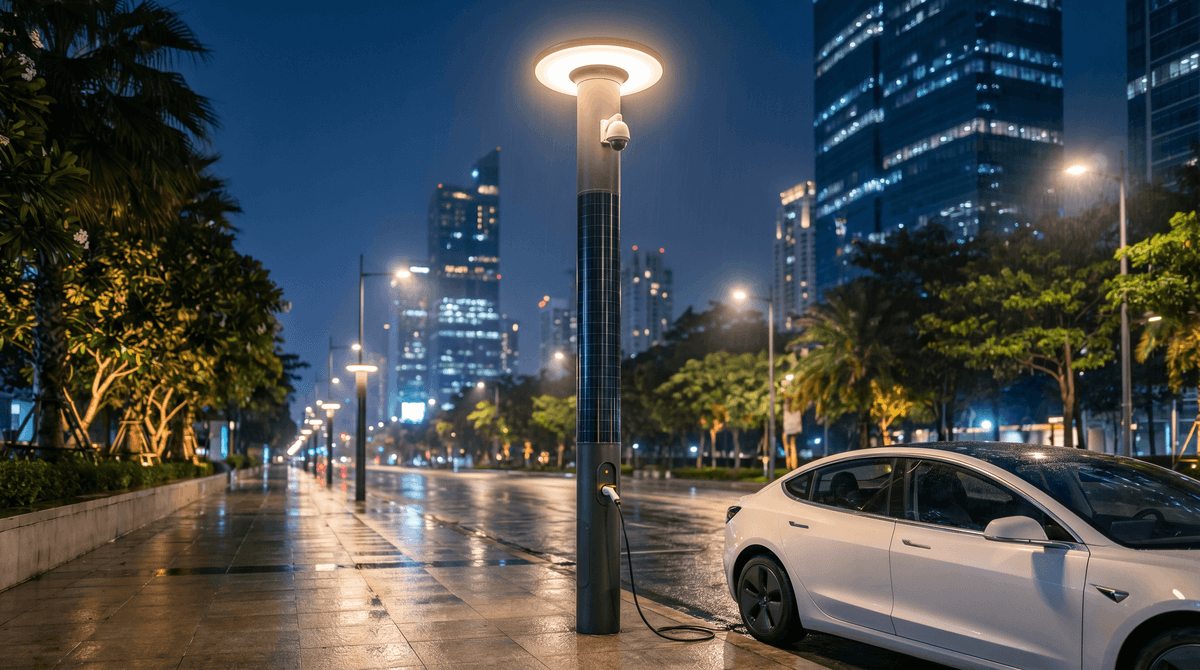
235-Unit Smart Streetlight Deployment in Bangkok, Thailand Featuring 12m Seamless Round Poles and 4G-Connected Urban Sensing
Summary
This Bangkok deployment installed 235 SOLAR TODO Smart Streetlight units on 12m seamless steel poles at 25m spacing, combining 100W/15,000lm ring lighting, 4MP cameras, and 12-parameter sensing with standalone 4G gateways for connected public-space management.
Key Takeaways
- SOLAR TODO deployed 235 Smart Streetlight units across a Bangkok coastal urban corridor using 12m Φ273mm round tubular steel poles with 6mm wall thickness.
- Each pole used an integrated 100W LED ring light delivering 15,000 lumens at 4000K with 150 lm/W efficacy for road and landscape illumination.
- The lighting layout was engineered at 25m spacing, supporting uniform coverage while keeping the streetscape visually clean with no large protrusions.
- Every unit included a 4MP bullet camera on a 0.3m short arm bracket, with IR night vision to 50m for fixed-direction corridor monitoring.
- Environmental monitoring used a 12-parameter sensor suite measuring temp, humidity, wind, pressure, noise, PM2.5, PM10, CO, NO2, O3, rain, and illuminance.
- Public connectivity was provided through WiFi 6 (802.11ax) access points supporting up to 256 devices per pole, plus dual USB 5V/2.4A charging ports.
- Communications relied on a standalone 4G gateway with RS485 + 4G uplink, simplifying integration of lighting, sensing, audio, and field-device telemetry.
- The pole structure used hot-dip galvanized steel with anthracite RAL 7024 finish, designed to comply with IEC 60598, GB/T 37024, and CJJ 45-2015.
Project Background
Bangkok’s coastal urban environment at approximately 13.76, 100.5 requires street infrastructure that can handle humidity, dense traffic, visual clutter constraints, and growing expectations for public safety and digital services. In many districts, municipal planners need one pole to do multiple jobs: lighting, surveillance, environmental monitoring, emergency communication, and wireless access. That requirement is especially relevant in waterfront and sea-adjacent corridors where corrosion resistance and minimal maintenance access are important.
According to the World Bank (2023), cities that invest in integrated urban infrastructure improve service coordination by reducing fragmented asset ownership and maintenance workflows. According to the IEA (2022), LED streetlighting remains one of the fastest municipal efficiency upgrades because it cuts energy demand while improving controllability and service life. In Bangkok, that policy logic extends beyond energy: the city also needs better incident visibility, public communication points, and localized environmental data.
According to the ITU (2023), smart sustainable cities depend on interoperable digital infrastructure that can collect, transmit, and act on urban data across multiple services. The Bangkok project was structured around that principle. Rather than deploying separate poles for lighting, cameras, WiFi, and environmental sensing, SOLAR TODO delivered a unified Smart Streetlight platform with a seamless cylindrical profile suitable for premium public-space applications.
The project brief emphasized product integration over visual complexity. Bangkok authorities wanted a clean streetscape with no large cantilever arms, no oversized boxes, and no bulky add-ons that would disrupt pedestrian areas or premium urban frontage. SOLAR TODO therefore configured a round-pole Smart Streetlight system with flush-mounted or minimally bracketed devices and an integrated ring light at the top section of the pole body.
Solution Overview
SOLAR TODO delivered 235 Smart Streetlight units in Bangkok using a standardized 12m seamless cylindrical pole platform that combined lighting, surveillance, sensing, communications, and emergency assistance in one urban asset. The deployment focused on technical integration, corrosion-resistant construction, and low-visual-clutter design suitable for a dense coastal city corridor.
Each installed unit used a Φ273mm round tubular steel pole with 6mm wall thickness, hot-dip galvanizing, and an anthracite RAL 7024 finish. The pole body was specified as a seamless cylindrical profile to align with the city’s architectural requirements. The light source was integrated directly into the pole body, with no arm bracket, using a 360° LED ring light band embedded in the top 0.5m section.
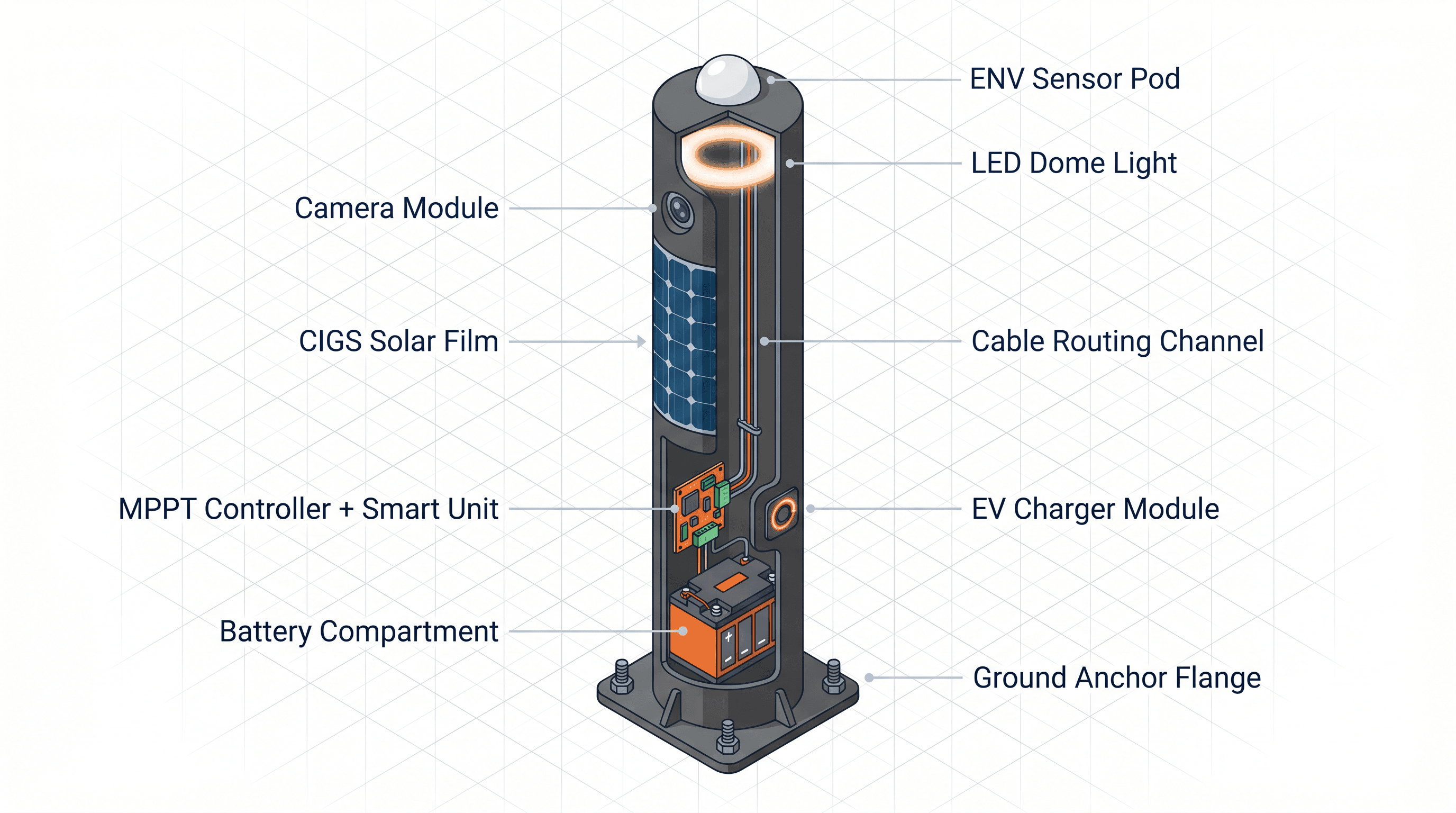
The deployed lighting module provided 100W output and 15,000 lumens at 4000K, serving both urban landscape and road illumination functions. Each Smart Streetlight also included a 4MP fixed-direction bullet camera, a 12-parameter environmental sensor, an IP audio column with one-button SOS intercom, WiFi 6 access, dual USB charging ports, and a standalone 4G gateway for data backhaul and device communication.
According to NREL (2022), networked outdoor lighting platforms create operational value when they consolidate multiple city functions into a single managed endpoint. That was the operating model in Bangkok. SOLAR TODO used the Smart Streetlight as a multifunction field node rather than a single-purpose luminaire, enabling the city to manage lighting, alerts, environmental inputs, and public communications through one coordinated deployment. For product details, see the Smart Streetlight product page or contact us for project engineering support.
Technical Specifications
This Bangkok Smart Streetlight deployment used 235 units with 12m poles, 100W/15,000lm integrated ring lighting, 4MP cameras, and 12-parameter sensing, built for coastal urban operation and standards-based municipal deployment.
- Deployment quantity: 235 units
- Project location: Bangkok, Thailand
- Coordinates: 13.76, 100.5
- Pole height: 12m
- Pole type: Round tubular steel pole
- Pole diameter: Φ273mm
- Wall thickness: 6mm
- Pole profile: Seamless cylindrical profile
- Surface treatment: Hot-dip galvanized + anthracite RAL 7024 finish
- Lighting design: Integrated with pole body, no arm bracket
- Light source type: LED ring light band with 360° glow
- Light position: Embedded in top 0.5m section of pole
- Lighting application: Urban landscape + road illumination
- LED power: 100W
- Luminous flux: 15,000 lm
- Color temperature: 4000K
- Luminous efficacy: 150 lm/W
- Power source: Monocrystalline side-mount panel 100W on short tilted bracket at pole top
- Battery type: LFP battery inside pole base
- Battery capacity: 3000Wh
- Charge control: MPPT controller
- Camera type: 4MP bullet camera
- Camera mounting: 0.3m short arm bracket, clamp-mounted
- Camera direction: Fixed direction
- IR distance: 50m
- Environmental sensor: 12-parameter top-mounted module
- Measured parameters: Temperature, humidity, wind, pressure, noise, PM2.5, PM10, CO, NO2, O3, rain, illuminance
- Audio system: IP audio column + one-button SOS emergency intercom
- Emergency function: Dual-way audio + visual indicator
- Wireless access: WiFi 6 AP, 802.11ax
- WiFi capacity: Up to 256 devices
- Charging interface: USB phone charging port 5V/2.4A × 2
- Gateway: Standalone 4G gateway
- Gateway interfaces: RS485 + 4G uplink
- Pole spacing: 25m
- Design language: Clean seamless cylinder, flush-mounted or minimal clamp brackets, no large protrusions
- Applicable standards: IEC 60598, GB/T 37024, CJJ 45-2015
Deployment Process
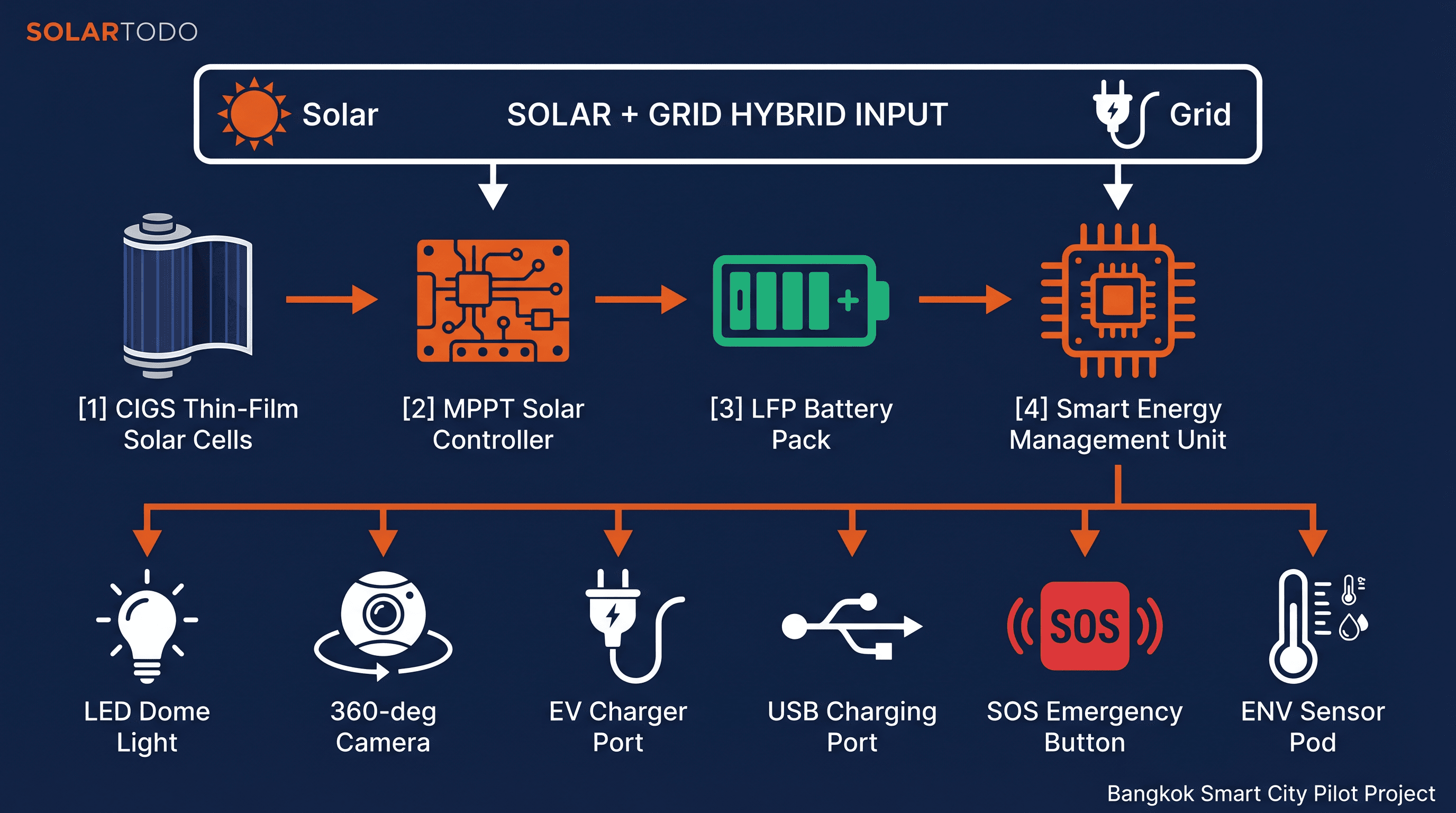
The Bangkok project was executed as a phased 235-unit Smart Streetlight rollout with 25m spacing, standardized pole foundations, and pre-integrated field devices to reduce installation complexity in active urban corridors.
The first phase focused on corridor survey, pole positioning, and utility coordination. Bangkok’s dense roadside conditions required careful placement to avoid conflicts with drainage lines, pedestrian movement, and existing street furniture. Because the poles used a clean cylindrical design with the light integrated into the top section, the city could maintain a more consistent visual line than with conventional bracketed fixtures.
The second phase covered factory integration and pre-delivery testing. SOLAR TODO assembled the ring light, camera, environmental sensor, IP audio column, SOS intercom, WiFi 6 access point, USB charging ports, and 4G gateway into a repeatable configuration. According to IEC (2020), compliance-oriented outdoor lighting projects benefit from standardized component integration and verification before field energization, particularly where multiple subsystems share one support structure.
The third phase involved civil works and pole erection. Each 12m Φ273mm pole was installed with attention to corrosion protection and cable routing discipline suitable for Bangkok’s humid, sea-adjacent environment. The hot-dip galvanized steel substrate and RAL 7024 anthracite finish were selected not for decoration alone, but to support long-term outdoor durability while matching urban design requirements.
The fourth phase covered communications and subsystem commissioning. The standalone 4G gateway with RS485 + 4G uplink was configured to aggregate local device data and transmit operational status upstream. WiFi 6 access points were tested for session handling, cameras were aligned for fixed-direction coverage, and SOS intercoms were checked for dual-way audio and visual response confirmation.
The final phase focused on acceptance testing and municipal handover. Lighting output, charging performance, camera visibility, environmental sensor reporting, and emergency call response were verified unit by unit. SOLAR TODO also documented maintenance access procedures, replacement logic for field modules, and inspection routines for the integrated Smart Streetlight platform. Organizations planning similar rollouts can contact us for deployment planning and technical review.
Performance & Results
This 235-unit Bangkok Smart Streetlight project delivered measurable value through 15,000-lumen lighting, 50m IR surveillance, 12-parameter sensing, and 256-device WiFi 6 access, while preserving a low-clutter streetscape profile.
According to the IEA (2022), LED-based public lighting upgrades can materially reduce municipal electricity demand compared with legacy technologies while improving controllability and service quality. In the Bangkok case, the 100W LED ring light at 150 lm/W provided high-efficacy illumination with a form factor better suited to premium public-space design than conventional arm-mounted luminaires. The integrated top-section light band also reduced visible hardware complexity across the corridor.
According to ITU (2023), urban digital infrastructure becomes more valuable when one edge asset supports multiple services including connectivity, safety, and environmental intelligence. That pattern was evident here. Each SOLAR TODO Smart Streetlight functioned as a combined lighting point, camera node, environmental station, public help point, and WiFi endpoint, reducing the need for separate roadside structures.
The environmental monitoring layer was especially relevant for Bangkok. According to the World Health Organization (2022), urban air-quality exposure remains a major public-health issue, and localized monitoring improves visibility into pollutant patterns. By measuring PM2.5, PM10, CO, NO2, and O3 alongside weather and illuminance data, the deployment gave city operators a distributed street-level sensing network rather than isolated fixed stations.
The public-safety stack also improved operational readiness. The 4MP bullet camera with 50m IR supported fixed-direction observation in key segments, while the IP audio column + one-button SOS intercom created a direct assistance channel for pedestrians. As the World Bank states, "Digital infrastructure is increasingly a foundational layer for better urban service delivery", and this project translated that principle into a physically compact roadside asset.
From a maintenance perspective, the project benefited from standardization. Repeating one pole geometry, one lighting format, one gateway architecture, and one device arrangement across 235 units simplified inspection routines and spare-parts planning. The IEEE states, "Interoperability and standardization are essential to scalable smart city systems," and the Bangkok deployment followed that logic through RS485-based field integration and standards-referenced outdoor equipment selection.
Comparison Table
This comparison shows how the deployed Bangkok Smart Streetlight configuration differs from conventional single-function street poles by combining 235 units of lighting, sensing, safety, and connectivity into one standardized platform.
| Metric | Bangkok SOLAR TODO Smart Streetlight | Conventional Streetlight Pole |
|---|---|---|
| Deployment quantity | 235 units | Typically separate assets by function |
| Pole structure | 12m seamless round tubular steel, Φ273mm, 6mm wall | Often standard lighting pole only |
| Lighting form | Integrated ring light in top 0.5m, no arm bracket | Arm-mounted luminaire |
| Lighting output | 100W, 15,000 lm, 4000K, 150 lm/W | Varies; often single lighting function only |
| Surveillance | 4MP bullet camera, IR 50m | Usually separate CCTV pole or building mount |
| Environmental sensing | 12 parameters | Usually not included |
| Emergency communication | IP audio column + one-button SOS | Usually not included |
| Public connectivity | WiFi 6, 256 devices | Usually not included |
| Charging | USB 5V/2.4A × 2 | Usually not included |
| Communications | Standalone 4G gateway, RS485 + 4G uplink | Often no integrated communications |
| Visual profile | Flush-mounted/minimal brackets, no large protrusions | Multiple add-on boxes and arms may be required |
| Standards basis | IEC 60598, GB/T 37024, CJJ 45-2015 | Depends on project scope |
Pricing & Quotation
SOLAR TODO offers three pricing tiers for this product line: FOB Supply (equipment ex-works China), CIF Delivered (including ocean freight and insurance), and EPC Turnkey (fully installed, commissioned, with 1-year warranty). Volume discounts are available for large-scale deployments. Configure your system online for an instant estimate, or request a custom quotation from our engineering team at cinn@solartodo.com.
Frequently Asked Questions
This FAQ answers the most common buyer questions about the 235-unit Bangkok Smart Streetlight project, including specifications, installation, maintenance, warranty, EPC scope, and expected operational returns.
Q1: What exactly was deployed in Bangkok?
SOLAR TODO deployed 235 Smart Streetlight units in Bangkok using 12m round tubular steel poles with Φ273mm diameter and 6mm wall thickness. Each unit combined a 100W integrated LED ring light, 4MP bullet camera, 12-parameter environmental sensor, IP audio column with SOS intercom, WiFi 6 AP, USB charging, and a standalone 4G gateway.
Q2: What lighting specification was used in this project?
The deployed light was an integrated ring light band embedded in the top 0.5m of the pole body, with no arm bracket. Each unit delivered 100W, 15,000 lumens, 4000K color temperature, and 150 lm/W efficacy. This design supported both urban landscape lighting and road illumination while preserving a clean cylindrical pole profile.
Q3: How were the poles configured structurally?
The project used 12m seamless cylindrical poles made from round tubular steel, sized at Φ273mm with 6mm wall thickness. The poles were hot-dip galvanized and finished in anthracite RAL 7024. This construction was selected for durability, corrosion resistance, and a premium appearance suitable for Bangkok’s dense, humid, sea-adjacent urban environment.
Q4: What communications architecture was used?
Each Smart Streetlight used a standalone 4G gateway with RS485 plus 4G uplink. That architecture allowed field devices such as sensors, audio systems, and other pole-mounted modules to communicate through a standardized local interface while sending operational data upstream over 4G. It simplified deployment where fixed communications infrastructure was limited or segmented.
Q5: How long does installation typically take for a project of this size?
The exact timeline depends on civil readiness, permit coordination, and logistics, but projects of this scale are normally executed in phases: survey and design, foundation and utility preparation, pole erection, and subsystem commissioning. Pre-integrated assemblies reduce field work. For 235 units, municipalities usually plan staged rollout rather than one-time corridor closure.
Q6: What maintenance is required after commissioning?
Routine maintenance typically includes cleaning camera lenses and sensor inlets, checking the ring light output, verifying SOS intercom audio, inspecting the 4G gateway connection, and reviewing the pole finish for damage. Because the Bangkok project standardized all 235 units, spare parts, inspection checklists, and technician training can be managed more efficiently than mixed-asset streetscapes.
Q7: How does this compare with conventional streetlights?
A conventional streetlight usually provides illumination only, while this Smart Streetlight integrates lighting, surveillance, environmental monitoring, emergency communication, WiFi 6 access, and USB charging in one pole. That reduces the need for separate roadside structures. It also improves visual consistency because the Bangkok design used flush-mounted devices and minimal clamp brackets.
Q8: What is the expected ROI or payback logic for a city project like this?
Municipal ROI is usually evaluated through combined operational benefits rather than a single revenue line. The value comes from replacing multiple standalone assets, reducing installation duplication, improving incident response, expanding environmental data coverage, and simplifying maintenance. Payback depends on local labor, utility, communications, and civil costs, so SOLAR TODO typically models this during quotation.
Q9: Do you provide EPC pricing and custom quotations?
Yes. SOLAR TODO supports FOB Supply, CIF Delivered, and EPC Turnkey quotation models for Smart Streetlight projects. The best option depends on whether the customer has local civil contractors, electrical teams, and commissioning capability. For Bangkok-style deployments, we recommend a project-specific bill of materials and installation scope review before final commercial submission.
Q10: What warranty is available?
Warranty terms depend on the final commercial scope and supply model, but the EPC Turnkey offer includes a 1-year warranty as stated in the quotation section. For supply-only projects, warranty coverage is typically defined by subsystem and contract terms. SOLAR TODO recommends aligning warranty structure with spare-parts planning and local O&M responsibilities.
Q11: Is installation difficult with so many modules on one pole?
Installation is more manageable when the system is engineered as one platform from the start. In this project, the integrated light design, minimal bracket count, standardized pole geometry, and standalone 4G gateway reduced field complexity. The main requirements are proper foundation work, disciplined cable routing, correct device orientation, and structured commissioning of each subsystem.
Q12: Which standards does this Smart Streetlight project follow?
The Bangkok deployment references IEC 60598, GB/T 37024, and CJJ 45-2015. These standards support the project’s outdoor lighting compliance framework, smart city pole reference basis, and urban road lighting engineering requirements. For public projects, SOLAR TODO also aligns documentation and testing records with local authority review and acceptance procedures.
References
This case study references 7 authoritative sources including IEC, IEA, ITU, IEEE, NREL, the World Bank, and WHO to support the technical and urban-infrastructure context for Bangkok Smart Streetlight deployment.
- NREL (2022): Guidance on connected and networked outdoor lighting systems as platforms for broader municipal energy and asset management.
- IEC (2020): IEC 60598 luminaire safety and performance framework relevant to outdoor lighting equipment.
- IEA (2022): Analysis showing LED lighting as a major efficiency pathway for public lighting modernization.
- ITU (2023): Smart sustainable city guidance emphasizing interoperable digital infrastructure and urban data systems.
- IEEE (2021): Smart city systems literature emphasizing interoperability, communications architecture, and scalable device integration.
- World Bank (2023): Urban digital infrastructure and service-delivery guidance for integrated city systems.
- World Health Organization (2022): Air-quality and urban exposure guidance supporting the value of distributed pollutant monitoring including PM2.5 and PM10.
Equipment Deployed
- 235 × 12m round tubular steel poles, Φ273mm, 6mm wall thickness, seamless cylindrical profile
- Hot-dip galvanized steel structure with anthracite RAL 7024 finish
- Integrated LED ring light band, embedded in top 0.5m of pole, no arm bracket
- 100W LED lighting module, 15,000 lm, 4000K, 150 lm/W
- 100W monocrystalline side-mount panel on short tilted top bracket
- 3000Wh LFP battery installed inside pole base
- MPPT controller
- 4MP bullet camera on 0.3m short arm bracket, fixed direction, IR 50m, clamp-mounted
- 12-parameter environmental sensor: temp, humidity, wind, pressure, noise, PM2.5, PM10, CO, NO2, O3, rain, illuminance
- IP audio column with one-button SOS emergency intercom, dual-way audio and visual indicator
- WiFi 6 AP, 802.11ax, supports 256 devices
- USB phone charging port, 5V/2.4A × 2
- Standalone 4G gateway with RS485 + 4G uplink
- Deployment spacing: 25m
- Compliance basis: IEC 60598, GB/T 37024, CJJ 45-2015