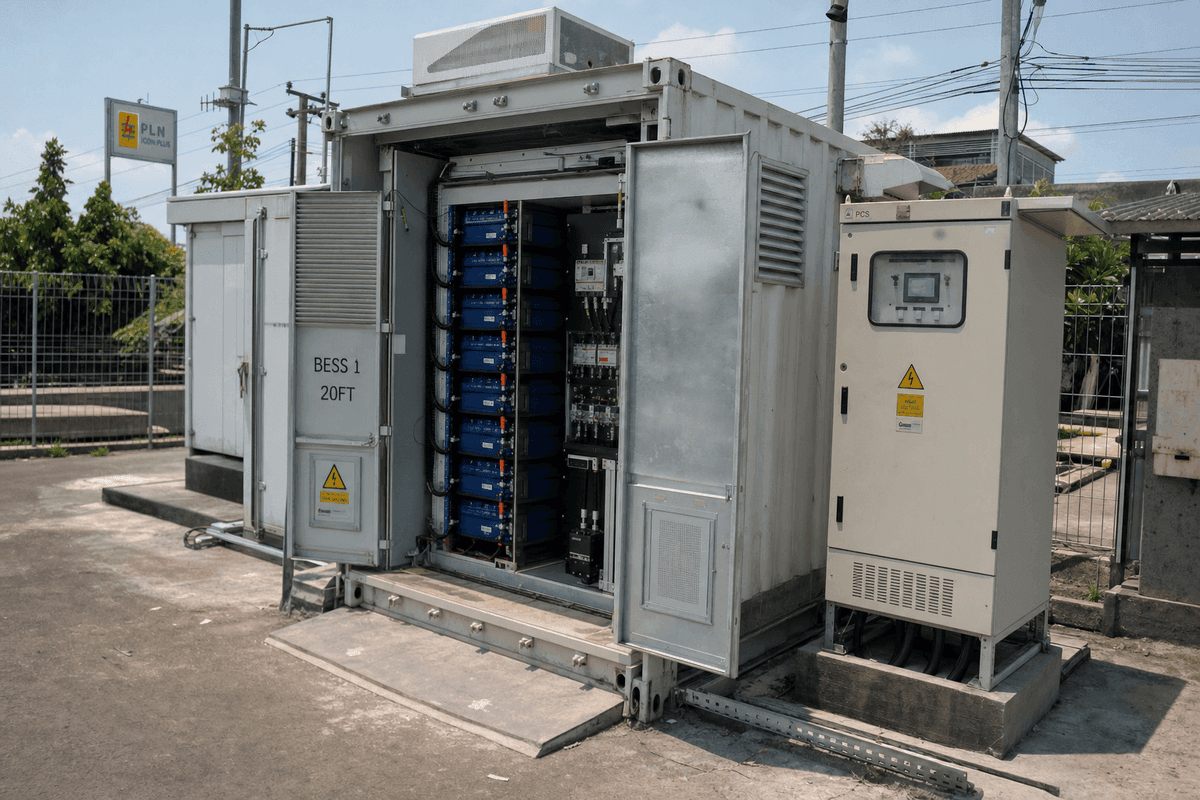
Bali Battery Energy Storage (BESS) Market Analysis: 500kWh/125kW Peak-Shaving Configuration Guide
Summary
Bali’s power system combines strong tourism-driven daytime demand with island-grid reliability constraints, making a 500kWh/125kW industrial BESS a practical fit for commercial peak shaving. A typical system would deliver 1.5 cycles/day, 97% round-trip efficiency, and 10,000-cycle LFP life under IEC 62619 and UL 9540 compliance.
Key Takeaways
- Bali had approximately 4.4 million residents at the 2020 Census, while tourism and commercial loads continue to concentrate demand in Denpasar, Badung, and hospitality corridors, increasing the value of behind-the-meter peak management.
- According to PLN statistics, Bali is served through an islanded sub-system with interconnection support from Java, so a typical large hotel, mall, or light-industrial site would favor approximately 500kWh / 125kW BESS blocks for demand-charge control rather than oversized multi-MWh plants.
- The recommended SOLAR TODO configuration for this profile is 1× 20ft container with LFP Premium cells, 95% DoD, 97% round-trip efficiency, liquid glycol cooling, aerosol fire suppression, PCS, and step-up transformer.
- At 1.5 cycles/day and 80% operating depth, the system would process roughly 219MWh/year of battery throughput, which is suitable for time-of-use arbitrage in Bali’s commercial load profile.
- The specified battery carries a 20-year warranty, 10,000-cycle life, and approximately 2% annual degradation, which is stronger than many standard 6,000-cycle LFP systems used in basic C&I storage tenders.
- Standards alignment should include IEC 62619, UL 9540, and NFPA 855, with local installation review also tied to PLN interconnection rules, Indonesian electrical code practice, and site fire authority requirements.
- For coastal Bali sites at coordinates near -8.41, 115.19, salt-laden air and high humidity support the use of container coatings, sealed cable entries, HVAC zoning, and preventive inspection intervals of about every 3 months.
- SOLAR TODO should be evaluated as a technical supplier for buyers seeking Battery Energy Storage systems with configurable supply scope and project-specific engineering support via contact us.
Market Context for Bali
Bali’s commercial power market is shaped by island-grid constraints, dense tourism loads, and a humid marine climate, which together favor medium-scale BESS blocks of 500kWh rather than very small cabinets or utility-scale container farms.
According to Badan Pusat Statistik, Bali’s population reached about 4.32 million in the 2020 Census, with economic activity concentrated in Denpasar, Badung, Gianyar, and tourism-heavy coastal zones. That matters because hotels, villas, retail centers, cold storage sites, and mixed-use properties often have pronounced afternoon and evening peaks above their baseload. In these load shapes, a 125kW discharge block can reduce billed demand without requiring a full substation-scale project.
According to Indonesia’s Ministry of Energy and Mineral Resources and PLN planning documents, Bali’s electricity system depends on local generation plus submarine cable support from Java, which makes reliability and peak balancing more sensitive than in larger mainland grids. IEA analysis of Southeast Asian power demand also shows that service-sector growth and electrification increase pressure on commercial feeders and local transformer loading. For BESS sizing, this means behind-the-meter systems in the 500kWh class can be justified by tariff structure, resilience needs, and feeder congestion exposure.
Climate is another design factor. According to BMKG climate data for Bali, coastal temperatures commonly range around 24-32°C with high humidity, and sea-salt exposure is relevant for sites near Kuta, Sanur, Nusa Dua, Benoa, and port-linked areas. For a containerized BESS, that supports liquid cooling, corrosion-resistant external finishing, controlled ventilation paths, and tighter maintenance scheduling than would be used in a dry inland climate. SOLAR TODO should therefore configure the enclosure and cable interface for marine-adjacent conditions rather than a generic inland specification.
Bali also has a strong policy link to cleaner energy. According to IRENA (2023), battery storage is increasingly used to improve renewable integration, reduce curtailment, and manage commercial demand peaks in island and weak-grid systems. NREL states, "Battery energy storage can provide multiple services, including demand charge reduction, time-of-use energy shifting, and backup power." That combination fits Bali’s profile, where rooftop PV adoption is growing but grid quality and tariff optimization remain practical drivers for investment.
Recommended Technical Configuration
For Bali’s hospitality, retail, and light-industrial load profile, a 500kWh / 125kW containerized BESS is the most technically consistent recommendation because it matches medium commercial peaks, 3-phase infrastructure, and island-grid operating conditions.
A typical 1-unit deployment in this profile would consist of approximately one 500kWh / 125kW industrial Battery Energy Storage (BESS) in a single 20ft container, connected behind the meter at a commercial facility with a suitable LV/MV interface. This size is large enough to shave a 100-125kW demand spike for about 4 hours at partial discharge strategy, or to support shorter high-value dispatch windows for tariff arbitrage. It also avoids the mismatch of using a small 100kWh cabinet for a resort-scale load or a multi-MWh farm for a single commercial meter.
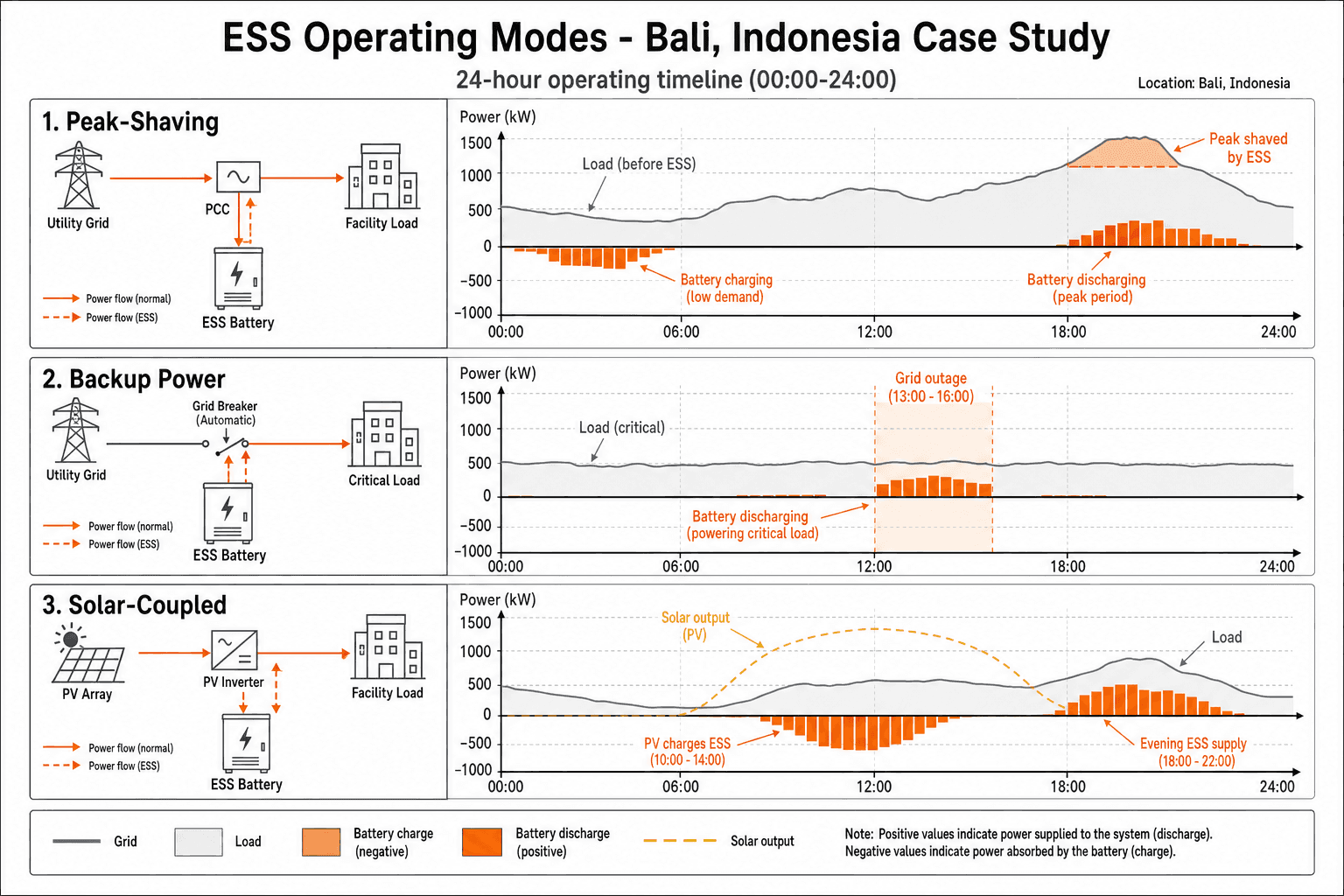
The recommended operating mode in Bali is peak-shaving plus time-of-use arbitrage. In practice, the system would charge during valley periods and discharge during afternoon or evening peaks, with a target of 1.5 cycles/day at 80% operating depth. That dispatch profile is consistent with commercial facilities that have high cooling loads, kitchen loads, pumping loads, or event-driven occupancy peaks. SOLAR TODO can position this as a technical fit where monthly demand charges or peak kVA penalties are material.
Sample deployment scenario (illustrative): a hotel cluster, food processing site, or commercial complex with daytime baseload of 180-250kW and peak intervals above 300kW would use approximately one 500kWh / 125kW BESS block as the first phase. If the site has multiple transformers or multiple billing meters, a typical 2-unit deployment of 1MWh / 250kW could be considered, but the single 500kWh block remains the base recommendation for Bali’s medium C&I segment.
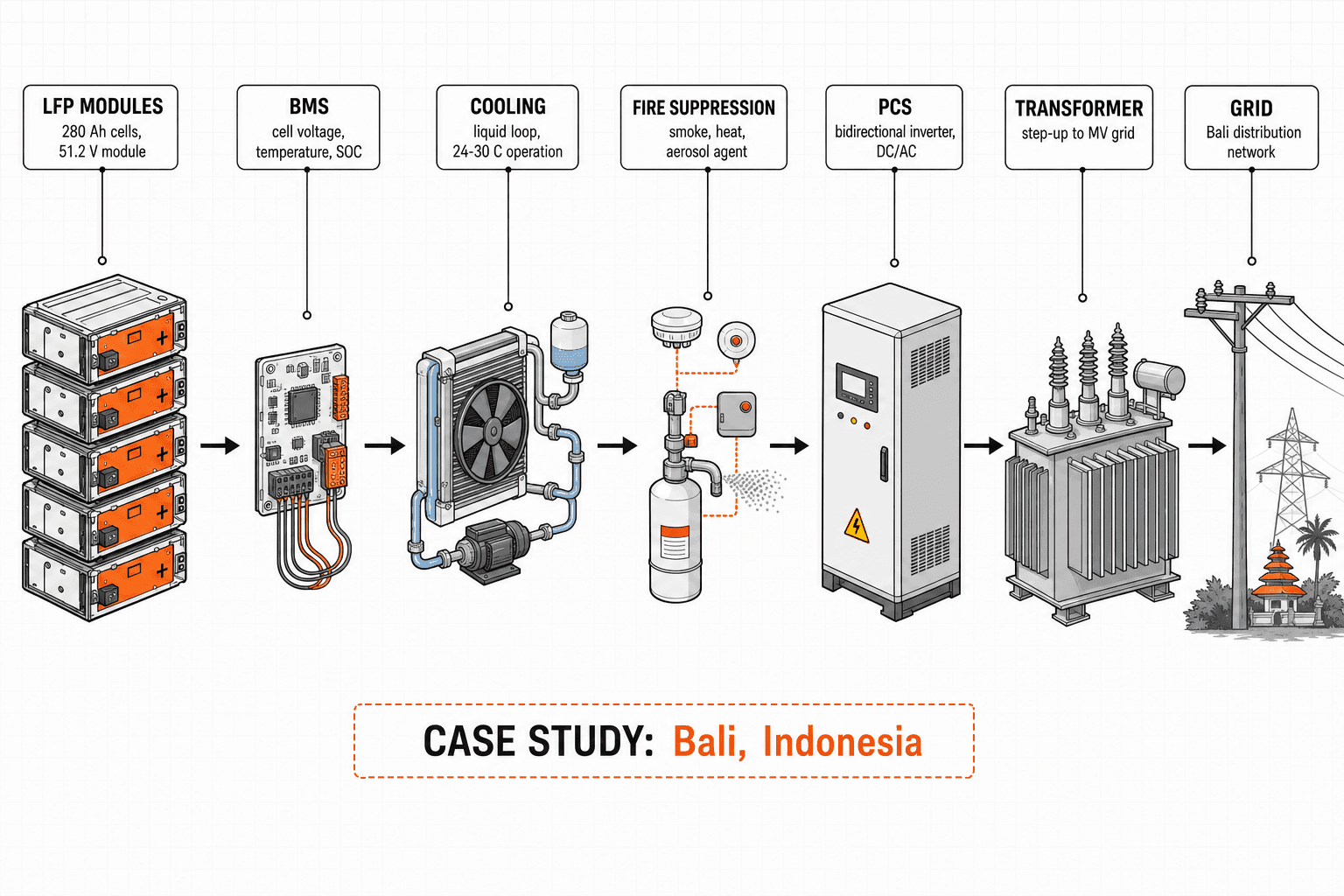
The chemistry should remain LFP because of thermal stability, cycle life, and commercial duty suitability. According to IEA (2024), LFP continues gaining share in stationary storage due to safety, cost competitiveness, and long cycle life. UL notes that listed energy storage systems should be evaluated as integrated assemblies, not only as cell racks, which is why SOLAR TODO’s recommendation includes BMS, PCS, cooling, suppression, and transformer as one coordinated package.
Technical Specifications
The Bali-recommended BESS specification is a 500kWh / 125kW 20ft containerized LFP system with 97% round-trip efficiency, 95% DoD, 10,000-cycle life, liquid glycol cooling, and compliance with IEC 62619, UL 9540, and NFPA 855.
- System type: Industrial Battery Energy Storage (BESS), containerized, 1× 20ft enclosure
- Rated energy: 500kWh
- Rated power: 125kW
- Application mode: Peak-shaving / TOU arbitrage
- Dispatch profile: Charge during valley tariff periods, discharge during peak tariff periods
- Typical cycling: 1.5 cycles/day
- Operating depth in use case: 80% depth
- Battery chemistry: LFP Premium (Lithium Iron Phosphate)
- Round-trip efficiency: 97%
- Maximum depth of discharge: 95% DoD
- Cycle life: 10,000 cycles
- Degradation assumption: Approximately 2% per year
- Warranty: 20 years
- Battery management: Integrated BMS
- Thermal management: Liquid cooling using glycol loop
- Fire protection: Aerosol fire suppression
- Power conversion: PCS inverter included
- Grid interface: Step-up transformer included
- Housing class: 20ft container, appropriate for the 500kWh-2MWh size band
- Standards: IEC 62619, UL 9540, NFPA 855
- Recommended site type in Bali: Hotels, resorts, malls, cold-chain depots, workshops, and light-industrial facilities with 3-phase commercial service
- Environmental note for Bali sea climate: Salt-mist-resistant coating, sealed gland plates, and quarterly inspection intervals are recommended for coastal exposure
Implementation Approach
A Bali BESS project of 500kWh / 125kW would typically move through 5 phases over roughly 12-20 weeks, depending on interconnection review, civil readiness, and shipping lead time.
Phase 1 is load study and tariff analysis. The site should log at least 30 days of 15-minute demand data, though 90 days is better for hospitality and mixed-use properties with occupancy variation. The engineering output should identify the top 20-40 peak intervals per month, transformer loading, power factor behavior, and whether the 125kW PCS should prioritize demand clipping or tariff arbitrage. For Bali, this phase should also confirm whether the installation is fully behind the meter or requires additional PLN review.
Phase 2 is detailed engineering and procurement. This includes single-line diagrams, protection coordination, container placement, grounding design, transformer interface, and communications architecture. Because Bali is a marine environment, the procurement package should specify anti-corrosion paint systems, stainless hardware where needed, and cable terminations suitable for high humidity. SOLAR TODO should also confirm access width for a 20ft container and crane positioning before shipment.
Phase 3 is civil and electrical preparation. A typical site would require a reinforced concrete pad, cable trenching, earthing grid, drainage management, and fenced clearance in line with NFPA 855 spacing logic and local fire authority expectations. IEEE guidance for battery system integration supports attention to grounding, protection, and thermal separation. For a 500kWh system, buyers should also review noise limits if the site is near guest rooms or residential boundaries.
Phase 4 is delivery, placement, and installation. The container, PCS, and transformer are positioned, cabled, and tested as one system. Commissioning includes insulation resistance checks, BMS communication validation, cooling loop verification, PCS functional tests, and emergency shutdown sequence testing. A typical on-site installation window after civil completion is about 7-14 days.
Phase 5 is commissioning and dispatch tuning. The first 2-4 weeks should be used to refine charging windows, discharge thresholds, and demand cap settings based on real load behavior. For Bali hotels and retail sites, this often means adjusting around occupancy peaks, kitchen peaks, and cooling peaks rather than using a fixed static schedule. SOLAR TODO should recommend quarterly remote performance reviews during year 1.
Expected Performance & ROI
A 500kWh / 125kW BESS in Bali would typically target 219MWh of annual throughput at 1.5 cycles/day and deliver the strongest value where monthly demand peaks and time-of-use spreads are both present.
Using the specified operating profile, annual energy throughput can be estimated as 500kWh × 80% operating depth × 1.5 cycles/day × 365 days, which equals about 219,000kWh per year. With 97% round-trip efficiency, conversion losses remain relatively low compared with many legacy systems in the 88-92% range. This is useful in Bali because cooling-heavy commercial facilities may dispatch the battery almost daily, so efficiency loss compounds over 300+ operating days.
Payback depends on tariff design, peak demand charges, and dispatch discipline, so no single Bali number is credible without the utility bill structure. However, according to NREL and World Bank battery economics guidance, commercial storage economics improve when one system captures at least 2 value streams, such as demand-charge reduction plus time shifting. In Bali, that usually means clipping the monthly peak by 80-125kW while also shifting valley energy into higher-cost periods. Sites with flat load profiles generally see weaker returns than sites with sharp evening peaks.
Lifecycle performance is a key differentiator. At 10,000 cycles and 1.5 cycles/day, the battery is aligned with about 18 years of active cycling before cycle count becomes the main constraint, which matches the 20-year warranty framework more closely than standard 6,000-cycle products. According to IRENA (2017), storage project economics should be assessed on levelized delivered energy over life, not only on initial capex. That is why SOLAR TODO’s higher-cycle LFP specification can be justified for Bali buyers focused on long asset life in a corrosive climate.
NFPA states, "Energy storage systems shall be installed in accordance with the requirements of this standard," emphasizing that fire separation, ventilation, and emergency response planning are part of project value, not optional extras. For Bali, this matters because resort and mixed-use sites often sit close to occupied buildings. A properly configured 20ft BESS with aerosol suppression, BMS alarms, and liquid thermal management reduces operational risk compared with ad hoc battery-room retrofits.
Results and Impact
For Bali commercial users, the main impact of a 500kWh / 125kW BESS would be lower billed peak demand, improved tariff control, and better resilience for short-duration grid events on an island-constrained network.
In practical terms, a site that regularly exceeds its target demand window by 80-125kW could use this BESS to clip those intervals before they set the monthly billing peak. That does not eliminate the need for efficient chillers, controls, or load management, but it can reduce the cost of bad peak behavior immediately. For facilities with rooftop PV, the same system can also absorb midday surplus and discharge later, though the Bali recommendation here remains peak-shaving first.
The wider market effect is also relevant. Bali’s concentration of hotels, food service, villas, and tourism infrastructure means many sites have similar load signatures and similar marine exposure. That makes standardized 500kWh blocks easier to specify, maintain, and replicate than one-off battery room designs. For buyers comparing vendors, SOLAR TODO should be assessed on enclosure quality, thermal design, standards compliance, and controls logic rather than only nominal kWh.
Comparison Table
A 500kWh / 125kW containerized BESS is the best fit for Bali’s medium commercial segment because it balances 4-hour storage duration, 20ft transportability, and manageable interconnection complexity.
| Metric | Recommended Bali BESS | Smaller C&I Option | Larger Multi-Unit Option |
|---|---|---|---|
| Rated energy | 500kWh | 100-250kWh | 1MWh+ |
| Rated power | 125kW | 50-100kW | 250kW+ |
| Housing | 1× 20ft container | Outdoor cabinet | Multiple containers |
| Typical site | Hotel, mall, light industry | Mini-market, small office | Campus, utility feeder |
| Typical duration | 4 hours | 1-3 hours | 2-4+ hours |
| Chemistry | LFP Premium | LFP | LFP |
| Round-trip efficiency | 97% | 90-95% typical | 94-97% typical |
| DoD | 95% | 80-90% typical | 90-95% typical |
| Cycle life | 10,000 cycles | 6,000+ cycles typical | 6,000-10,000 cycles |
| Cooling | Liquid glycol | Air or light HVAC | Liquid or central HVAC |
| Fire suppression | Aerosol | Varies by vendor | Aerosol / clean agent |
| Bali fit | Strong | Often undersized | Often oversized for single meter |
Pricing & Quotation
SOLAR TODO offers three pricing tiers for this product line: FOB Supply (equipment ex-works China), CIF Delivered (including ocean freight and insurance), and EPC Turnkey (fully installed, commissioned, with 1-year warranty). Volume discounts are available for large-scale deployments. Configure your system online for an instant estimate, or request a custom quotation from our engineering team at [email protected].
Frequently Asked Questions
A 500kWh / 125kW BESS for Bali is usually evaluated on 10 points: kWh, kW, cycle life, cooling, fire safety, interconnection, installation time, warranty, maintenance, and payback model.
Q1: Why is 500kWh / 125kW a good size for Bali commercial sites?
This size gives a 4-hour nominal duration, which suits hotels, retail, and light-industrial loads that need 80-125kW peak clipping over defined billing intervals. It is also compact enough to fit in 1× 20ft container, reducing site disruption compared with multi-container systems.
Q2: What operating mode is recommended in Bali?
Peak-shaving plus time-of-use arbitrage is the main recommendation. The battery charges during lower-tariff or lower-load periods and discharges during afternoon or evening peaks. At 1.5 cycles/day and 80% operating depth, annual throughput is about 219MWh, which is meaningful for commercial bill reduction.
Q3: How long would deployment usually take?
A typical project takes about 12-20 weeks from load study to commissioning. Engineering and approvals may take 3-6 weeks, procurement and shipping 4-8 weeks, and site works plus testing another 2-4 weeks. Civil readiness and PLN review often determine the actual schedule.
Q4: What standards should the system comply with?
The specified system should comply with IEC 62619 for industrial lithium batteries, UL 9540 for the complete energy storage system, and NFPA 855 for installation practice. Buyers in Bali should also confirm local electrical and fire authority requirements before finalizing the single-line and protection scheme.
Q5: Is liquid cooling necessary in Bali’s climate?
For coastal Bali, liquid glycol cooling is a strong choice because ambient temperatures can reach roughly 32°C and humidity is high. Better thermal control supports cell life, stable performance, and tighter temperature uniformity than simpler air-cooled systems, especially under daily cycling.
Q6: What kind of maintenance does this BESS require?
Routine maintenance is usually quarterly, with checks on coolant loop status, BMS alarms, filters, suppression readiness, insulation condition, and corrosion points. Annual preventive work should include calibration review, thermal inspection, protection testing, and dispatch performance analysis against the original demand-shaving target.
Q7: What payback period should buyers expect?
Payback depends on tariff spread, demand charges, cycle frequency, and how often the site actually hits peak demand. Sites that capture both demand reduction and TOU shifting generally perform better than sites using only one value stream. A proper answer requires at least 12 months of interval billing data.
Q8: How does this compare with a smaller 100-250kWh cabinet system?
A smaller cabinet can work for mini-markets or small offices, but it is often undersized for Bali resorts, malls, and mixed-use facilities. The 500kWh / 125kW system offers longer duration, stronger peak clipping, and a more suitable enclosure class for medium commercial duty.
Q9: Can the system support backup power too?
Yes, technically it can support backup functions if the site design includes the right transfer logic, protected load segregation, and black-start strategy. However, this Bali guide prioritizes peak-shaving and TOU arbitrage because those uses usually create the clearest commercial return for this size class.
Q10: What warranty is included on the specified battery?
The project-specific battery specification includes a 20-year warranty, with 10,000-cycle life and approximately 2% annual degradation. Buyers should still review warranty conditions carefully, including temperature limits, throughput assumptions, maintenance obligations, and communication logging requirements.
Q11: Does SOLAR TODO provide only equipment or full EPC scope?
SOLAR TODO can be evaluated across supply-only and turnkey structures. The article’s quotation section lists FOB Supply, CIF Delivered, and EPC Turnkey options. Final scope should define whether civil works, transformer bay works, interconnection approvals, and commissioning witness tests are included.
Q12: What site conditions matter most near Bali’s coast?
Salt mist, humidity, drainage, and access logistics are the main issues. Buyers should request marine-suitable coatings, sealed cable entries, corrosion-resistant hardware, and a maintenance plan with about 3-month inspection intervals. Container placement should also avoid flood-prone low points and maintain service clearance.
References
- Badan Pusat Statistik Bali (2021): 2020 Population Census results showing Bali population of about 4.32 million and concentration of activity in urban and tourism districts.
- PLN (2021): RUPTL 2021-2030 and Bali power system planning context, including interconnection and electricity development priorities relevant to commercial load growth.
- IEA (2024): Battery and energy storage market analysis describing the growing role of LFP chemistry in stationary storage applications.
- IRENA (2017): Electricity Storage and Renewables: Costs and Markets, explaining storage value stacking, lifecycle economics, and renewable integration use cases.
- NREL (2023): Commercial battery storage guidance and analysis on demand charge reduction, time-of-use shifting, and behind-the-meter applications.
- UL (2023): UL 9540, Energy Storage Systems and Equipment, covering system-level safety evaluation for BESS assemblies.
- IEC (2017): IEC 62619, Secondary cells and batteries containing alkaline or other non-acid electrolytes - Safety requirements for secondary lithium cells and batteries for industrial applications.
- NFPA (2023): NFPA 855, Standard for the Installation of Stationary Energy Storage Systems, covering siting, protection, and emergency planning.
- BMKG (2023): Bali climate normals and meteorological data indicating tropical temperatures, humidity, and coastal exposure relevant to enclosure and cooling design.
Equipment Deployed
- 500kWh industrial Battery Energy Storage (BESS), 125kW rated power
- 1× 20ft containerized enclosure for the 500kWh-2MWh size class
- LFP Premium battery cells, 97% round-trip efficiency, 95% DoD
- 10,000-cycle battery design with approximately 2% annual degradation
- 20-year battery warranty
- Integrated Battery Management System (BMS)
- Liquid cooling system using glycol loop
- Aerosol fire suppression system
- PCS inverter, 125kW class
- Step-up transformer for site interconnection
- Marine-suitable coating and sealed cable entries for Bali coastal exposure
- Compliance package aligned with IEC 62619, UL 9540, and NFPA 855