Baku Smart Traffic System Market Analysis: 11-Intersection 8m L-Arm Configuration Guide
Summary
Baku's 2.34M residents, 12 districts, and 2020-2040 transport renewal agenda make an 11-intersection Smart Traffic System a practical fit using 8m L-arm poles, 4K AI, 77GHz radar, and EPC turnkey delivery.
Key Takeaways
A typical Baku configuration should prioritize 8m intersection poles, 11 signalized sites, and sub-50ms edge response for dense urban corridors.
- Baku has approximately 2,344,900 residents across 12 administrative districts, creating corridor-level demand for adaptive traffic control.
- The recommended configuration is 11 intersections with 8m dark grey L-arm hot-dip galvanized steel poles.
- Each 4-in-1 pole integrates a 4K AI camera, 77GHz mmWave radar, LED fill light, and LED signal head.
- Edge analytics run on NVIDIA Jetson hardware with <50ms response for pedestrian detection and incident auto-alert logic.
- A typical 11-intersection deployment would use 5G/fiber backhaul to a TrafficGPT central platform for natural-language traffic queries.
- Standards alignment should include NTCIP for traffic device communications and GB 25280 for road traffic signal requirements.
- The recommended commercial model is EPC turnkey, covering installation, commissioning, and 1-year warranty under SOLARTODO's pricing framework.
Market Context for Baku
Baku's smart-traffic need is shaped by a 2.34M-person capital city, coastal wind exposure, and long-range transport modernization through 2040.
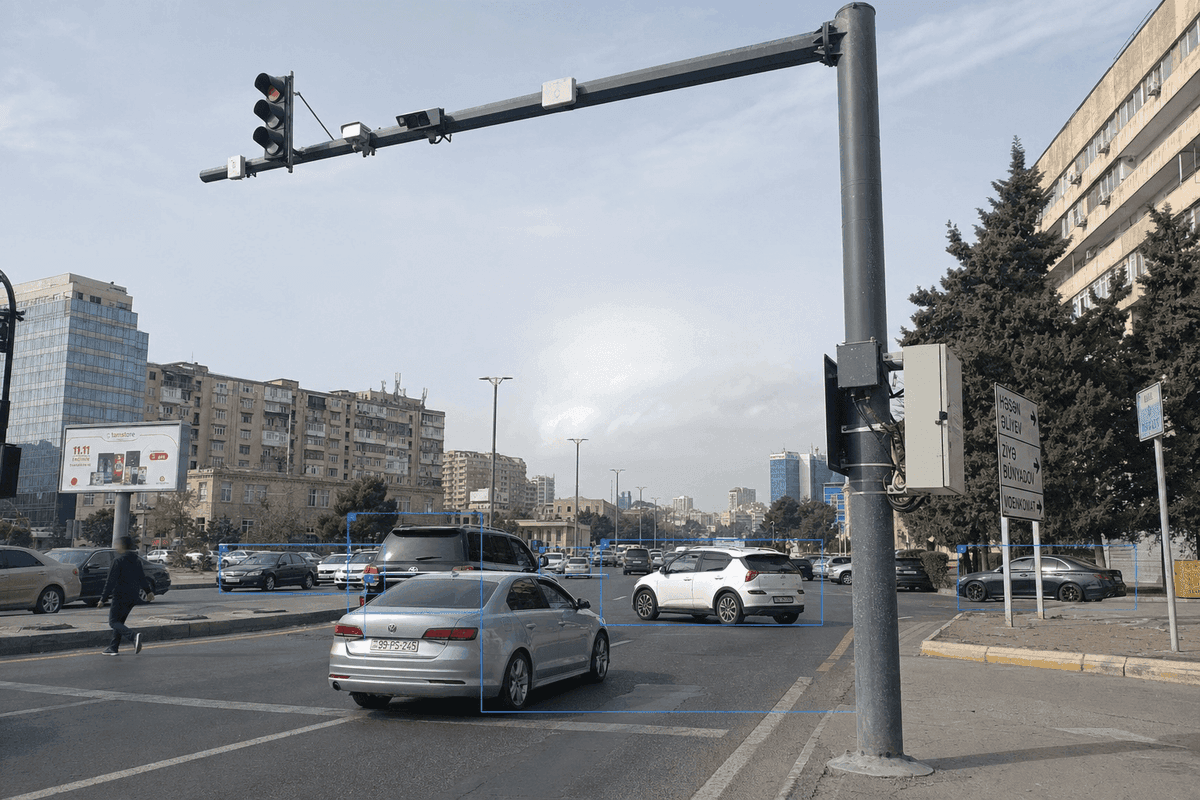
Baku is Azerbaijan's capital and largest urban market, located at 40.41, 49.87 on the Absheron Peninsula. According to the State Statistical Committee of Azerbaijan (2024), Baku's city population is approximately 2,344,900, with the wider metro area commonly estimated above 3.7 million. That scale makes signal timing, pedestrian safety, and incident response relevant at the corridor level rather than only at isolated junctions.
According to Baku Executive Power and national statistical data (2024), the city covers about 2,140 km² and is organized into 12 administrative districts. This creates a mixed operating profile: central boulevard and business-district intersections need pedestrian-heavy control, while arterial approaches toward airport, port, and suburban districts need vehicle detection, queue management, and incident alerts. SOLARTODO should therefore treat Baku as a multi-corridor urban ITS market rather than a single downtown pilot environment.
According to the State Committee on Urban Planning and Architecture (2020), the Baku General Plan covers the 2020-2040 period and includes transport infrastructure renewal, engineering networks, and urban redevelopment. This matters technically because smart poles should be specified as infrastructure assets with long lifecycle compatibility, not temporary camera mounts. The recommended Smart Traffic System therefore uses steel pole infrastructure, integrated signal heads, and standards-based backhaul so the city can expand from 11 intersections to district-wide corridors.
Baku's climate also affects pole and device selection. The city is widely known as the "City of Winds," and Absheron Peninsula conditions include low precipitation, coastal exposure, dust, and recurring high wind events. A hot-dip galvanized steel L-arm pole in dark grey finish is appropriate because it combines corrosion resistance, signal mounting stiffness, and a lower visual profile for dense urban streetscapes.
According to the World Bank (2023), Azerbaijan's urban population share is above 50%, and Baku concentrates a large share of national economic activity, public institutions, tourism, and transport demand. According to ITU (2023), Azerbaijan's internet and mobile connectivity indicators support connected public infrastructure, although critical ITS designs should still allow fiber-first and 5G-redundant architecture. For Baku, that supports 5G/fiber dual-path backhaul rather than camera-only standalone operation.
Recommended Technical Configuration
A recommended Baku Smart Traffic System uses approximately 11 intersections with 8m L-arm poles and 4-12 poles per site depending on approaches.
The correct size class for this Baku profile is the 8m intersection pole, not a highway gantry or 10-12m expressway structure. The project-specific configuration is 11 intersections × 8m L-arm steel pole, dark grey, hot-dip galvanized, using SOLARTODO's 4-in-1 smart traffic pole architecture. A typical N-unit deployment of this scale would place one primary pole per approach and auxiliary poles where pedestrian crossings, turning lanes, or occluded stop lines require separate sensor views.
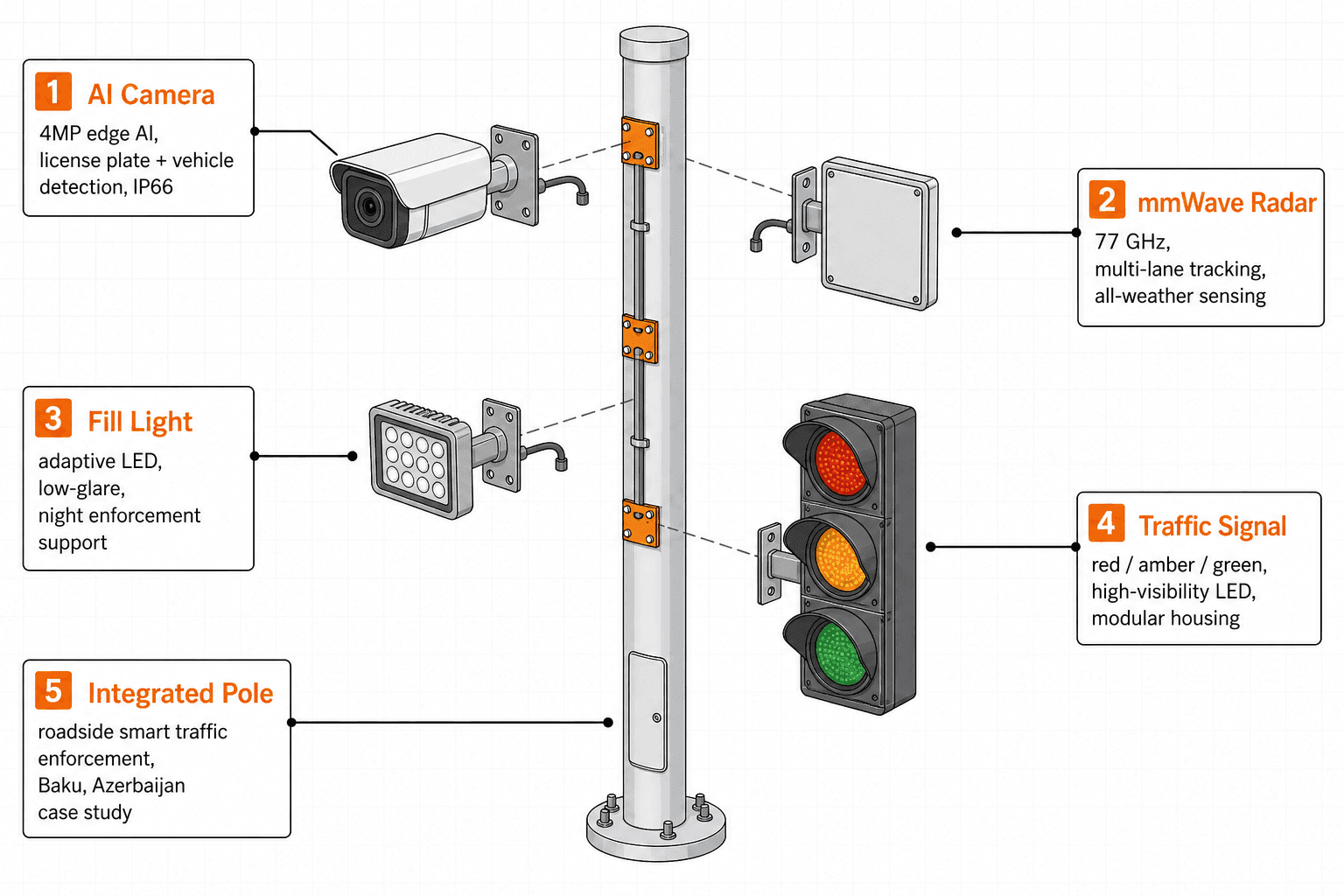
Each pole would integrate four always-on modules: a 4K AI camera, 77GHz mmWave radar, LED fill light, and LED signal head. The AI camera provides 98% detection accuracy across 45+ detection types, while the radar adds speed, distance, and presence detection in rain, glare, night scenes, and partially occluded conditions. This sensor pairing is important in Baku because coastal glare, dust, and night-time boulevard traffic can reduce camera-only reliability.
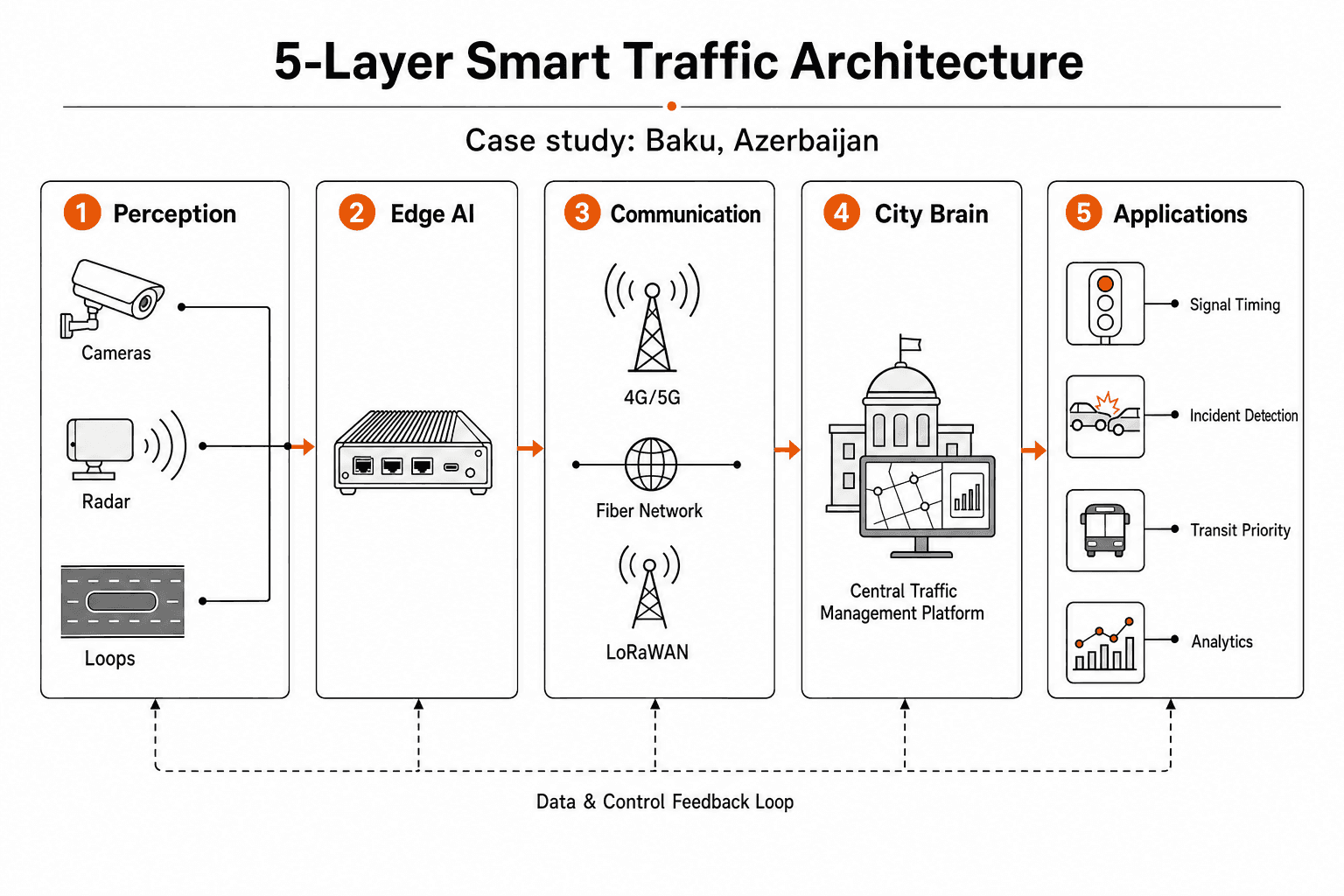
The recommended software stack is SOLARTODO's 5-layer architecture: Perception, Edge AI, Communications, City Brain, and Applications. Edge AI runs on NVIDIA Jetson to support pedestrian detection, adaptive signal optimization, and incident auto-alert within <50ms response. Backhaul should use fiber as the primary path where ducts are available and 5G as either a primary link for rapid rollout or secondary redundancy for signal-critical locations.
The central layer should connect to the TrafficGPT platform, enabling natural-language queries such as "show pedestrian conflicts at corridor A between 18:00 and 20:00" or "rank intersections by average queue length this week." This is not a claim of a past Baku deployment; it is the recommended operational model for an EPC turnkey configuration. SOLARTODO's role in this guide is technical fit analysis, equipment configuration, and quotation pathway for Baku buyers evaluating Smart Traffic System procurement.
Technical Specifications
The Baku technical baseline is an 8m L-arm steel pole with 4K AI, 77GHz radar, LED fill, LED signal, Jetson edge AI, and NTCIP/GB 25280 alignment.
- Product form: 4-in-1 Smart Traffic Pole, L-arm hot-dip galvanized steel pole, dark grey finish.
- Height class: 8m for city intersections; 6m and 10m variants remain available for small crossings or larger mounting requirements.
- Project-specific scale: 11 intersections, with approximately 4-12 poles per intersection depending on geometry and approach count.
- Core sensing: 4K AI camera with 98% accuracy, 45+ detection types, and <50ms response when processed at the edge.
- Radar sensing: 77GHz mmWave radar for vehicle presence, speed, range, and queue support under low-visibility conditions.
- Lighting and signaling: integrated LED fill light plus LED signal head, reducing the need for separate lighting brackets.
- Edge compute: NVIDIA Jetson running pedestrian detection, adaptive signal optimization, and incident auto-alert workloads.
- Communications: 5G/fiber backhaul to TrafficGPT central platform for dashboards, alerts, and natural-language operations.
- Standards: NTCIP for traffic controller/device communications and GB 25280 for road traffic signal technical requirements.
- Cooperation model: EPC turnkey, covering supply, civil works coordination, installation, commissioning, and 1-year warranty.
According to AASHTO, ITE, and NEMA (2021), NTCIP 1202 defines object structures for actuated traffic signal controller units, which supports interoperable controller data exchange. According to the Standardization Administration of China (2016), GB 25280 specifies road traffic signal requirements for signal head performance and control relevance. FHWA states, "Adaptive Signal Control Technology adjusts the timing of red, yellow and green lights," which is the core function this configuration is designed to support.
According to IEEE (2022), IEEE 802.3 defines Ethernet physical and data-link behavior for wired networks, including fiber-based deployments widely used in traffic control cabinets. For Baku, that means the pole-side cabinet should be specified with surge protection, industrial Ethernet, secured 5G router options, and maintenance access that does not require disturbing the pole foundation.
Implementation Approach
An EPC turnkey rollout for 11 Baku intersections would typically proceed through 5 phases from survey to TrafficGPT commissioning.
Phase 1 should begin with intersection survey, utility marking, line-of-sight mapping, and controller cabinet audit. Baku's mix of historic streets, boulevards, and wide arterials means sensor geometry is not uniform. Each 8m L-arm pole should be mapped against stop line, crosswalk, turn-lane, and signal-head visibility before foundation drawings are finalized.
Phase 2 is technical design and procurement. The EPC package would define the pole bill of materials, 4K AI camera lensing, 77GHz radar angle, LED signal head arrangement, cabinet interfaces, fiber/5G route, and TrafficGPT data schema. SOLARTODO should also confirm NTCIP message requirements with the local controller environment before factory acceptance testing.
Phase 3 is factory integration and CKD or assembled shipping. A practical Baku schedule would pre-configure Jetson edge AI, device addressing, camera-radar pairing, and TrafficGPT site IDs before delivery. Factory testing should verify camera streams, radar telemetry, signal head logic, LED fill power, and secure network connectivity.
Phase 4 covers foundations, pole erection, wiring, and cabinet integration. The civil scope should include anchor bolts, grounding, conduit, lightning protection, and traffic management during installation windows. For most urban intersections, night work or off-peak lane closures reduce disruption and allow signal continuity planning.
Phase 5 is commissioning and performance tuning. Engineers should validate pedestrian detection, vehicle presence, queue length, incident auto-alert thresholds, and adaptive optimization behavior across peak and off-peak periods. Final acceptance should include at least 7-14 days of monitored operation before handover, with operations staff trained to use TrafficGPT natural-language queries.
Expected Performance & ROI
Expected ROI for Baku depends on corridor delay value, but adaptive signal control benchmarks support 10-30% delay reduction targets when detection is tuned correctly.
According to FHWA (2017), adaptive signal control can reduce delay, stops, travel time, and fuel consumption when compared with poorly timed fixed plans. A realistic Baku business case should avoid promising a universal payback figure; instead, it should model delay savings, incident clearance time, enforcement-policy constraints, maintenance cost, and avoided manual retiming. For an 11-intersection EPC turnkey project, a conditional payback range of 3-5 years is reasonable when deployed on congested corridors with measurable peak-hour delay.
The primary operational benefit is not simply adding cameras. It is the combination of radar-confirmed vehicle presence, pedestrian detection, local Jetson inference, and central TrafficGPT analysis. This reduces dependence on manual observation and supports faster decision-making for signal timing, event response, and public safety coordination.
According to ITU (2021), intelligent transport systems depend on communication networks that support safety, efficiency, and sustainability. ITU states, "ICTs can make transport safer, smarter and greener," which aligns with Baku's modernization agenda. In practical terms, the 5G/fiber architecture lets operators compare intersections, isolate malfunctioning detection zones, and prioritize maintenance before a failure becomes a corridor-level issue.
Results and Impact
For Baku, the expected impact is measurable intersection intelligence across 11 sites rather than a claimed past deployment or fabricated client outcome.
A typical 11-intersection deployment of this scale would create a connected detection layer for pedestrian presence, vehicle queues, approach speed, and incident events. The immediate impact would be better data quality for signal timing decisions. The medium-term impact would be more consistent corridor operations because TrafficGPT can normalize data from every pole into comparable metrics.
For municipal buyers, the value is procurement clarity. Instead of buying separate camera poles, radar units, fill lights, and signal structures, the 4-in-1 system consolidates these functions in one 8m L-arm form factor. That reduces street clutter and simplifies responsibility under EPC turnkey delivery.
For SOLARTODO, the recommended Baku positioning should remain analytical and conditional: approximately 11 intersections, 8m poles, NTCIP/GB 25280 alignment, 5G/fiber backhaul, and TrafficGPT central platform. No past deployment quantity, client name, date, or project result should be presented unless independently documented by the buyer.
Comparison Table
The 8m Smart Traffic System provides the best fit for Baku intersections because it balances signal visibility, sensor height, and urban maintainability.
| Option | Typical Use | Height | Sensor Package | Backhaul | Fit for Baku 11-Intersection Scope |
|---|---|---|---|---|---|
| 6m smart pole | Small crossings, low-speed streets | 6m | 4K AI + 77GHz radar + LED fill + signal | 5G/fiber | Useful for minor pedestrian crossings, but limited for wider arterials |
| Recommended 8m L-arm pole | Standard urban intersections | 8m | 4K AI, 98% accuracy, <50ms edge response, radar | 5G/fiber to TrafficGPT | Best match for Baku's 11 intersections and mixed pedestrian/vehicle demand |
| 10m pole | Large junctions or elevated mounting | 10m | Same 4-in-1 module set | 5G/fiber | Suitable where extra mounting height is required, but not default for this scope |
| 10-12m gantry class | Highway and expressway monitoring | 10-12m | Multi-lane monitoring package | Fiber preferred | Over-specified for standard city intersections unless used on urban expressways |
Pricing & Quotation
SOLARTODO pricing for Baku should be quoted by tier, with EPC turnkey recommended for the specified 11-intersection technical configuration.
SOLARTODO offers three pricing tiers for this product line: FOB Supply (equipment ex-works China), CIF Delivered (including ocean freight and insurance), and EPC Turnkey (fully installed, commissioned, with 1-year warranty). Volume discounts are available for large-scale deployments. Configure your system online for an instant estimate, or request a custom quotation from our engineering team at [email protected].
For Baku, EPC turnkey is the preferred model because the scope includes pole foundations, signal interfaces, 5G/fiber backhaul, edge AI commissioning, and TrafficGPT integration. FOB or CIF supply can work for buyers with their own civil contractor and ITS integrator, but it shifts installation risk to the local project team. For procurement planning, the quotation should separate poles, modules, cabinets, communications, civil works, installation, commissioning, and warranty support.
Frequently Asked Questions
The following 10 answers summarize Baku-specific sizing, timeline, ROI, maintenance, EPC pricing, warranty, installation, and comparison assumptions.
Q1: What Smart Traffic System configuration is recommended for Baku? A typical Baku configuration would use 11 intersections with 8m L-arm hot-dip galvanized steel poles in dark grey. Each pole integrates a 4K AI camera, 77GHz mmWave radar, LED fill light, and LED signal head. Edge AI runs on NVIDIA Jetson, with 5G/fiber backhaul to the TrafficGPT central platform.
Q2: Why is the 8m pole class recommended instead of 6m or 10m? The 8m class is the best fit for standard urban intersections because it provides better signal visibility and camera/radar geometry than 6m while avoiding the over-height profile of 10m highway-style installations. Baku's arterial and pedestrian mix requires reliable stop-line and crosswalk coverage, not gantry-level mounting.
Q3: How long would an 11-intersection EPC turnkey rollout typically take? A realistic EPC schedule is usually 10-16 weeks after final design approval, depending on permits, foundation readiness, shipping mode, and traffic management windows. Survey and design may take 2-3 weeks, equipment integration 4-6 weeks, civil installation 3-5 weeks, and commissioning 1-2 weeks.
Q4: What ROI or payback period should Baku buyers expect? ROI depends on congestion, labor cost, delay value, and maintenance baseline. For a congested 11-intersection corridor, a conditional 3-5 year payback can be modeled if adaptive control reduces delay and incident response time. Buyers should validate this with local traffic counts, peak-hour delay, and existing signal retiming costs.
Q5: What maintenance is required for the 4-in-1 poles? Maintenance should include quarterly camera lens cleaning, radar alignment checks, LED signal inspection, cabinet ventilation checks, grounding inspection, and firmware updates. In Baku's coastal and windy environment, annual corrosion inspection and bolt torque checks are also recommended. TrafficGPT alerts can help prioritize maintenance by detecting abnormal device behavior.
Q6: How does this compare with a camera-only traffic system? A camera-only system can classify vehicles and pedestrians but is more sensitive to glare, dust, darkness, and occlusion. The 77GHz radar adds speed, range, and presence detection, improving reliability during poor visibility. The combined camera-radar design also supports stronger adaptive signal logic than basic video monitoring.
Q7: What does EPC turnkey pricing include? EPC turnkey generally includes equipment supply, engineering design support, foundations coordination, pole erection, wiring, cabinet integration, communications setup, commissioning, operator training, and a 1-year warranty. Final pricing depends on pole count, civil conditions, fiber availability, controller interface requirements, and whether 5G is primary or backup backhaul.
Q8: Which standards should be specified in procurement documents? Procurement documents should specify NTCIP for traffic controller and device communications, GB 25280 for road traffic signal requirements, and relevant local electrical and civil codes. IEEE 802.3 should be referenced where fiber or Ethernet networking is used. Cybersecurity and data retention requirements should be added by the buyer.
Q9: Can TrafficGPT support natural-language traffic operations? Yes. In the recommended architecture, pole data flows through 5G/fiber backhaul into the TrafficGPT central platform. Operators can query congestion, pedestrian events, incidents, or device health in natural language. The system should still preserve structured dashboards, alarms, and exportable reports for engineering review and audit trails.
Q10: Does SOLARTODO claim this has already been deployed in Baku? No. This article is a market analysis and technical configuration guide, not a fabricated case study. The recommended scope is approximately 11 intersections using 8m L-arm smart traffic poles. SOLARTODO should only claim a past Baku deployment if a real buyer, completion date, and documented project evidence are available.
References
These 7 references support the Baku context, standards alignment, communications design, and adaptive traffic-control assumptions used in this guide.
- State Statistical Committee of Azerbaijan (2024): Baku population and administrative-region statistics, including city population near 2.34 million.
- Baku Executive Power (2024): Baku municipal profile, administrative districts, and city governance context.
- State Committee on Urban Planning and Architecture of Azerbaijan (2020): Baku General Plan 2020-2040, including transport and engineering infrastructure renewal.
- World Bank (2023): Azerbaijan urban population and development indicators relevant to metropolitan infrastructure planning.
- FHWA (2017): Adaptive Signal Control Technology guidance describing real-time traffic signal timing adjustment and operational benefits.
- AASHTO/ITE/NEMA (2021): NTCIP 1202 v03, Object Definitions for Actuated Traffic Signal Controller Units.
- Standardization Administration of China (2016): GB 25280 road traffic signal standard for technical signal requirements.
- IEEE (2022): IEEE 802.3 Ethernet standard for wired LAN/MAN and fiber-connected infrastructure networks.
- ITU (2021): Intelligent transport systems and ICT guidance for safer, smarter, and greener transport networks.
Equipment Deployed
- 11 intersections × 8m L-arm hot-dip galvanized steel poles, dark grey finish
- 4-in-1 smart traffic pole with 4K AI camera, 77GHz mmWave radar, LED fill light, and LED signal head
- 4K AI camera with 98% accuracy, 45+ detection types, and <50ms edge response
- NVIDIA Jetson edge AI module for pedestrian detection, adaptive signal optimization, and incident auto-alert
- 5G/fiber backhaul to TrafficGPT central platform with natural-language query support
- NTCIP-compatible traffic communications and GB 25280-aligned signal requirements
- EPC turnkey delivery model with installation, commissioning, and 1-year warranty