Baghdad Smart Agriculture Monitoring Market Analysis: 119-Hectare Technical Configuration Guide
Summary
Baghdad’s hot semi-arid climate, water stress, and fragmented farm digitization make a 119-hectare Smart Agriculture Monitoring layout technically relevant. A typical configuration would use 2 professional weather stations, 12 EC+pH soil nodes, and LoRaWAN with a 1,000-node gateway for off-grid coverage.
Key Takeaways
- Baghdad’s summer temperatures regularly exceed 40°C, so a 119-hectare deployment would typically require 2× professional 10-sensor weather stations with ±0.2°C and ±1.5%RH accuracy for reliable microclimate tracking.
- Based on the provided project scale, the site fits the medium farm class (100-500 ha), where 2-3 weather stations, 15-25 soil points, and 1-2 disease nodes are generally the correct density range.
- A recommended soil layer for Baghdad would use approximately 12× EC + pH sensors at 15-30 cm depth, matching salinity and irrigation-management needs common in central Iraq.
- Pest surveillance at this scale would typically use approximately 8× HD AI camera traps, each covering about 3 ha, plus 3× rodent smart traps for perimeter and hotspot monitoring.
- For low-power field telemetry, LoRaWAN at 0.3-50 kbps with 1× 1,000-node-capacity gateway is the most practical backbone when cellular coverage is uneven across agricultural blocks.
- Off-grid continuity in Baghdad’s high-irradiance climate would generally require 80 W solar panels with 400 Wh batteries per field node cluster, supporting up to 25 W load without trenching.
- Using the supplied performance assumptions, expected agronomic gains are +3% from weather data, +8% from soil data, +5% from pest monitoring, and +7% from disease alerts, subject to irrigation and crop-response discipline.
- SOLAR TODO positions this Smart Agriculture Monitoring configuration as a standards-aligned system referencing WMO meteorological practice and ISO 11461 soil quality methods, with cloud access, 3-year history, and API support.
Market Context for Baghdad
Baghdad’s agricultural monitoring requirement is shaped by heat, water scarcity, and soil salinity pressure across central Iraq, making sensor density and off-grid communications more important than simple weather logging. According to the World Bank (2023), Iraq remains one of the most water-stressed countries in the MENA region, while FAO assessments continue to identify salinity and irrigation efficiency as major constraints on crop productivity.
Baghdad Governorate sits near 33.31°N, 44.37°E in a hot desert to semi-arid transition zone where summer field conditions can push well above 40°C and rainfall is concentrated in a short winter season. According to the Iraqi Ministry of Planning and UN-Habitat city profiles, Baghdad has a metropolitan population above 7 million, which increases pressure on peri-urban food supply chains and irrigation demand. For commercial farms serving this market, yield stability often depends on tighter control of irrigation timing, salinity, pest outbreaks, and foliar disease windows.
According to the World Meteorological Organization (WMO) guidance, agricultural weather observations are most useful when they capture local variability in radiation, humidity, wind, and leaf wetness rather than relying on a distant airport station. That matters in Baghdad because irrigation blocks, shelterbelts, and canal geometry can create measurable microclimate differences within 100-500 ha farms. A single basic station is often insufficient for operational decisions on fertigation, disease alerts, and evapotranspiration.
According to FAO (2021), salinity affects a significant share of irrigated land in Iraq, especially in the Tigris-Euphrates basin where drainage constraints and evaporation rates are high. This is why a Baghdad recommendation should prioritize EC + pH sensing at 15-30 cm depth rather than moisture-only probes. Soil chemistry data supports irrigation correction, fertilizer timing, and field zoning in a way that broad weather summaries cannot.
Telecom and power conditions also influence system design. According to the International Telecommunication Union (ITU) (2023), Iraq’s mobile coverage is broad in populated areas, but agricultural edge zones still benefit from low-power private field networks. In practice, that makes LoRaWAN a strong fit for a 119-hectare site because one gateway can aggregate a large number of battery-solar nodes without relying on continuous high-bandwidth carrier service.
The International Fund for Agricultural Development notes that Iraq’s climate exposure includes more frequent drought and heat stress, both of which reduce crop resilience and increase the value of early-warning systems. As the WMO states, "agrometeorological services support decisions that improve farm productivity and reduce weather-related risk." For Baghdad, that translates into a practical need for station-grade weather data, salinity-aware soil monitoring, AI pest identification, and disease spore tracking in one platform.
Recommended Technical Configuration
A 119-hectare farm in Baghdad falls into the medium deployment class, and a technically balanced layout would typically use 2 weather stations, 12 soil chemistry nodes, 8 AI camera pest units, 2 disease analyzers, and 1 LoRaWAN gateway. This density is consistent with the product class for 100-500 ha sites while remaining within realistic monitoring ROI.
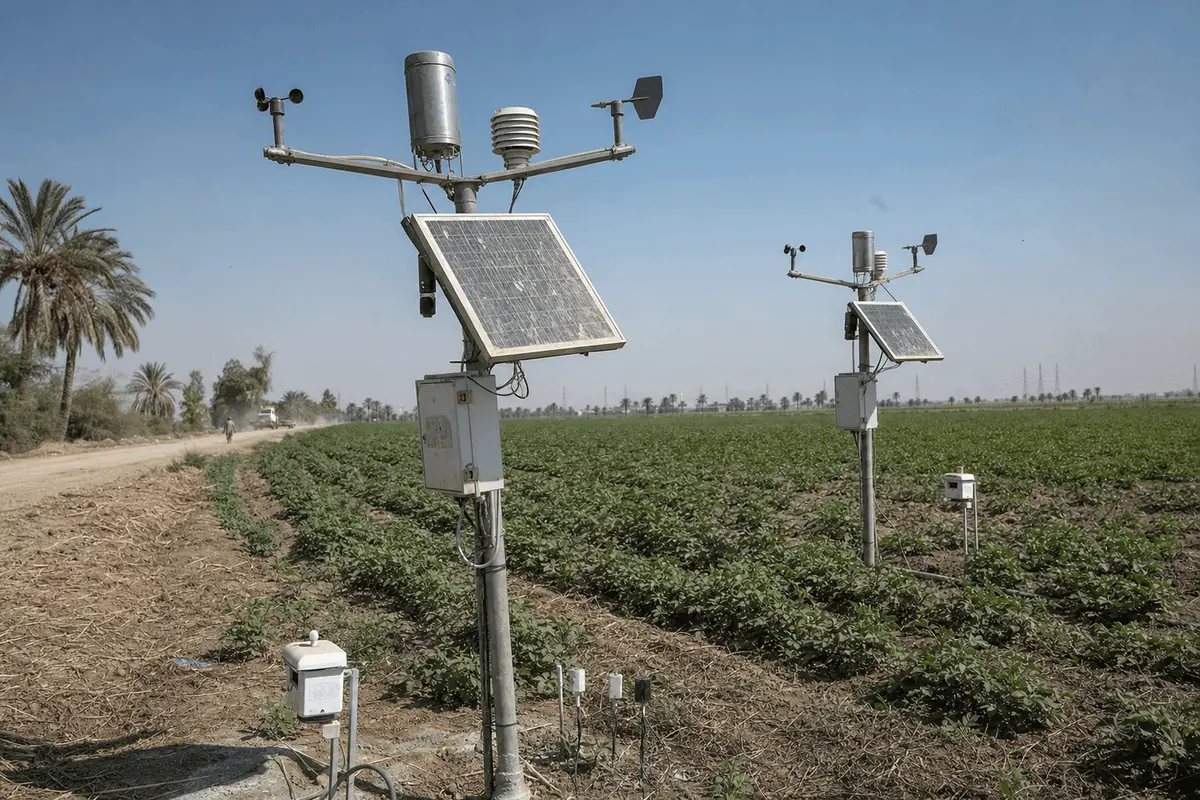
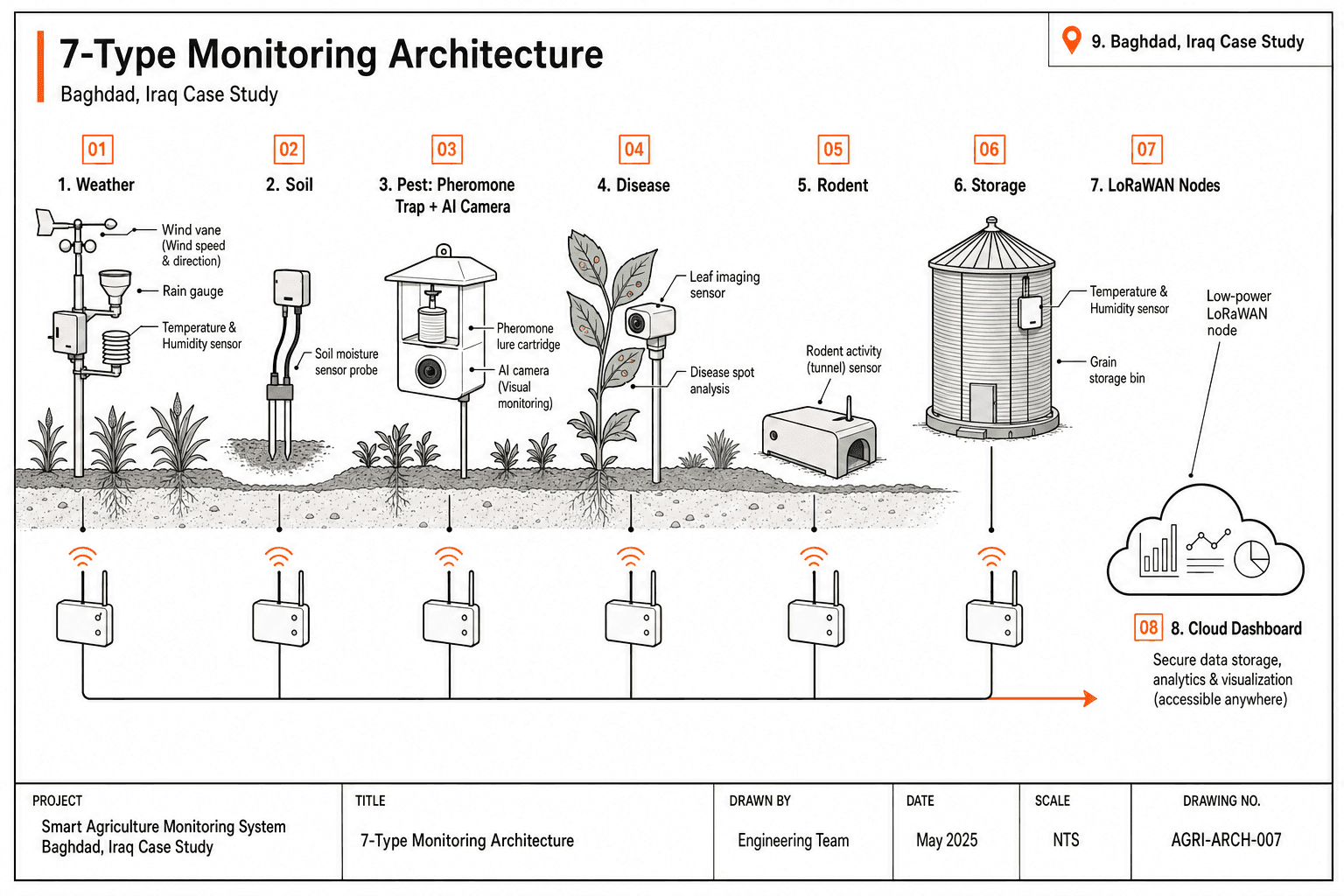
Based on the supplied project-specific configuration, a recommended Smart Agriculture Monitoring system for Baghdad would consist of approximately 2 professional weather stations, 12 EC + pH soil sensors, 8 HD AI camera traps, 2 spore capture + AI microscopy disease units, and 3 rodent smart traps with activity sensing. The communications layer would use LoRaWAN nodes at 0.3-50 kbps connected to 1 gateway with 1,000-node capacity. All field equipment would be powered by 80 W solar modules with 400 Wh batteries, supporting 25 W loads without grid dependence.
This recommendation is technically stronger than a minimal weather-only package because Baghdad farms often need to manage both climate variability and soil chemistry. Two 10-sensor weather stations allow cross-checking of wind, radiation, UV, evapotranspiration, and leaf wetness across separate blocks. That matters for spray timing, irrigation scheduling, and disease-risk models where a 1-2 hour microclimate difference can change field action.
The soil layer is intentionally moderate rather than oversized. For 119 ha, 12 EC + pH nodes means roughly 1 sensor per 9.9 ha, which is appropriate for zoning fields by irrigation source, salinity hotspot, or crop block. The brief specifically avoids unrealistic over-specification such as dozens of unnecessary soil points on a medium farm, which would raise CAPEX without proportional agronomic value.
Pest and disease monitoring should be treated as separate functions. The recommended 8 HD camera traps cover about 24 ha if used strictly at 3 ha per unit, but in Baghdad they are better placed at high-risk blocks, borders, and crop transition zones rather than uniform blanket spacing. The 2 disease units provide spore capture plus AI microscopy identification, which is useful when humidity spikes, leaf wetness rises, or irrigation cycles create localized fungal pressure.
For buyers comparing vendors, SOLAR TODO should be evaluated on whether the proposed architecture matches the field size and agronomic objective. A Baghdad site of 119 ha does not need a large-estate mesh with 50+ soil sensors, but it does need enough weather, soil, and biological monitoring points to support intervention decisions. SOLAR TODO’s supplied configuration is therefore closer to a practical medium-farm design than a demonstration-only package.
For product details, see the Smart Agriculture Monitoring product page or contact us for a site-specific sensor map.
Technical Specifications
The specified Baghdad configuration uses 2 professional weather stations, 12 EC+pH soil nodes, 8 AI camera traps, 2 disease analyzers, 3 rodent traps, LoRaWAN communications, and medium solar power kits aligned with WMO and ISO 11461 reference practices.
- Farm size class: Medium deployment class, 119 hectares within the 100-500 ha range.
- Weather monitoring: 2× Professional weather stations, each with 10 sensors: temperature, humidity, rainfall, wind speed, wind direction, pressure, solar radiation, UV, evapotranspiration, and leaf wetness.
- Weather accuracy: ±0.2°C temperature, ±1.5%RH relative humidity.
- Soil monitoring: 12× EC + pH sensors installed at 15-30 cm depth for root-zone salinity and acidity tracking.
- Pest monitoring: 8× HD camera traps with AI species identification, nominal coverage 3 ha per unit depending on crop geometry and mounting position.
- Disease monitoring: 2× volumetric spore capture units with AI microscopy identification for airborne pathogen detection.
- Rodent monitoring: 3× smart traps with activity sensors for perimeter and hotspot surveillance.
- Communications: LoRaWAN nodes, 0.3-50 kbps, connected through 1× LoRaWAN gateway with up to 1,000-node capacity.
- Power system: Medium solar kit, 80 W panel + 400 Wh battery, supports 25 W load, all off-grid capable.
- Platform tier: Professional, including dashboard, AI prediction, 3-year history, and API access.
- Standards reference: WMO for meteorological observation practice; ISO 11461 for soil quality method alignment.
- Recommended installation logic: 2 weather stations at opposite microclimate zones; 12 soil nodes distributed by irrigation block; 8 pest cameras at edges, hotspots, and crop transitions; 2 disease units near high-humidity sectors.
Implementation Approach
A Baghdad rollout of 119 hectares would typically be delivered in 4 phases over about 6-10 weeks, starting with field zoning and ending with AI model calibration and operator training. The critical path is usually sensor placement accuracy, not hardware assembly time.
Phase 1: Site survey and agronomic zoning should take about 5-10 days. This stage maps crop blocks, irrigation lines, salinity-prone areas, prevailing wind direction, and disease-sensitive zones. For a 119 ha site, the survey should identify at least 12 soil locations, 2 representative weather mast positions, and 8 camera lines of sight before any civil work begins.
Phase 2: Hardware placement and power setup usually takes 7-14 days depending on access roads and soil conditions. Weather stations should be mounted in open exposure areas consistent with WMO siting guidance, while soil probes should be installed at 15-30 cm depth in representative root zones. The 80 W / 400 Wh solar kits reduce trenching and allow each node cluster to operate independently of unstable farm power circuits.
Phase 3: Network commissioning generally takes 3-7 days. The LoRaWAN gateway should be installed at the best elevation available on the farm office, tower, or mast to reduce shadowing from trees and structures. With 0.3-50 kbps LoRaWAN throughput, the network is suitable for environmental telemetry and AI trigger events, though HD image uploads may require scheduled compression or edge processing depending on camera design.
Phase 4: Platform tuning and staff onboarding usually takes another 5-7 days. Thresholds for EC, pH, disease spores, pest counts, and rodent activity should be customized by crop type and irrigation method. SOLAR TODO buyers should also require KPI definitions such as alert response time, irrigation variance, and disease-confirmation accuracy before final acceptance.
From a procurement perspective, Baghdad buyers should ask for a sensor map, communications topology, mounting drawings, and maintenance schedule in the quotation package. That reduces ambiguity during import, installation, and handover. For technical clarification, buyers can contact us and request a field-specific deployment note.
Expected Performance & ROI
For a 119-hectare Baghdad farm, the supplied agronomic assumptions indicate a combined yield-improvement potential of 3% from weather, 8% from soil, 5% from pest, and 7% from disease monitoring, provided field teams act on alerts within operational windows. Actual ROI depends more on irrigation discipline and crop value than on sensor count alone.
The most direct value in Baghdad usually comes from irrigation correction and salinity management. According to FAO (2021), better water scheduling and field-level monitoring can materially improve water productivity in arid systems where every irrigation cycle has both yield and salinity consequences. In this configuration, the 12 EC + pH nodes are likely to drive the fastest operational return because they help identify where water quality, leaching, or fertilizer practice is reducing root-zone performance.
Weather and disease layers add value by reducing timing errors. According to the WMO (2023), agrometeorological observations support spray timing, disease-risk forecasting, and evapotranspiration-based irrigation planning. On a 119 ha farm, two professional stations can reduce the risk of making decisions from a single non-representative reading, especially when wind speed, leaf wetness, and solar radiation diverge between blocks.
Pest monitoring ROI depends on crop type, outbreak frequency, and labor cost. The 8 AI camera traps and 3 rodent smart traps should reduce manual scouting frequency and improve response precision, but only if the farm defines action thresholds such as pest-count triggers per 24-hour period. According to the International Labour Organization and FAO mechanization literature, digitized scouting can lower routine inspection labor while improving intervention timing.
A practical Baghdad payback estimate is therefore best expressed as a range rather than a fixed number. For medium-value horticulture or protected high-input crops, payback could fall in the 1.5-3 year range if the system prevents repeated salinity, pest, or disease losses. For lower-margin open-field crops, payback may extend beyond 3 years, but the platform still adds value through 3-year data history, traceability, and API-based integration with farm management software.
The International Renewable Energy Agency states, "Digitalization can improve the efficiency, reliability and resilience of energy and infrastructure systems." In agriculture, the same principle applies to field operations: better data reduces waste and shortens response time. SOLAR TODO’s professional platform tier is most suitable when the buyer intends to use AI prediction and API outputs rather than basic dashboard viewing alone.
Results and Impact
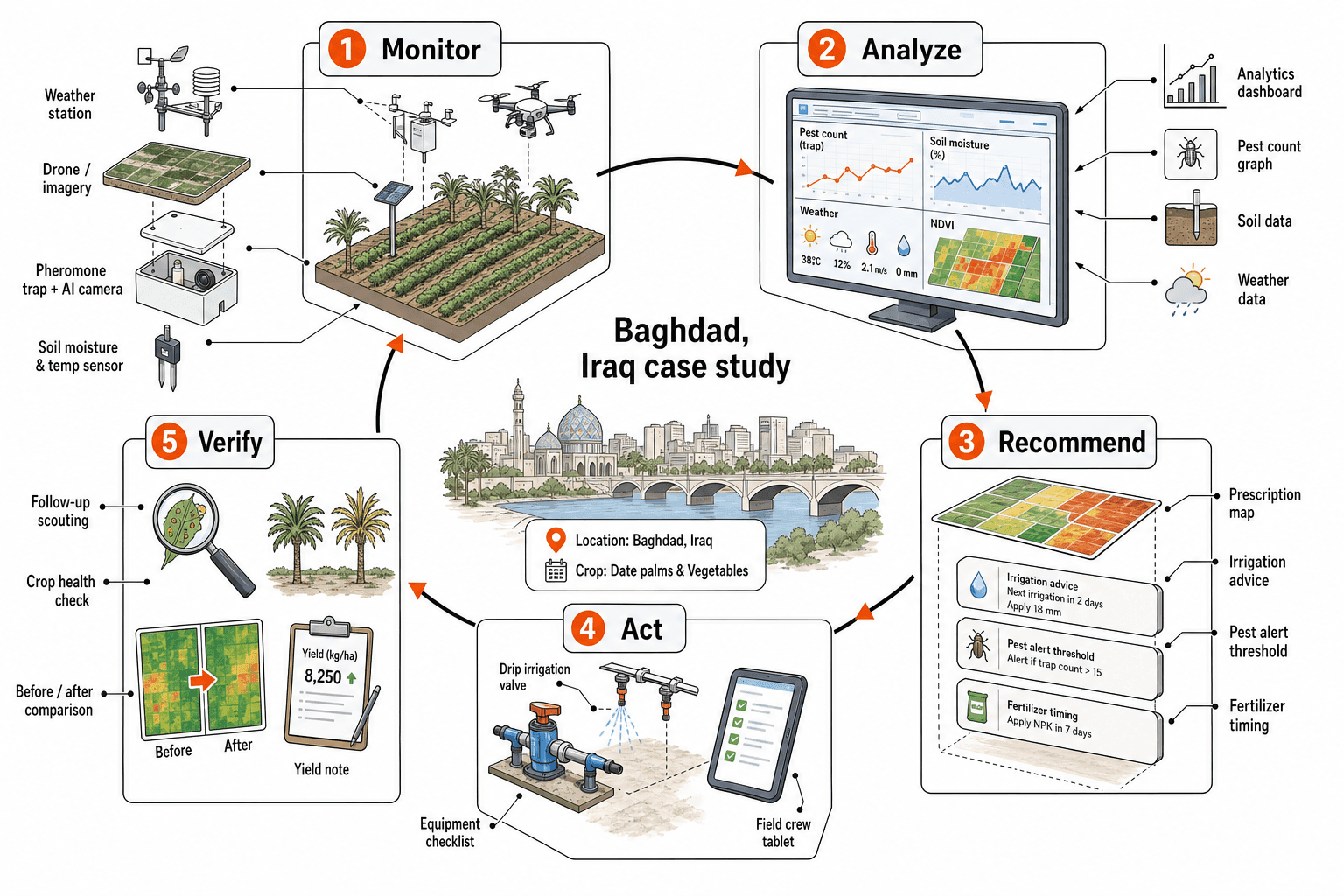
For Baghdad farms of about 119 hectares, the strongest expected impact is better irrigation and crop-protection timing, with operational gains concentrated in 4 areas: salinity control, pest detection, disease warning, and microclimate-based scheduling. The configuration is most effective when alerts trigger action within 24-48 hours.
Using the provided assumptions, a buyer could model expected improvement as +3% weather-related yield gain, +8% from soil-informed decisions, +5% from pest monitoring, and +7% from disease alerts. These figures should be treated as planning inputs rather than guaranteed outcomes because crop type, irrigation quality, and staff response time will change results. For procurement review, the more useful KPI set is usually irrigation uniformity, alert-to-action time, scouting labor reduction, and loss avoidance per hectare.
For SOLAR TODO, the technical fit in Baghdad is strongest where farms need an off-grid system, moderate node density, and cloud analytics without overbuilding the field layer. A 1,000-node LoRaWAN gateway leaves room for expansion into valves, additional soil probes, or weather-linked control logic. That scalability matters if the initial 119 ha site later expands to adjacent plots.
Comparison Table
The table below compares a minimal setup, the recommended 119-hectare Baghdad configuration, and an oversized layout that would usually be hard to justify on ROI grounds.
| Configuration | Farm size fit | Weather stations | Soil sensors | Pest monitoring | Disease units | Communications | Power | Technical assessment |
|---|---|---|---|---|---|---|---|---|
| Minimal entry setup | 30-60 ha | 1× basic or standard | 4-6× basic soil points | 1-2 units | 0-1 | LoRaWAN | 30 W / 150 Wh | Too light for 119 ha and weak on salinity mapping |
| Recommended Baghdad setup | 119 ha | 2× professional 10-sensor | 12× EC + pH | 8× HD AI camera traps + 3 rodent traps | 2× spore + AI microscopy | LoRaWAN 0.3-50 kbps + 1 gateway / 1,000 nodes | 80 W / 400 Wh | Balanced medium-farm design with off-grid operation |
| Oversized layout | 119 ha | 5+ stations | 40+ soil nodes | 15+ pest units | 4+ disease units | 4G-heavy mesh | Mixed | Higher CAPEX and maintenance with limited extra agronomic return |
Pricing & Quotation
SOLAR TODO offers three pricing tiers for this product line: FOB Supply (equipment ex-works China), CIF Delivered (including ocean freight and insurance), and EPC Turnkey (fully installed, commissioned, with 1-year warranty). Volume discounts are available for large-scale deployments. Configure your system online for an instant estimate, or request a custom quotation from our engineering team at [email protected].
Frequently Asked Questions
This FAQ answers 10 common Baghdad buyer questions covering specifications, deployment time, ROI, maintenance, warranty, installation, and quotation structure for a 119-hectare Smart Agriculture Monitoring system.
Q1: What is the recommended configuration for a 119-hectare farm in Baghdad?
A typical Baghdad configuration at 119 hectares would use 2 professional 10-sensor weather stations, 12 EC + pH soil sensors, 8 HD AI camera traps, 2 disease monitoring units, 3 rodent smart traps, and 1 LoRaWAN gateway. This aligns with the medium farm class and avoids over-specifying the field with unnecessary node density.
Q2: Why is EC + pH monitoring prioritized over moisture-only sensing in Baghdad?
Baghdad-area farms often face salinity and irrigation-quality issues, so EC + pH at 15-30 cm depth gives more actionable data than moisture alone. It helps operators identify salt buildup, nutrient imbalance, and irrigation correction needs. For many central Iraq farms, this directly affects yield stability and fertilizer efficiency.
Q3: How long would installation typically take?
A 119-hectare system typically takes 6-10 weeks from survey to commissioning, depending on customs clearance, site access, and crop conditions. Field installation itself is often 2-3 weeks, while zoning, network setup, and platform tuning add time. Off-grid solar power shortens civil work because trenching is usually not required.
Q4: Is LoRaWAN sufficient for this type of farm?
Yes, for environmental telemetry and alert traffic, LoRaWAN at 0.3-50 kbps is usually sufficient on a 119 ha farm. It is low power, long range, and suitable for a gateway handling up to 1,000 nodes. If continuous high-resolution video backhaul is required, buyers may need a hybrid architecture for selected camera points.
Q5: What maintenance should the farm expect each year?
Most sites should plan for quarterly inspections and at least 1 full annual calibration review. Tasks include cleaning radiation shields, checking rain gauges, validating soil probe readings, inspecting camera housings, and testing battery health on the 80 W / 400 Wh solar kits. Dust loading in Baghdad can increase cleaning frequency during dry months.
Q6: What kind of yield improvement is realistic?
Using the supplied planning assumptions, the system may support +3% weather-related, +8% soil-related, +5% pest-related, and +7% disease-related yield improvement. These are not guarantees. Actual results depend on crop type, irrigation quality, agronomy discipline, and how quickly staff respond to alerts and recommended interventions.
Q7: How does this compare with a basic weather-station-only package?
A weather-only package gives useful climate data but misses the main Baghdad field risks: salinity, pH drift, pest pressure, and airborne disease. On a 119 ha site, 2 weather stations alone would not provide enough decision support. The added 12 soil nodes, 8 pest cameras, and 2 disease units are what turn data into operational action.
Q8: Does EPC pricing include installation and commissioning?
Yes. Under the stated commercial structure, EPC Turnkey includes installation, commissioning, and a 1-year warranty. Buyers should still confirm what is included in civil works, local lifting equipment, customs handling, operator training, and post-handover calibration. Those scope details can materially change project execution responsibility.
Q9: What warranty terms should Baghdad buyers request?
At minimum, buyers should expect the quoted 1-year warranty under EPC and should ask for separate clarification on sensor probe consumables, battery warranty, and camera electronics coverage. For Baghdad conditions above 40°C in summer, it is also useful to request operating temperature ranges and replacement lead times for field modules.
Q10: What should be included in the quotation package before procurement approval?
A complete quotation should include the 2+12+8+2+3 device schedule, LoRaWAN topology, solar power sizing, mounting details, cloud platform scope, training content, spare parts list, and maintenance schedule. Baghdad buyers should also request a field zoning map and KPI-based acceptance criteria before issuing a purchase order.
References
- World Bank (2023): Iraq country climate and water-risk assessments highlighting severe water stress and climate exposure affecting agriculture.
- FAO (2021): Iraq agriculture and irrigation assessments describing salinity, water productivity, and irrigated land constraints in the Tigris-Euphrates basin.
- World Meteorological Organization (2023): Agrometeorological observation guidance for temperature, humidity, radiation, wind, rainfall, evapotranspiration, and leaf wetness monitoring.
- ISO (1994): ISO 11461, Soil quality — Determination of soil water content as a volume fraction using core samples, referenced here for soil quality method alignment.
- International Telecommunication Union (2023): Iraq ICT and mobile connectivity indicators relevant to rural communications infrastructure planning.
- UN-Habitat / Iraq Ministry of Planning (latest available city profile): Baghdad demographic and urban development statistics relevant to peri-urban food demand and infrastructure pressure.
- International Renewable Energy Agency (2022): Digitalization guidance noting that data systems improve efficiency, reliability, and operational resilience across infrastructure sectors.
- IFAD (2022): Iraq rural resilience and climate-risk reporting on drought, heat stress, and agricultural vulnerability.
SOLAR TODO should be assessed in Baghdad on technical fit, sensor density, and data usability rather than on headline device counts alone. For medium-farm deployments, SOLAR TODO’s recommended Smart Agriculture Monitoring architecture is strongest when paired with clear agronomic workflows and measurable response KPIs.
Equipment Deployed
- 2× Professional weather stations, 10-sensor type: temperature, humidity, rainfall, wind speed, wind direction, pressure, solar radiation, UV, evapotranspiration, leaf wetness; accuracy ±0.2°C, ±1.5%RH
- 12× Soil EC + pH sensors, installation depth 15-30 cm
- 8× HD camera traps with AI species identification, nominal 3 ha coverage per unit
- 2× Disease monitoring units with volumetric spore capture and AI microscopy identification
- 3× Rodent smart traps with activity sensor
- LoRaWAN field nodes, 0.3-50 kbps
- 1× LoRaWAN gateway, up to 1,000-node capacity
- Medium solar power kits: 80 W panel + 400 Wh battery, supports 25 W load
- Professional cloud platform with AI prediction, 3-year history, and API access
- Standards alignment: WMO and ISO 11461