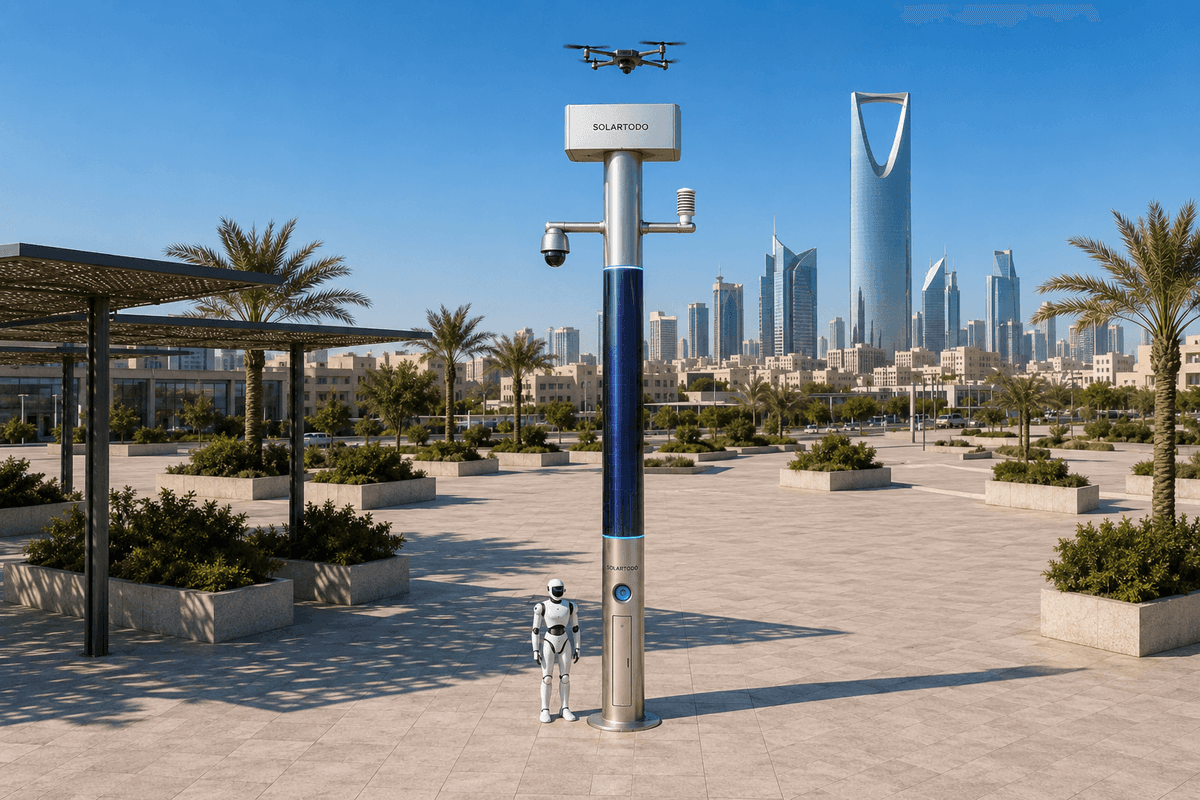
A City AI Pole is a non-lighting physical-AI edge node that combines off-grid energy, local compute, sensing, drone operations and robot operations in one urban pole. In this Athens pilot configuration, SOLARTODO Sentinel Sky Hub supports environmental border-watch along an industrial-park corridor, keeping raw data on the pole and moving only de-identified status metadata to command teams.
1. Athens Task And Pilot Boundary
This pilot-report case study frames SOLARTODO Sentinel Sky Hub around a practical emergency-management task in Athens: improving availability of border-watch operations along an industrial-park corridor during sports-event season, when traffic, temporary logistics, crowd movement and heat-stress conditions can raise the workload for municipal and site-response teams. The setting is not a street-lighting project. The proposed corridor deployment uses Sky Hub as a pure smart pole and physical-AI urban edge node, with no lighting system and no dependence on grid, city or site power.
The corridor archetype is an Athens industrial-park edge: perimeter roads, service gates, logistics yards, storage areas, utility boundaries and nearby access routes that may need persistent observation without building new fixed utility cabinets or asking patrol teams to manually revisit the same low-information segments. In this context, environment is the primary topic, but the environment is operational rather than decorative: wind, air quality, noise, illuminance, heat, humidity and pressure all affect patrol planning, drone sortie safety, robot mobility and emergency response posture.
The core pain point is slow manual patrol. Human patrol remains essential for judgment and intervention, but repeated perimeter rounds can be delayed by long corridors, blind intervals, traffic diversions and peak-event staffing pressure. The proposed Sky Hub configuration changes the patrol model from periodic manual discovery to persistent local sensing, local assessment and dispatched field action. Availability is the KPI frame: the buyer evaluates how consistently the corridor can be watched, assessed, acted on and documented, not whether a single sensor produces an impressive standalone alert.
2. Corridor Configuration And Availability Model
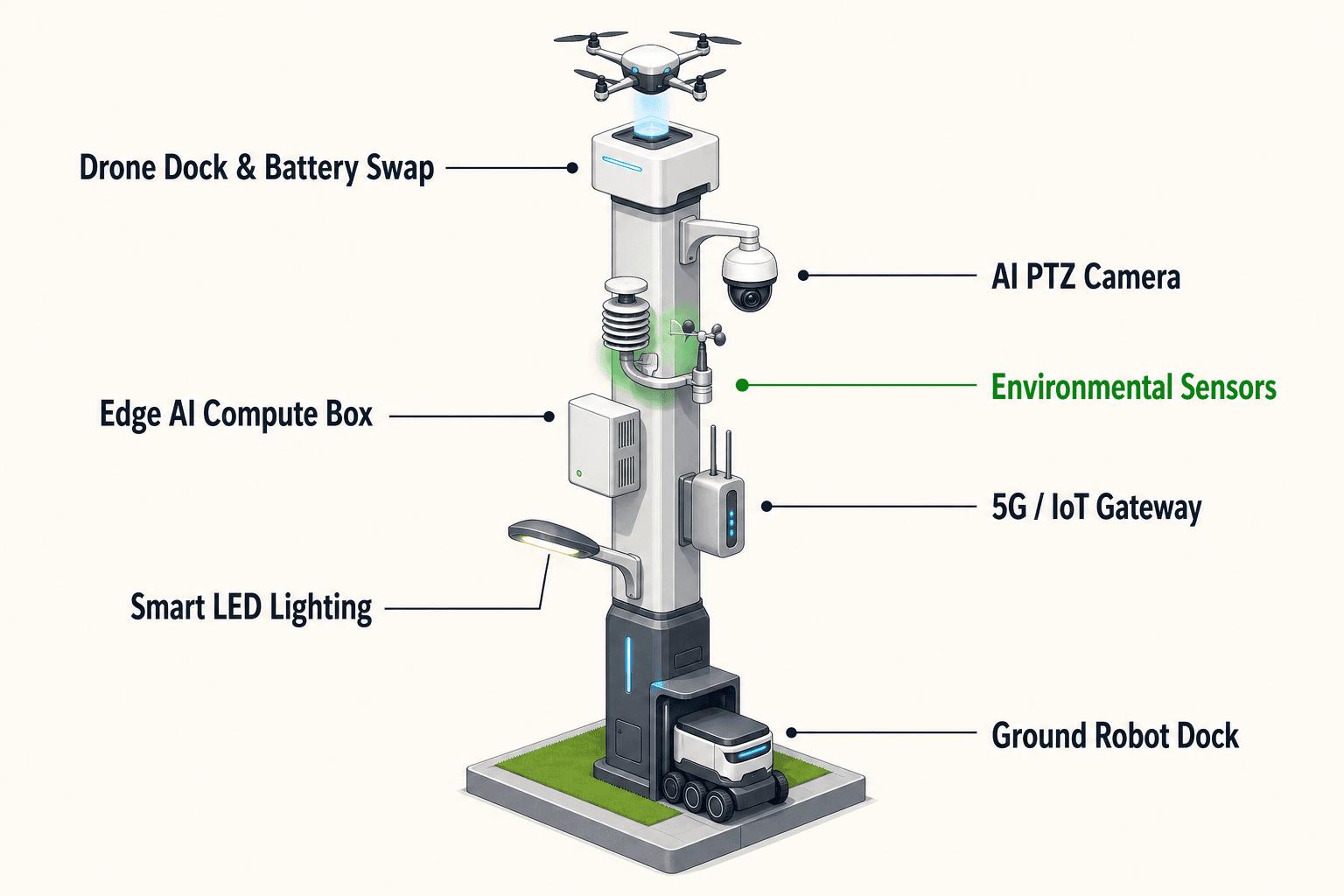
The proposed deployment mode is a corridor of off-grid Sky Hub nodes placed at decision points rather than evenly spaced like utility poles. Candidate positions include gate approaches, fence-line bends, service-road intersections, staging-zone edges and areas where a ground robot can reliably return to the pole base for wireless charging. Final siting would remain subject to detailed engineering confirmation, including solar exposure, wind loading, radio planning, robot travel paths, maintenance access, aviation permissions and local emergency-management operating rules.
Each node is configured as a battery-backed micro-station with approximately 15 square meters of 360-degree wrapped flexible CIGS thin-film solar on a vertical cylindrical body roughly 8 meters tall and 0.6 meters wide. The wrap is not treated as unlimited pure-solar self-sufficiency. A vertical cylinder collects direct sun on its sun-facing projection, not the entire wrap at once. In a high-irradiance region the realistic clear-sky output envelope is roughly 0.8 to 1.1 kW DC peak, often peaking mid-morning or mid-afternoon rather than exactly at noon, with about 6 to 9 kWh per day. Athens planning should use site-specific irradiation and shading checks, then schedule high-power drone and robot tasks against a 5 to 20 kWh-class storage buffer.
For availability, the useful question is how many patrol windows remain covered when people are busy, weather changes or a sports-event surge changes site demand. The pole therefore schedules workloads locally: camera perception, environmental sampling, robot charging, drone readiness, battery swap state, mission queueing and system health. The common operating picture shows operators whether the corridor is being watched, what the local confidence level is and which asset is ready to move next.
3. Ground-Robot-Led Border-Watch Operations
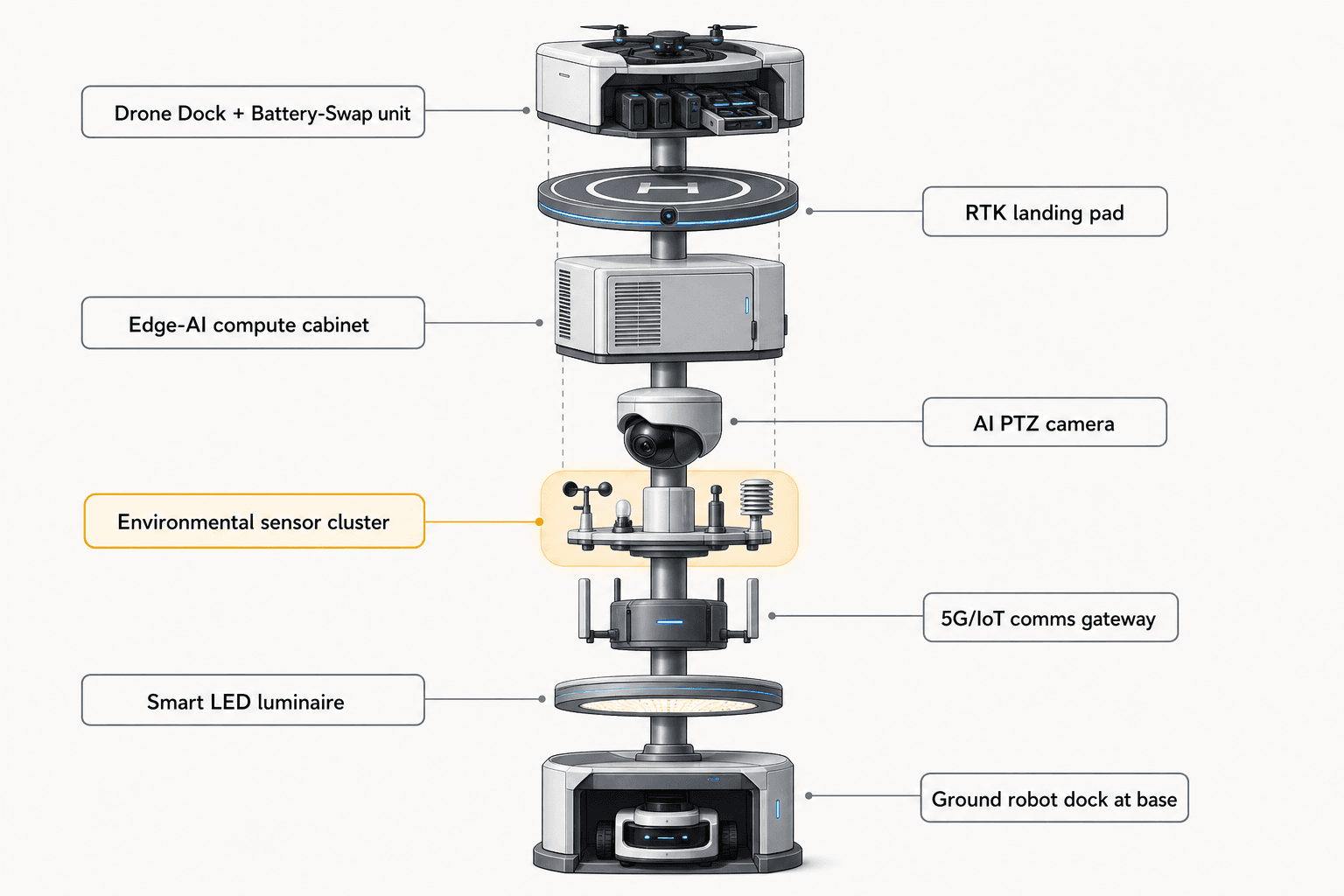
The module focus for this Athens pilot is ground-robot operations. The robot is not positioned as a novelty device; it is the repeatable field extension of the pole. From the pole base, a humanoid or service robot can conduct autonomous patrol, alarm response, close inspection, air-ground coordination and return-to-base wireless charging. The operational value is strongest where manual patrol is slow because staff must walk or drive a long corridor only to confirm routine conditions.
In the proposed border-watch workflow, the Sky Hub node first detects a change: a gate-side intrusion pattern, unusual crowd density near a restricted boundary, a stationary object at an access point, noise levels outside a planning threshold, or worsening dust and wind conditions that make a drone sortie less appropriate. The edge module processes video and sensor data on the pole. Raw video and raw sensor streams stay on the pole; only de-identified event and status metadata may leave the node for the command view.
When human authorization is required, the emergency-management operator sees a concise common-operating-picture event: location, time, confidence, environmental state, available robot battery, available drone battery magazine state and recommended response option. If the ground route is suitable, the robot is dispatched to inspect and relay local observations back to the pole. If the field condition requires wider area confirmation, the node can queue a drone sortie, manage launch and return, and perform automated rear-service battery exchange through a multi-bay battery magazine after landing. The ground robot remains central because it can handle slow, close, corridor-level confirmation while keeping people focused on decisions and interventions.
4. Edge AI, Data Handling And C-UAS Coordination
The Athens pilot configuration uses Jetson-class edge compute in an on-pole inference cabinet to keep processing close to the field condition. This is important for emergency-management governance as much as speed. The pole can classify corridor events, estimate anonymous vehicle counts, measure crowd density, monitor intrusion and perimeter awareness, and correlate those signals with environmental readings without sending raw video away from the site. The design is PDPL/LGPD-oriented because it is built around local processing, minimization and de-identified metadata movement; it should not be described as certified or already compliant without a separate formal assessment.
The same local-first architecture supports the operations loop described as sensing, authorized assessment and response, edge-compute scheduling, then field operations and maintenance. The COP command view is not a passive dashboard. It is the control surface for human-in-the-loop authorization, mission queueing, charge and swap state, fleet health and mission logs. That matters during sports-event season, when operators may need to decide quickly whether to send a ground robot, hold a drone due to wind, escalate to staff, or simply log a de-identified condition for trend review.
Counter-UAS coordination is handled within strict non-lethal limits. The pole can detect and track an unauthorized drone using its onboard sensing and optional partner-sensor inputs where available; radar is not built into the pole. When authorized by a human operator, the node can command its own friendly drone to perform soft aerial net-capture or close-approach deterrence. The system is not a shoot-down system, not a jammer and not an autonomous attack platform.
5. Evaluation Plan For Emergency Management Buyers
The proposed pilot should be evaluated as an availability improvement program, not as a claim of achieved results. A buyer can define target windows before procurement: corridor-watch hours per week, percentage of patrol events assessed locally, number of manual verification trips avoided, robot-ready hours, drone-ready state, energy reserve thresholds and COP audit completeness. These are planning metrics that can be recomputed after site survey, duty-cycle modeling and operational policy review.
A practical Athens evaluation would begin with a limited corridor segment rather than a citywide claim. The buyer would select representative gates and boundary segments, set the event taxonomy, configure anonymous counting and environmental thresholds, and define what requires human authorization. Availability should then be measured against the old manual-patrol pattern: how often the corridor had no current observation, how long it took to assess a low-risk anomaly, how often patrol teams were diverted from higher-value tasks, and how reliably mission logs captured decisions.
The expected value is operational discipline. Sky Hub gives emergency-management teams an off-grid edge node that can sense, compute, dispatch a ground robot, coordinate a drone, manage battery state and maintain a local evidence trail without becoming a streetlight project or a raw-video cloud-upload project. For Athens industrial corridors facing sports-event season pressure, the strongest use case is persistent, locally processed border-watch with human-authorized field response and measurable availability targets.
System Configuration
| Parameter | Configuration |
|---|---|
| Pole form | SOLARTODO Sentinel Sky Hub pure non-lighting smart pole, fully off-grid cylindrical physical-AI edge node |
| Energy system | ~15 m2 360-degree wrapped flexible CIGS thin-film solar, 5-20 kWh-class battery storage, duty-cycle scheduling |
| Edge AI compute | Jetson-class on-pole inference cabinet for local perception, workload scheduling and mission-state control |
| Security sensing | AI PTZ camera for anonymous vehicle count, crowd density, intrusion and perimeter awareness |
| Environmental monitoring | Wind speed, wind direction, temperature, humidity, atmospheric pressure, noise, PM10, PM2.5 and illuminance |
| Ground robot operations | Autonomous corridor patrol, alarm response, close inspection, air-ground coordination and wireless return-to-base charging |
| Drone operations | Autonomous launch, patrol, inspection, return, task redeployment and automated multi-bay battery hot-swap |
How It Works
- On-pole sensing flags a corridor anomaly or environmental threshold breach.
- Edge AI classifies the event locally and keeps raw video and sensor data on the pole.
- The COP presents de-identified status metadata, asset readiness and recommended response options.
- A human operator authorizes robot inspection, drone tasking, escalation or watch-only logging.
- The node schedules energy, charge or battery-swap state, then records the mission and decision trail.
Planning Assumptions (Indicative)
Illustrative planning inputs a buyer can recompute — target metrics, not achieved results. Subject to final engineering confirmation.
| Metric | Planning assumption | Indicative value |
|---|---|---|
| Inspection labor | Ground robot handles routine corridor confirmation rounds that previously required manual patrol dispatch | ~10-20 routine patrol checks per week automated as a target input |
| Availability window | Off-grid node and stored energy keep border-watch active through planned patrol windows subject to duty-cycle limits | ~80-95% target monitored-window availability for evaluation |
| Manual response focus | Operators dispatch people mainly for confirmed, authorized exceptions rather than every low-information perimeter check | ~30-50% fewer low-priority manual verifications as a planning target |
| Energy reserve | Drone and robot tasks are scheduled around battery state and clear-sky replenishment assumptions | Maintain configurable reserve threshold, commonly ~30-40% |
| Evidence completeness | COP records de-identified event metadata, human authorization and asset mission logs for review | ~90%+ target log completeness for evaluated events |
Deployed Equipment
- SOLARTODO Sentinel Sky Hub non-lighting pole body
- Flexible CIGS thin-film solar wrap
- Battery-backed off-grid micro-station
- AI PTZ camera and local perception stack
- Nine-parameter environmental sensor suite
- Ground robot wireless charging base interface
- Drone landing and automated multi-bay battery hot-swap module
- COP command-view and mission-log software
Frequently Asked Questions
Is Sky Hub a smart streetlight for Athens roads?
No. Sky Hub is a pure smart pole and physical-AI edge node with no lighting system. The Athens configuration is framed for industrial-park corridor monitoring, emergency-management operations, environmental sensing, drone coordination and ground-robot patrol. It should not be specified, procured or evaluated as a street-lighting or luminaire project.
Does the fully off-grid design mean unlimited solar autonomy?
No. The pole is designed as a fully off-grid battery-backed micro-station, but the CIGS wrap is a supplemental replenishment layer, not an unlimited power source. Real planning must account for vertical-cylinder solar geometry, shading, weather, storage size and duty cycle for drone, robot, compute and sensing workloads.
What data leaves the pole in the proposed Athens deployment?
The architecture is local-processing first. Raw video and raw sensor data stay on the pole and are processed by the on-pole edge compute module. The COP may receive de-identified event and status metadata, such as alert category, asset readiness, environmental thresholds, mission state and authorization logs, subject to final governance design.
Why is the ground robot the module focus for this corridor case?
The pain point is slow manual patrol along an industrial boundary. A ground robot can perform repeatable close inspection, alarm response and corridor confirmation while returning to the pole base for wireless charging. Drone operations remain available for wider-area assessment, but the robot is the primary tool for reducing low-information manual checks.
How should emergency-management buyers evaluate availability?
Availability should be treated as a target evaluation metric, not an achieved claim. Buyers can define monitored windows, robot-ready hours, drone-ready state, energy reserve thresholds, percentage of events assessed locally and mission-log completeness before the pilot. Those values should then be recomputed after site survey and operational testing.
How is Counter-UAS handled without creating a weapons system?
The allowed workflow is non-lethal and human-authorized. The pole can detect and track an unauthorized drone, including through optional partner-sensor inputs where available, and a human operator may authorize a friendly drone for soft aerial net-capture or close-approach deterrence. The system is not for jamming, shoot-downs or autonomous attacks.
Explore Further
- City AI Pole / smart streetlight product line
- More smart-city deployment cases
- Talk to our engineering team
Planning a similar physical-AI deployment for streets, campuses or public spaces? Request an engineering consultation