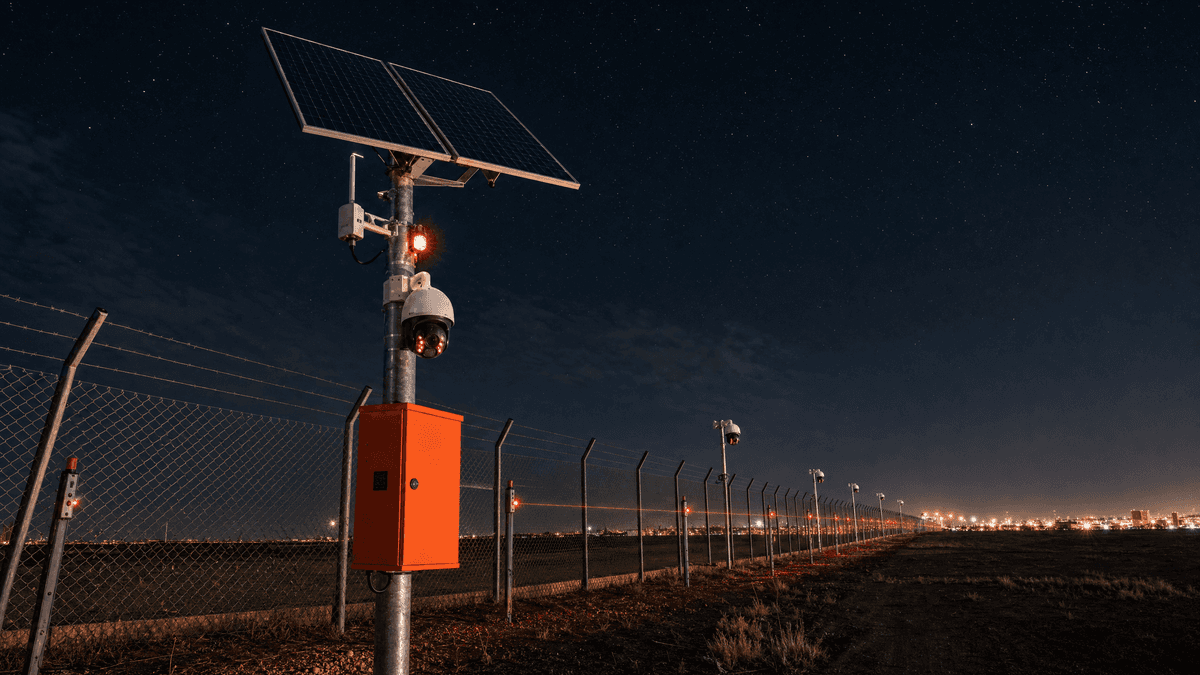
Asunción Smart Security System Market Analysis: 56-Zone Hybrid Configuration Guide for 1,008m Perimeters
Summary
Asunción’s humid subtropical climate, dense mixed-use districts, and grid reliability needs support a large 56-zone Smart Security System profile with 1,008m perimeter coverage, 34 cameras, and hybrid solar+LFP+grid backup delivering 24-hour autonomy.
Key Takeaways
- A typical large-site deployment in Asunción would fit a 56-zone architecture built on 1× 64-zone TCP/IP hybrid alarm panel with 6× LCD touch keypads for multi-building control.
- For a 1,008m perimeter, a recommended layout uses 10× quad IR beams rated at 100m each, leaving overlap for gate zones and corner alignment tolerance.
- Interior and entry-point coverage at this scale would typically include 56× PIR detectors, 112× magnetic door contacts, and 28× glass break sensors with 7m range.
- Fire-life safety support in mixed commercial compounds would commonly add 28× photoelectric smoke detectors tied into the same alarm logic and notification workflow.
- Video verification at this site size would generally require 28× 4MP HD bullet/dome cameras, 6× PTZ 2MP 20× auto-tracking cameras, and 3× 16-channel NVRs with 4TB HDD each.
- Audible response for multi-zone compounds would typically use 11× indoor sirens at 110dB and 6× outdoor siren/strobes at 120dB to separate building and perimeter alerts.
- A hybrid power design of solar + LFP battery + grid with 24-hour autonomy is the practical fit for Asunción, where security uptime matters even during feeder interruptions or storm-related instability.
- The recommended event chain is intrusion → alarm in under 2 seconds → PTZ auto-track → NVR recording → app notification → dispatch, with self-monitored operation aligned to many owner-operated facilities.
Market Context for Asunción
Asunción combines a metropolitan population above 2 million with high humidity, summer heat, and mixed residential-commercial security exposure, making large multi-zone systems more suitable than small standalone alarm kits.
Asunción is Paraguay’s capital and anchor of the Gran Asunción metropolitan area. According to the World Bank (2023), Paraguay remains one of South America’s most urbanizing economies, with national urbanization above 60%, while the Dirección General de Estadística, Encuestas y Censos and successor national statistical publications place the wider metropolitan concentration around Asunción as the country’s dominant urban cluster. In practice, this means a high density of warehouses, schools, offices, gated compounds, and municipal facilities within a relatively compact footprint.
Climate matters for security design. According to the World Bank Climate Change Knowledge Portal (2021), Asunción has a humid subtropical climate with summer temperatures frequently above 30°C and a rainy season that increases exposure to lightning, moisture ingress, and temporary power disturbances. That local condition supports specifying IP67 external cameras, outdoor sirens with weather protection, and a hybrid power path rather than a grid-only alarm backbone.
Power quality is another design variable. Paraguay’s national grid is strong in generation because of Itaipú and Yacyretá, yet distribution continuity at the end-user level still depends on local feeders, transformers, and storm resilience. According to the International Energy Agency (2023), Paraguay has one of the world’s highest shares of low-emissions electricity generation, but that does not eliminate local outage risk for compounds that need 24/7 surveillance. For security systems in Asunción, the technical question is less about energy cost and more about continuity of detection, recording, and alerting during short disruptions.
Telecom and digital monitoring also support larger integrated systems. According to the ITU (2023), mobile broadband penetration across Latin America continues to support app-based notifications and remote monitoring workflows, which is relevant for self-monitored compounds using TCP/IP alarm panels and mobile alerts. A site with 56 zones and 34 cameras can therefore use local recording plus smartphone escalation without requiring a full third-party control room from day one.
From a market-fit perspective, Asunción favors systems that protect mixed assets in one architecture: perimeter fencing, multiple doors, glazing, internal rooms, and vehicle access points. That profile aligns with a large Smart Security System rather than a medium package. SOLAR TODO’s modular approach fits this pattern because the city often presents campuses and compounds that need 24 to 64 zones, not just a single-building intrusion panel.
The standards side is also important for B2B buyers. EN 50131 and UL 1023 are relevant references for intrusion and alarm equipment performance. In parallel, video subsystem selection should consider compression, retention, and enclosure ratings suitable for hot, wet outdoor conditions. SOLAR TODO should therefore position the Asunción recommendation as a standards-aligned, hybrid-powered, large-compound system rather than a residential alarm bundle.
Recommended Technical Configuration
For Asunción’s mixed-use compounds, a large 56-zone Smart Security System with 1,008m perimeter coverage is the most credible fit, balancing perimeter detection, building intrusion layers, video verification, and 24-hour hybrid backup.
A typical deployment of this scale in Asunción would consist of approximately 1× 64-zone hybrid alarm panel (TCP/IP) and 6× LCD touch keypads. This size class is justified because the target profile is not a villa or a small office. A 56-zone layout suggests multiple structures, repeated entry points, and a perimeter long enough to require segmented beam coverage and camera handoff.
For intrusion detection, the recommended count is approximately 56× PIR detectors, 112× magnetic door contacts, 28× glass break sensors, and 28× photoelectric smoke detectors. This ratio is logical for compounds with many doors and partitions. Two magnetic contacts per PIR-protected room or access area is common when both primary and secondary entries need independent supervision.
For perimeter protection, approximately 10× quad IR beams with 100m range suit a 1,008m line better than electric fence in this scenario. The beam count allows for segmentation, overlap, and gate treatment without overbuilding the perimeter. This matters because the brief calls for a large system, not an enterprise campus with 2,000m fencing and dispatch-grade electric fence sectors.
For video verification, the recommended layer is approximately 28× 4MP HD bullet/dome cameras and 6× PTZ 2MP 20× zoom auto-tracking cameras, backed by 3× 16-channel NVRs with 4TB HDD each. That gives 48 total recording channels, leaving headroom above the 34 installed cameras for future additions, maintenance swaps, or blind-spot corrections. In procurement terms, this reserve capacity reduces the chance of replacing recorders when the site expands.
Alarm output should include approximately 11× indoor sirens rated at 110dB and 6× outdoor siren/strobes rated at 120dB. This quantity is consistent with a multi-building site where local annunciation is needed inside structures while perimeter and yard zones need stronger external warning. The audible layer should also be mapped by zone to avoid triggering every building on every minor event.
Power should use the Hybrid Basic path: solar + LFP battery + grid with 24-hour autonomy. In Asunción, this is the practical recommendation because it supports continuity during feeder interruptions while avoiding the larger battery bank and array footprint of a 72-hour or 120-hour design. For many schools, depots, logistics yards, and office compounds, 24 hours is the right balance between resilience and footprint.
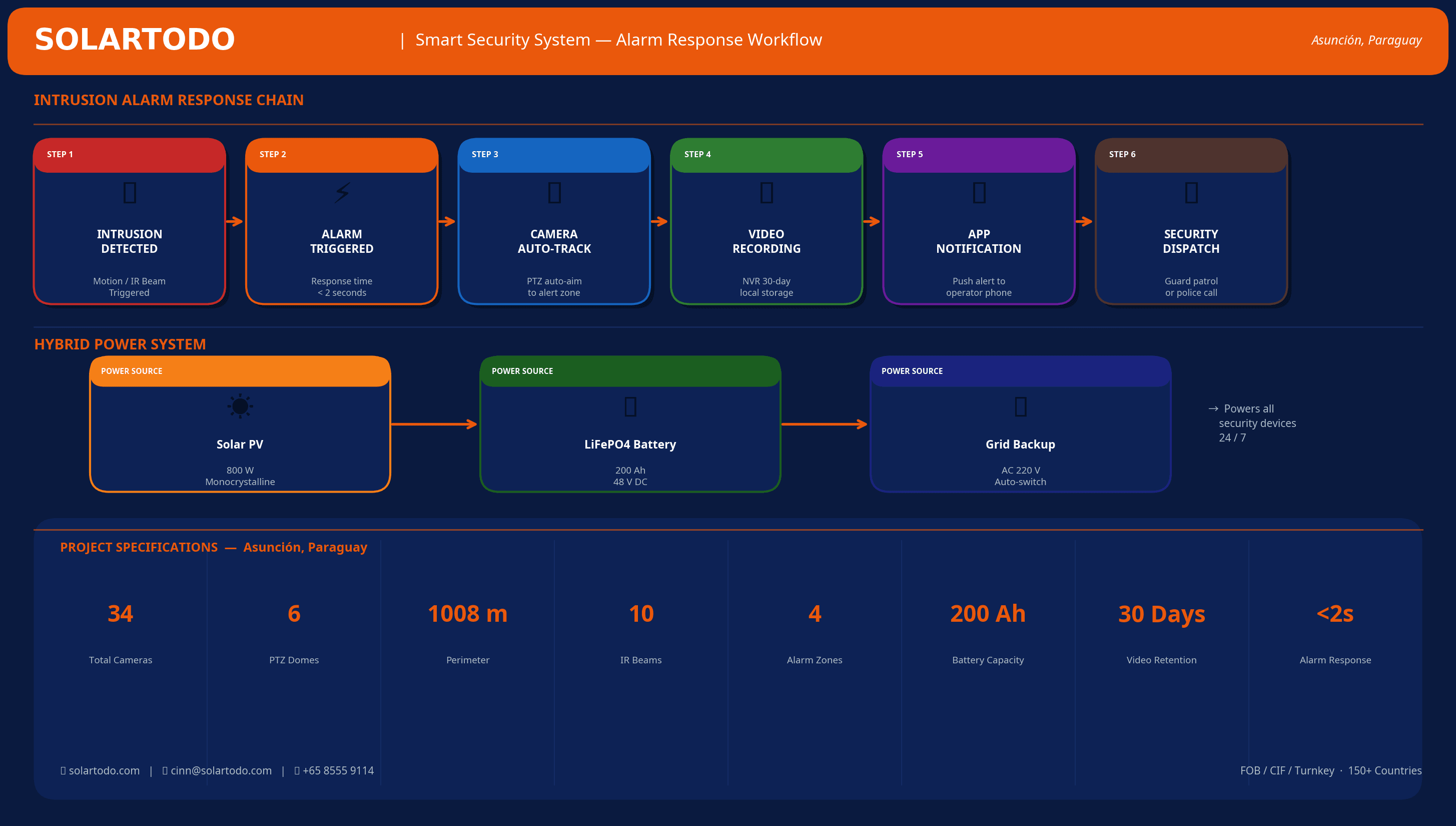
Monitoring for this profile is best framed as self-monitored with mobile app notification and optional escalation. The intended event chain is fixed: intrusion → alarm in under 2 seconds → PTZ auto-track → NVR recording → app notification → dispatch. SOLAR TODO can present this as a scalable baseline that later supports a higher monitoring tier if the site owner wants contracted response.
Technical Specifications
The recommended Asunción configuration is a large-class Smart Security System: 56 zones, 1,008m perimeter, 34 cameras, EN 50131 / UL 1023 alignment, and hybrid solar+LFP+grid backup with 24-hour autonomy.
- System class: Large deployment profile for 24-64 zones
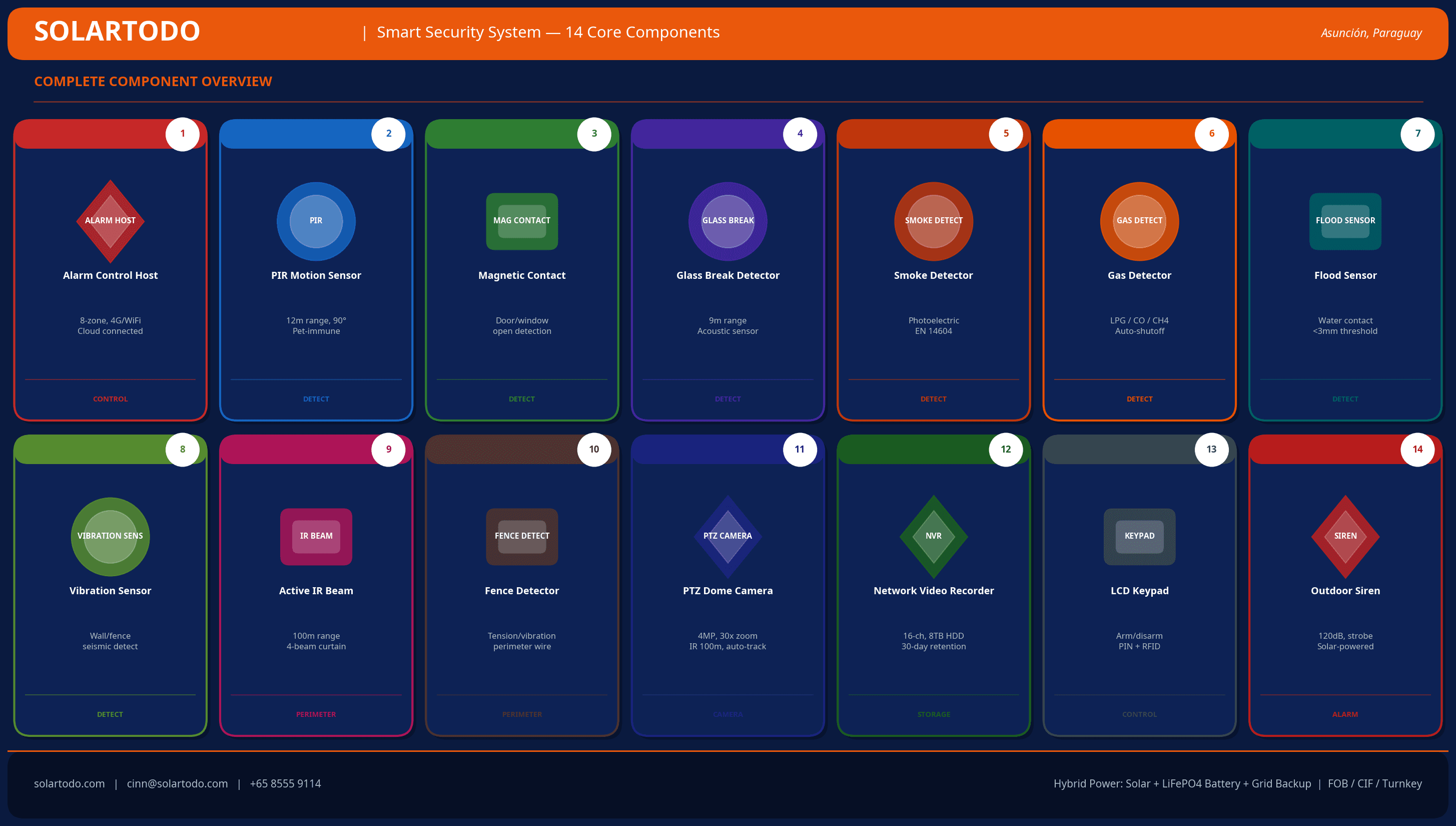
- Alarm core: 1× 64-zone hybrid alarm panel, TCP/IP communication
- User interface: 6× LCD touch keypads
- Motion detection: 56× PIR detectors, dual-element, pet immune up to 25kg, typical coverage 12-15m
- Door/window detection: 112× magnetic door contacts
- Glass protection: 28× glass break sensors, rated up to 7m
- Fire support: 28× photoelectric smoke detectors
- Perimeter detection: 10× quad IR beams, 100m nominal range each
- Fixed video: 28× 4MP HD bullet/dome cameras, IR, H.265+, IP67
- PTZ video: 6× PTZ cameras, 2MP, 20× zoom, auto-tracking
- Recording: 3× 16-channel NVRs, H.265+, 4TB HDD each
- Indoor alerting: 11× indoor sirens, 110dB
- Outdoor alerting: 6× outdoor siren/strobes, 120dB
- Power architecture: Solar + LFP battery + grid, 24-hour autonomy
- Monitoring mode: Self-monitored
- Smart linkage: intrusion → <2s alarm → PTZ auto-track → NVR recording → app notification → dispatch
- Applicable standards: EN 50131, UL 1023
According to UL (2020), intrusion alarm units covered by UL 1023 are evaluated for functional safety and signaling performance under defined test conditions. ENA and European security guidance tied to EN 50131 similarly support graded intrusion system design, detector integrity, and alarm transmission logic. For Asunción, those references matter because B2B buyers often need a standards path for insurance, tender review, or internal compliance.
Implementation Approach
A typical Asunción rollout for a 56-zone, 1,008m-perimeter system would proceed in 4 phases over roughly 8 to 14 weeks, depending on civil readiness, import lead time, and network integration scope.
Phase 1 is site survey and zone mapping. This usually takes 5 to 10 working days for a multi-building compound. The design team would map 56 zones, identify the 1,008m perimeter line, check gate geometry, verify camera sightlines, and confirm where the 6 keypads should sit to match guard, admin, and service circulation.
Phase 2 is procurement and logistics. For imported systems in Paraguay, lead time often depends on consolidation, customs, and inland transport. A practical planning window is 3 to 6 weeks for core equipment, enclosures, and power components. SOLAR TODO should advise buyers to freeze detector counts early, because changing from 28 to 40 fixed cameras or moving from 24-hour to 72-hour autonomy affects recorder, battery, and mounting schedules.
Phase 3 is installation. Cable trays, conduit runs, detector mounting, camera brackets, siren placement, and perimeter beam alignment usually take 2 to 4 weeks at this scale. The 10 quad IR beams need careful line-of-sight treatment and stable posts. The 28 fixed cameras and 6 PTZ units also require coordinated field-of-view testing so that PTZ presets correspond to beam sectors and gate zones.
Phase 4 is commissioning and training. This commonly takes 3 to 7 days. The installer would test alarm latency below 2 seconds, validate NVR retention settings, confirm app notifications, and train the owner’s team on arming groups, event review, and battery health checks. A self-monitored site should also run at least 1 full alarm drill per shift group before handover.
According to NIST (2024), physical security systems should be commissioned as integrated systems rather than isolated devices, with verification of sensors, communications, and response workflows. That principle is directly relevant here because the value of 34 cameras and 56 zones depends on event linkage, not just device count.
Expected Performance & ROI
For Asunción compounds, a 56-zone hybrid Smart Security System would typically improve detection coverage, reduce guard dependence on patrol-only routines, and maintain core security functions for 24 hours during power interruptions.
Expected performance should be framed conservatively. The 10 perimeter IR beams cover approximately 1,000m of boundary with overlap, while the 34-camera architecture supports both broad situational awareness and zoom-based verification. The <2 second alarm-to-action sequence is important because it shortens the time between perimeter breach and visual confirmation. In operational terms, that helps reduce nuisance dispatches and speeds decision-making for owner-managed sites.
The ROI case is usually driven by avoided losses, lower manual patrol intensity, and better incident documentation rather than direct energy savings. According to ASIS International guidance on layered physical security, combining perimeter detection, intrusion sensors, and video verification typically reduces false assessment time compared with single-layer systems. For a site with 112 monitored access points and 28 glass zones, the reduction in undetected entry risk is often more valuable than the hardware itself.
Lifecycle planning also matters. Lithium iron phosphate storage is widely used because of cycle life and thermal stability. According to IRENA (2023), LFP chemistry remains a leading stationary storage choice due to safety profile and cost competitiveness in commercial applications. In a 24-hour autonomy design, that supports lower maintenance intensity than legacy lead-acid backup arrangements and reduces the chance of backup failure during summer heat.
Payback periods vary by sector, so a single number would be misleading. For logistics depots, education campuses, and municipal compounds in Asunción, buyers usually evaluate return through three metrics over 3 to 7 years: avoided theft or vandalism incidents, reduced after-hours guard overtime, and stronger evidence capture for insurance or legal claims. SOLAR TODO should present ROI as a risk-reduction calculation tied to incident frequency and asset value, not as a generic payback promise.
Results and Impact
For Asunción, the practical impact of this 56-zone configuration is broader site visibility, faster verification within 2 seconds, and continued operation across 24 hours of backup power during local feeder interruptions.
The main operational result is layered coverage. A site of this size moves from isolated alarms to a linked workflow joining 56 intrusion zones, 10 perimeter beam segments, and 34 video channels. That gives security managers a better basis for deciding whether an event is a perimeter crossing, forced entry, glass attack, smoke event, or internal movement after hours.
A second impact is staffing efficiency. The system does not replace guards in every use case, but it can reduce dependence on patrol-only routines across a 1,008m perimeter. When keypads, app alerts, PTZ presets, and NVR playback are configured correctly, one supervisor can review more area in less time and with better evidence quality.
A third impact is resilience. Asunción’s heat, rain, and occasional power instability make solar + LFP + grid more suitable than a grid-only alarm stack. For owner-operated compounds, that means the security posture remains active even when utility quality drops for several hours. SOLAR TODO can therefore position this configuration as a practical city-fit recommendation rather than an oversized enterprise system.
Comparison Table
This comparison shows why a large 56-zone hybrid configuration is the best fit for Asunción compounds with about 1,008m of perimeter and multiple buildings.
| Metric | Medium System | Recommended Large System | Enterprise System |
|---|---|---|---|
| Typical zone range | 8-24 | 24-64 | 64-128 |
| Recommended fit in Asunción | Small office / villa cluster | Warehouse, school, office campus | Port, utility, major industrial site |
| Alarm panel | 64-zone hybrid | 64-zone hybrid | Expanded enterprise architecture |
| PIR detectors | ~10 | 56 | 64-128+ |
| Magnetic contacts | ~5 | 112 | 128+ |
| Glass break sensors | Optional few | 28 | 40+ |
| Smoke detectors | Limited | 28 | 40+ |
| Perimeter protection | IR beams, short runs | 10× quad IR beams, 1,008m | IR beams + electric fence sectors |
| Fixed cameras | ~6-12 | 28× 4MP | 40+ |
| PTZ cameras | ~1-3 | 6× 2MP 20× | 8-16 |
| Recording | 1× NVR | 3× 16ch NVR, 4TB each | Multi-NVR + monitoring server |
| Backup power | 24h hybrid | 24h hybrid | 72h hybrid or 120h off-grid |
| Monitoring | Self / basic | Self-monitored | Premium with dispatch |
| Suitability for 1,008m perimeter | Low | High | High but often oversized |
Pricing & Quotation
SOLAR TODO offers three pricing tiers for this product line: FOB Supply (equipment ex-works China), CIF Delivered (including ocean freight and insurance), and EPC Turnkey (fully installed, commissioned, with 1-year warranty). Volume discounts are available for large-scale deployments. Configure your system online for an instant estimate, or request a custom quotation from our engineering team at [email protected].
Frequently Asked Questions
A 56-zone hybrid Smart Security System for Asunción usually raises questions about perimeter fit, backup time, NVR sizing, standards, installation sequence, and long-term maintenance.
Q1: Why is a 56-zone system appropriate for Asunción rather than a smaller package? A 56-zone layout fits compounds with multiple buildings, repeated entry points, and a perimeter near 1,008m. In Asunción, many schools, depots, and office campuses need more than 24 zones once doors, glass areas, perimeter beams, and smoke detection are counted. A smaller package often runs out of expansion capacity too early.
Q2: How does the 1,008m perimeter get covered with only 10 IR beams? Each quad IR beam is rated at 100m, so 10 units provide about 1,000m nominal coverage. In practice, installers use overlap at corners, gates, and high-risk segments, so exact alignment matters. The 1,008m profile is credible when beam sectors are planned carefully and supported by nearby cameras for verification.
Q3: What is the role of the 6 PTZ cameras if 28 fixed cameras are already installed? The 28 fixed 4MP cameras provide constant scene coverage and evidence capture. The 6 PTZ cameras handle zoom-based verification, preset patrols, and auto-tracking after an alarm event. This combination helps security staff confirm whether a beam trigger or PIR alert is a real intrusion without relying on one camera type alone.
Q4: Is 24-hour autonomy enough for Asunción conditions? For many urban and peri-urban compounds, 24-hour autonomy is the practical baseline. It covers short utility interruptions and storm-related instability without the larger battery footprint of 72-hour or 120-hour systems. If the site is remote, lightly staffed, or exposed to longer outages, a higher-autonomy design can be quoted separately.
Q5: How long would installation typically take? A project of this scale usually needs about 8 to 14 weeks end to end, including survey, procurement, installation, and commissioning. On-site installation alone is often 2 to 4 weeks, depending on conduit routes, civil readiness, and network setup. Perimeter beam alignment and PTZ preset programming are usually the most schedule-sensitive tasks.
Q6: What maintenance does this Smart Security System require? Routine maintenance usually includes monthly alarm tests, quarterly camera cleaning, beam alignment checks after storms, and battery health review at least twice per year. NVR storage settings and firmware should also be checked on a planned schedule. In Asunción’s humid climate, enclosure seals and outdoor connectors deserve extra attention.
Q7: How does this compare with a guard-only security model? A guard-only model depends heavily on patrol frequency and human observation across 1,008m of perimeter. This system adds continuous detection, event logs, and video evidence across 56 zones and 34 cameras. It does not eliminate guards in every case, but it usually improves verification speed and reduces blind intervals between patrol rounds.
Q8: What standards are relevant for procurement review? The core references listed here are EN 50131 and UL 1023 for intrusion and alarm performance. Buyers may also request camera, cabling, and power subsystem documentation depending on internal policy or insurer requirements. For public or institutional tenders, documenting detector ratings, IP67 enclosures, and event latency below 2 seconds is often useful.
Q9: Does SOLAR TODO provide supply-only and turnkey quotation options? Yes. SOLAR TODO can structure quotations around equipment-only, delivered supply, or full EPC scope depending on the buyer’s procurement model. That is useful in Paraguay because some customers prefer local installers while others want a single package covering supply, commissioning, and warranty. The exact scope should match customs, civil works, and integration responsibilities.
Q10: What warranty structure is typical for this product line? Warranty terms depend on the quotation model and final contract scope. The standard pricing section states that EPC Turnkey includes a 1-year warranty. Buyers should also ask for separate clarity on battery coverage, recorder HDD terms, and whether outdoor alignment visits are included during the initial operating period.
Q11: Can this system be expanded later beyond 56 zones? Yes, within the limits of the 64-zone panel and recorder channel headroom. Since 3 NVRs provide 48 channels and only 34 cameras are used initially, there is spare recording capacity for additional cameras. Expansion planning should still reserve panel zones, power margins, and conduit space during the first installation.
Q12: Where can buyers request a technical review for an Asunción site? Buyers can review the product details at SOLAR TODO Smart Security System and submit site data through the contact page. A useful inquiry should include perimeter length, building count, gate locations, preferred backup time, and whether the site will be self-monitored or linked to external response.
References
- World Bank (2023): Paraguay urban development and national infrastructure indicators relevant to metropolitan concentration in Asunción.
- World Bank Climate Change Knowledge Portal (2021): Climate profile for Paraguay/Asunción region, including temperature and rainfall patterns affecting outdoor equipment selection.
- International Energy Agency (IEA) (2023): Paraguay electricity profile and generation mix, relevant to grid context and backup design assumptions.
- International Telecommunication Union (ITU) (2023): Regional mobile broadband and digital connectivity indicators supporting app-based monitoring and TCP/IP alarm communications.
- UL (2020): UL 1023 standard for household burglar alarm system units and related signaling performance references used in alarm procurement review.
- CENELEC / EN (2019): EN 50131 series for intrusion and hold-up alarm systems, including system design and component performance framework.
- International Renewable Energy Agency (IRENA) (2023): Battery storage outlook and LFP chemistry relevance for stationary backup systems.
- NIST (2024): Physical security system integration and commissioning guidance relevant to testing sensors, communications, and response workflows.
- ASIS International (2022): Layered physical security and risk-based protection principles for commercial and institutional compounds.
Equipment Deployed
- 1× 64-zone hybrid alarm panel with TCP/IP communication
- 6× LCD touch keypad
- 56× PIR detector, dual-element, pet immune up to 25kg, 12-15m coverage
- 112× magnetic door contact
- 28× glass break sensor, 7m range
- 28× photoelectric smoke detector
- 10× quad IR beam, 100m range
- 28× 4MP HD bullet/dome camera with IR, H.265+, IP67
- 6× PTZ camera, 2MP, 20× zoom, auto-tracking
- 3× 16-channel NVR with H.265+ and 4TB HDD
- 11× indoor siren rated at 110dB
- 6× outdoor siren/strobe rated at 120dB
- Hybrid power system: solar + LFP battery + grid, 24-hour autonomy