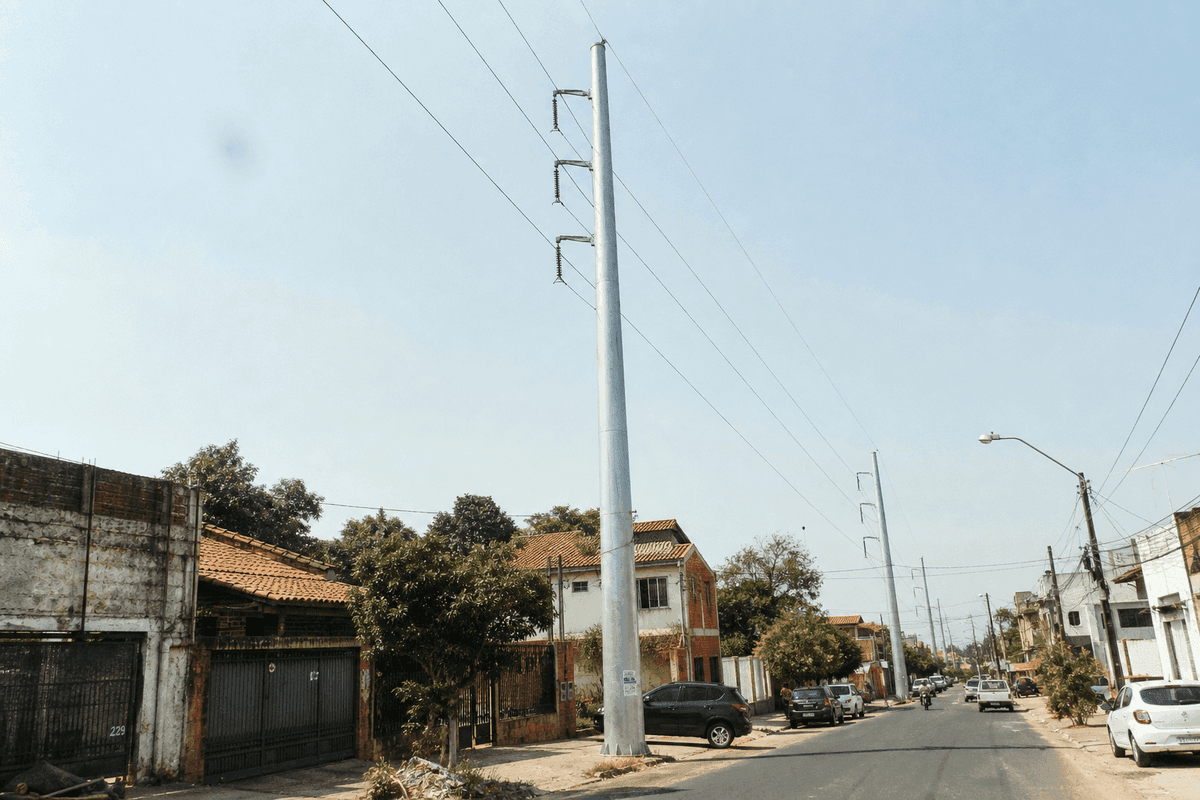
Asunción Power Transmission Tower Market Analysis: 35kV Municipal Distribution Configuration Guide
Summary
Asunción’s 35kV municipal distribution corridors serve a 477,346-person capital within a 2.3M metro area; a typical 5km upgrade would use about 90 steel tubular poles with 60m spans.
Key Takeaways
A 35kV Power Transmission Tower program in Asunción should prioritize 12-18m standard distribution geometry, with any 25m pole treated as a clearance-driven exception.
- Asunción has about 477,346 residents in the capital district and more than 2.3 million people in Greater Asunción, concentrating urban load growth.
- The recommended voltage class is 10-35kV municipal distribution, normally 12-18m pole height, 1-3t per pole, and 80-150m standard spans.
- The supplied technical package is approximately 90 units, 25m tapered Q345 steel poles, 35kV double circuit, and about 5km total line length.
- The specified conductor is ACSR-70 at 275kg/km with maximum tension of 22kN, suitable for compact medium-voltage urban feeders.
- The provided span is 60m, shorter than the 80-150m standard class, which fits constrained city rights-of-way and turning alignments.
- Wind Class 1 at 25m/s, 0.8m insulator strings, 1.5m phase spacing, and 5.5m ground clearance require route-specific clearance verification.
- SOLARTODO should position this Power Transmission Tower as a hot-dip galvanized Q345 municipal distribution monopole, not lattice, FRP, wood, or concrete.
Market Context for Asunción
Asunción’s distribution market is shaped by a dense capital district of about 117km², high metropolitan commuting flows, and hydropower-backed national supply.
According to Paraguay’s 2022 census results reported by the Instituto Nacional de Estadística, Asunción ranks among the country’s largest jurisdictions with roughly 477,346 residents, while Greater Asunción exceeds 2.3 million people. That density makes medium-voltage corridor reliability more important than long-span rural transmission economics. In a compact urban market, pole selection is driven by right-of-way width, clearance above roads, transformer service points, and fast construction in live utility corridors.
According to the World Bank (2022), Paraguay’s electricity access rate is above 99%, so Asunción’s issue is not first-time electrification; it is urban reinforcement, loss reduction, and resilient distribution capacity. According to IEA (2023), Paraguay’s electricity system is dominated by hydropower, which supports low-carbon supply but still depends on robust transmission and distribution assets to move power into load centers. ANDE is the central national utility operator, so specifications generally need to align with utility design review, local permitting, and public-road construction sequencing.
According to IRENA (2024), Paraguay had about 8.85GW of renewable generation capacity in 2023, almost entirely hydropower. That upstream capacity does not remove the need for medium-voltage grid reinforcement in Asunción neighborhoods where feeders serve residential towers, commercial loads, government buildings, riverfront redevelopment, and transport corridors. SOLARTODO’s role in this market is technical configuration support for steel tubular poles that can be adapted to municipal distribution corridors without presenting a fabricated deployment history.
Recommended Technical Configuration
A typical Asunción configuration for this profile would use about 90 galvanized steel tubular poles over 5km, subject to utility clearance approval.
For voltage-first engineering, a 35kV distribution line normally belongs to the 10-35kV class: 12-18m height, 1-3t per pole, single or double circuit, 80-150m span, and about 8-12 poles/km. The supplied project-specific package is heavier and taller: approximately 90 units of 25m tapered steel tubular poles, about 10t per pole, 35kV double circuit, and 60m spans. SOLARTODO should therefore present the 25m/10t profile as a non-standard, clearance-driven municipal distribution configuration rather than a generic 35kV baseline.
A recommended engineering note is: use the standard 12-18m class where road clearance, building setbacks, and conductor sag permit; reserve the 25m heavy-duty pole only for river-adjacent alignments, road crossings, double-circuit compact routing, or locations where the authority requires additional conductor elevation. This avoids the common engineering error of treating all 35kV lines as high-voltage transmission assets. It also gives procurement teams a clean decision path: standardize where possible, overbuild only where the route survey proves the need.
The supplied SOLARTODO configuration uses hot-dip galvanized Q345 steel, tapered tubular geometry, flanged bolt sections, concrete base foundations, anchor cages, cross arms, grounding kits, climbing steps, bird guards, and vibration dampers. Conductor selection is ACSR-70, with 275kg/km unit mass and 22kN maximum tension. The 60m span and double-circuit layout suit constrained urban distribution more than rural transmission, where longer spans would usually be preferred.
Technical Specifications
The 35kV engineering baseline is 12-18m and 1-3t per pole, while the supplied 25m configuration requires documented clearance justification.
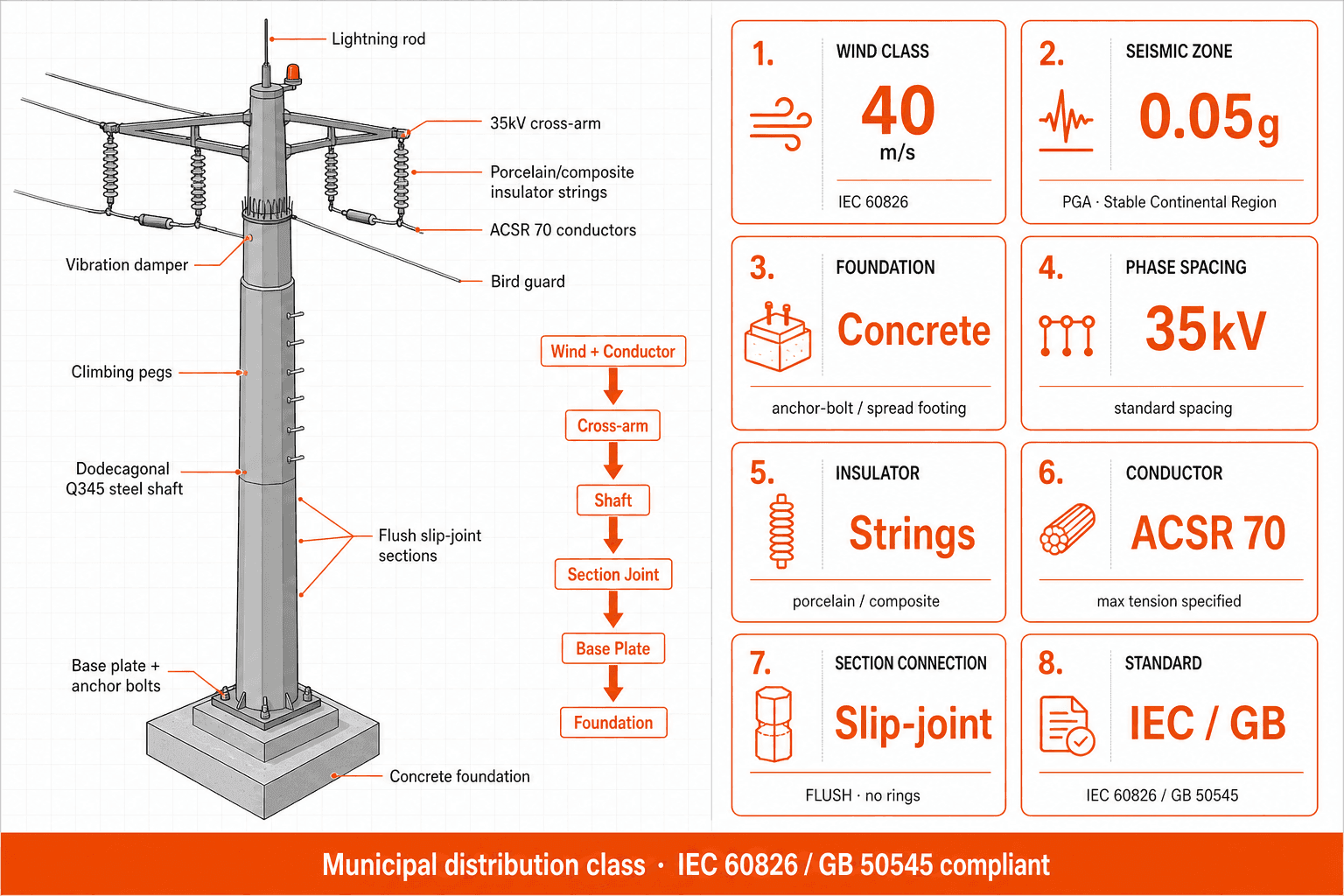
- Product: SOLARTODO Power Transmission Tower, steel tubular monopole form only.
- Voltage class: 35kV medium-voltage municipal distribution, double circuit.
- Standard voltage-derived class: 10-35kV distribution, 12-18m height, 1-3t per pole, 80-150m span, 8-12 poles/km.
- Supplied configuration for review: approximately 90 units, 25m tapered steel tubular poles, about 10t per pole, 400kg/m.
- Material: hot-dip galvanized Q345 steel; Q420 may be considered where structural calculations require higher yield strength.
- Pole geometry: tapered round or dodecagonal steel monopole with flanged bolt sections.
- Circuit hardware: cross-arm brackets for insulator strings and ACSR conductors.
- Conductor: ACSR-70, 275kg/km, maximum tension 22kN.
- Insulation: 0.8m insulator length with 1.5m phase spacing.
- Clearance: 5.5m stated ground clearance, subject to local road and public-safety review.
- Span and route length: 60m typical span, about 5km total line, approximately 90 pole positions.
- Wind class: Class 1, 25m/s basic wind condition, to be checked against IEC 60826 loading methodology.
- Foundation: concrete base foundation with anchor cage; final dimensions depend on soil bearing, uplift, overturning, and drainage.
- Accessories: climbing steps, cross arm, grounding, bird guard, vibration damper, anchor bolts, nameplates, and earthing hardware.
- Design life: 30 years with galvanized corrosion protection and scheduled inspection.
- Standards basis: IEC 60826 for overhead line loading and GB 50545 for overhead transmission line design practice.
IEC states, “International Standards and Conformity Assessment” support electrical and related technologies. IEEE states, “standards fuel the development and implementation of technologies,” which is directly relevant when matching conductor tension, wind loading, grounding, and clearance requirements. For Asunción, the core engineering control is that voltage class comes first; pole height, pole mass, span, and foundation then follow the route-specific loading case.
Implementation Approach
A 5km Asunción municipal distribution package would typically move through survey, design approval, fabrication, foundation works, erection, and commissioning.
The first phase is route confirmation. Survey teams would verify road crossings, building clearances, soil conditions, existing feeders, drainage, and utility conflicts along the proposed 5km alignment. For a 35kV double-circuit line, this stage should confirm whether the 25m heavy-duty pole is required at all locations or only at selected high-clearance positions.
The second phase is engineering approval and procurement. SOLARTODO would prepare pole drawings, material certificates, galvanizing requirements, flange details, anchor cage drawings, packing lists, and accessory schedules for review by the utility or EPC contractor. CKD or sectioned shipping is typically used for steel tubular poles because flanged sections reduce container and handling constraints compared with one-piece long poles.
The third phase is civil construction. Concrete base foundations should be poured after geotechnical checks confirm bearing capacity and groundwater behavior, especially near low-lying river-adjacent areas. Anchor cages must be set accurately because tubular monopoles are less forgiving of bolt-circle misalignment than light distribution poles.
The fourth phase is erection and commissioning. Pole sections are lifted, bolted, grounded, fitted with cross arms and insulator strings, then strung with ACSR-70 conductors under controlled tension. Final commissioning should include torque checks, earthing resistance measurement, phase clearance verification, conductor sag measurement, vibration damper placement, and documentation handover.
Expected Performance & ROI
A 30-year galvanized steel pole design can reduce replacement frequency, simplify right-of-way use, and support lower lifecycle risk than wood or concrete alternatives.
According to IEA (2023), Paraguay’s power system benefits from very low-carbon hydropower, but distribution reliability remains a separate infrastructure requirement. In Asunción, the expected performance value of steel tubular poles is not energy generation; it is feeder reliability, compact routing, lower vegetation conflict, and a cleaner municipal streetscape than lattice structures. A 35kV double-circuit arrangement also improves corridor utilization because two circuits can share one pole line.
Lifecycle economics should be evaluated through avoided rework, fewer pole replacements, reduced outage exposure, and faster installation windows. A typical payback discussion for municipal distribution reinforcement is conditional: if the route replaces aging mixed-material poles or avoids acquiring a second corridor, steel monopoles can justify higher initial capital cost through 30-year structural life and lower right-of-way disruption. No project-specific ROI should be claimed without the utility’s baseline outage, loss, and maintenance data.
According to the World Bank (2022), high electricity access in Paraguay shifts investment logic toward quality-of-service rather than grid extension. For an EPC buyer, the measurable indicators would include SAIDI/SAIFI improvement, pole inspection intervals, corrosion performance, grounding resistance, conductor clearance compliance, and emergency replacement availability. SOLARTODO can support this evaluation with bill-of-material optimization and engineering documents through contact us.
Results and Impact
The expected impact of a properly specified 35kV steel pole corridor is higher feeder resilience across about 5km without claiming any completed deployment.
A typical 90-unit deployment of this scale would provide a compact double-circuit structure for medium-voltage urban distribution. The 60m span is conservative compared with the 80-150m standard class, but it can be appropriate where street geometry, service taps, and clearances drive shorter bay lengths. The 25m height should be justified by route-specific crossings or clearance needs, while standard 12-18m poles remain the normal 35kV reference.
The main market impact is procurement clarity. Instead of treating the Power Transmission Tower as a generic “transmission tower,” the Asunción specification should separate standard distribution needs from heavy-duty municipal exceptions. That distinction helps utilities avoid both under-engineering and unnecessary overbuild.
Comparison Table
The key purchasing decision is whether each Asunción segment needs standard 35kV distribution poles or the heavier 25m clearance-driven profile.
| Parameter | Standard 10-35kV Distribution Class | Supplied Asunción Heavy-Duty Profile | Engineering Note |
|---|---|---|---|
| Voltage | 10-35kV | 35kV | Voltage class is medium-voltage distribution |
| Pole height | 12-18m | 25m | 25m needs clearance justification |
| Pole weight | 1-3t/pole | ~10t/pole | Heavy for 35kV; use selectively |
| Circuit type | Single or double | Double circuit | Good corridor utilization |
| Span | 80-150m | 60m | Short span fits urban constraints |
| Pole density | 8-12 poles/km | ~18 poles/km | Higher density due to 60m spacing |
| Conductor | ACSR family | ACSR-70, 275kg/km | Compact medium-voltage conductor |
| Wind basis | Project-specific | 25m/s Class 1 | Verify with IEC 60826 load cases |
| Foundation | Concrete with anchor cage | Concrete base foundation | Soil report required |
| Design life | Project-specific | 30 years | Depends on galvanizing and inspection |
Pricing & Quotation
SOLARTODO supports 3 quotation scopes for Asunción buyers: FOB supply, CIF delivery, and EPC turnkey, without publishing unit prices here.
SOLARTODO offers three pricing tiers for this product line: FOB Supply (equipment ex-works China), CIF Delivered (including ocean freight and insurance), and EPC Turnkey (fully installed, commissioned, with 1-year warranty). Volume discounts are available for large-scale deployments. Configure your system online for an instant estimate, or request a custom quotation from our engineering team at [email protected].
For quotation accuracy, buyers should provide route length, voltage class, circuit count, conductor type, wind speed, soil report, corrosion environment, grounding requirements, and local utility drawing templates. SOLARTODO can then separate standard 35kV pole positions from special 25m heavy-duty locations, which is usually more cost-effective than applying one oversized pole to every structure.
Frequently Asked Questions
These 10 FAQs address 35kV technical fit, installation, maintenance, EPC scope, payback, and warranty assumptions for Asunción municipal distribution buyers.
Q1: Is a 25m, 10t pole normal for a 35kV line in Asunción? No. The voltage-first engineering table places 35kV distribution at 12-18m and 1-3t per pole under normal conditions. The supplied 25m, about 10t profile should be treated as a heavy-duty municipal exception for crossings, constrained double-circuit corridors, or special clearance cases, not as the default for every 35kV structure.
Q2: What is the recommended SOLARTODO Power Transmission Tower configuration? A typical configuration would use hot-dip galvanized Q345 tapered steel tubular monopoles, double-circuit cross arms, ACSR-70 conductor, 0.8m insulators, 1.5m phase spacing, 5.5m clearance, concrete base foundations, grounding, bird guards, vibration dampers, and climbing steps. For Asunción, approximately 90 units over 5km should be validated by route survey.
Q3: How long would deployment typically take? A 5km municipal distribution package commonly requires several stages: route survey, engineering approval, fabrication, galvanizing, shipping, foundation construction, erection, stringing, and commissioning. The total schedule depends on utility approval speed, rainy-season access, road permits, and customs clearance. No fixed timeline should be claimed before drawings, soil data, and permit requirements are reviewed.
Q4: What ROI or payback can buyers expect? ROI depends on avoided outages, reduced replacement frequency, corridor consolidation, and maintenance savings compared with the existing asset base. A 30-year galvanized steel pole can support lifecycle value, but payback should be calculated from local outage cost, pole failure history, labor cost, and right-of-way constraints. SOLARTODO should not claim a fixed payback without buyer data.
Q5: How does steel tubular pole maintenance compare with wood or concrete? Steel tubular poles require inspection of galvanizing condition, flange bolts, grounding, foundation cracking, corrosion points, and accessory hardware. Compared with wood, they avoid rot and termite exposure; compared with concrete, they are easier to section, transport, and erect in constrained streets. Maintenance intervals should follow utility practice and local environmental exposure.
Q6: Does the EPC price include installation and commissioning? Under EPC Turnkey scope, installation and commissioning are included with the supplied equipment and 1-year warranty. FOB Supply covers equipment ex-works China, while CIF Delivered includes freight and insurance but not field construction. Buyers should confirm civil works, outage coordination, traffic management, testing, and utility acceptance responsibilities in the quotation.
Q7: What warranty is appropriate for this product line? The quotation paragraph specifies a 1-year warranty for EPC Turnkey scope. The structural design life can be 30 years when galvanizing, foundations, loading, and inspection are correctly specified, but design life is not the same as commercial warranty. Warranty terms should define coating defects, fabrication defects, accessories, and exclusions for overload or unauthorized modification.
Q8: Which standards should govern the design? IEC 60826 should guide overhead line loading and reliability methodology, while GB 50545 can support overhead line design practice for steel pole engineering. Local utility requirements in Paraguay must still control final clearance, grounding, and approval. The route engineer should reconcile standards with ANDE review requirements before fabrication release.
Q9: Why use ACSR-70 instead of a larger conductor? ACSR-70 is a compact conductor option at 275kg/km with 22kN maximum tension, suitable for many medium-voltage municipal distribution corridors. Larger ACSR-120, ACSR-240, or ACSR-400 conductors may be required for higher current, longer spans, or future load growth, but they increase mechanical loading and may require stronger poles and foundations.
Q10: What information is needed for a custom quotation? A custom quotation needs voltage class, route length, pole count, span schedule, circuit count, conductor type, wind speed, soil bearing data, corrosion environment, foundation preference, accessories, delivery term, and EPC boundary. For Asunción, buyers should also identify any road crossings or river-adjacent segments that justify 25m heavy-duty poles.
References
These 7 references support the demographic, grid, standards, and energy-market assumptions used for this Asunción technical configuration guide.
- Instituto Nacional de Estadística Paraguay (2022): Final census data for Paraguay and Asunción population; https://www.ine.gov.py/.
- World Bank (2022): Paraguay electricity access indicators show national access above 99%; https://data.worldbank.org/indicator/EG.ELC.ACCS.ZS?locations=PY.
- IEA (2023): Paraguay country energy profile and electricity-sector context dominated by hydropower; https://www.iea.org/countries/paraguay.
- IRENA (2024): Renewable Capacity Statistics 2024 reporting Paraguay renewable capacity at about 8.85GW in 2023; https://www.irena.org/Publications/2024/Mar/Renewable-capacity-statistics-2024.
- ANDE (2024): Paraguay national utility responsible for electricity generation, transmission, and distribution planning; https://www.ande.gov.py/.
- IEC (2017): IEC 60826, Design criteria of overhead transmission lines, used for load and reliability methodology; https://webstore.iec.ch/.
- GB 50545 (2010): Code for design of 110kV-750kV overhead transmission lines, used as a steel pole engineering reference where applicable.
Equipment Deployed
- Approximately 90 units x 25m tapered steel tubular pole, Q345 hot-dip galvanized steel, heavy-duty 35kV municipal distribution profile
- 35kV double-circuit cross-arm assembly with 1.5m phase spacing and 0.8m insulator strings
- ACSR-70 conductor, 275kg/km unit mass, maximum tension 22kN
- Concrete base foundation with anchor cage for flanged bolt pole sections
- Wind Class 1 design basis, 25m/s, to be checked against IEC 60826 loading cases
- Grounding kit, climbing steps, bird guard, vibration damper, cross arms, anchor bolts, and pole accessories
- 5.5m stated ground clearance and 60m typical span for about 5km total route length
- 30-year design life basis with hot-dip galvanized corrosion protection