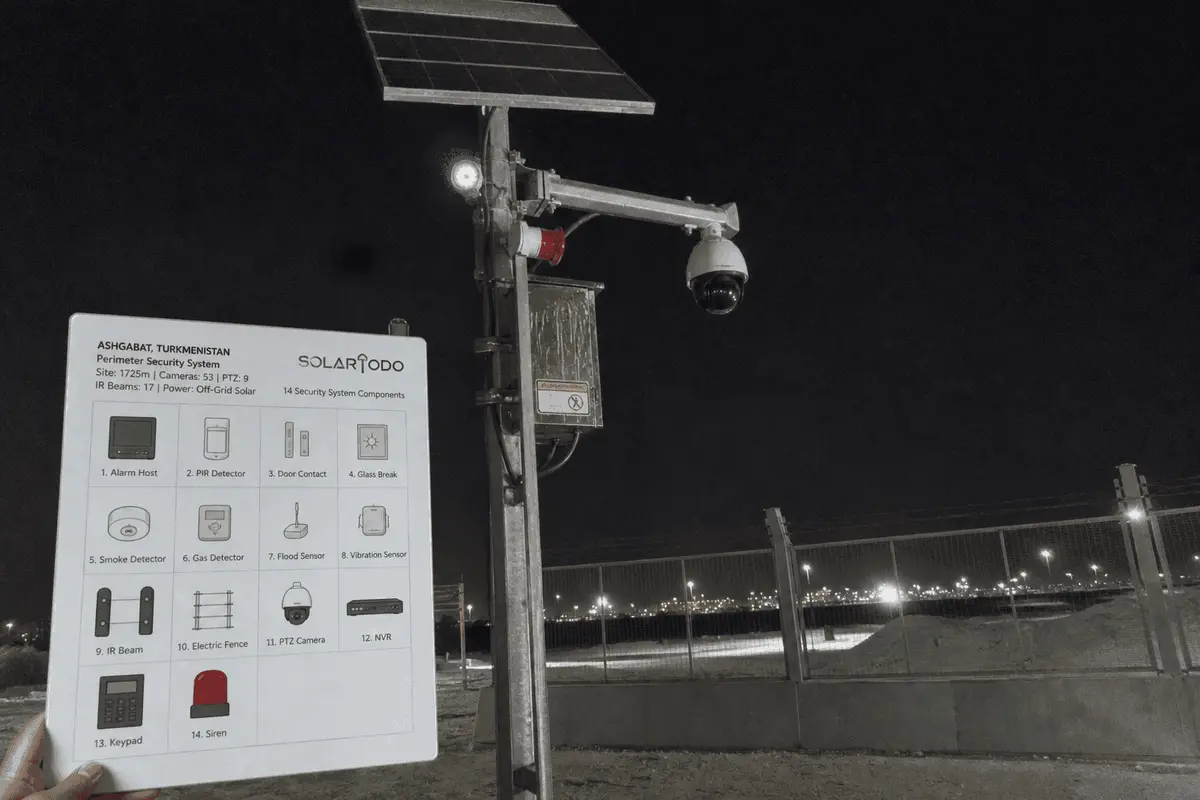
Ashgabat Smart Security System Market Analysis: 88-Zone Off-Grid Enterprise Configuration Guide
Summary
Ashgabat’s 1.03 million residents, 470 km2 urban area, and desert-edge location support an 88-zone off-grid Smart Security System with 1,725m perimeter coverage and 120hr autonomy.
Key Takeaways
An enterprise security profile in Ashgabat should prioritize 88 alarm zones, 1,725m perimeter detection, and 5-day off-grid resilience for large public, logistics, and utility sites.
- A typical enterprise deployment would use approximately 88 PIR detectors, 176 magnetic contacts, and 44 glass-break sensors for layered intrusion detection.
- The recommended perimeter package covers 1,725m using approximately 17 quad IR beams rated at 100m plus 17 electric fence sections at 10kV pulse output.
- Video verification would use approximately 44 IP67 4MP bullet/dome cameras, 9 PTZ 2MP 20x auto-tracking cameras, and 4 16-channel NVRs with 4TB HDD each.
- Off-grid power is specified as Full Solar + LFP Battery with 120hr, or 5-day, autonomy for facilities where grid continuity is operationally sensitive.
- Alarm linkage should execute intrusion to alarm in under 2 seconds, then PTZ tracking, NVR recording, app notification, and basic 24/7 monitoring.
- EN 50131 and UL 1023 alignment helps standardize detector grading, alarm control performance, and household/security alarm unit expectations.
- SOLARTODO positions this as an enterprise 64-128 zone class, not a villa-scale system, because the 1,725m perimeter requires fence and multi-NVR design.
Market Context for Ashgabat
Ashgabat’s scale, climate, and urban expansion make perimeter-led electronic security more relevant than small indoor alarm kits for enterprise facilities.
According to Turkmenistan’s 2022 census data reported for Ashgabat, the capital has 1,030,063 residents within roughly 470 km2, creating a city-scale demand base for government compounds, depots, campuses, telecom yards, and utility assets. According to the World Bank (2024), Turkmenistan’s urban population indicator is tracked through UN World Urbanization Prospects, which is relevant because Ashgabat concentrates national administrative and commercial functions. Ashgabat also lies between the Karakum Desert and the Kopet Dag range, about 50km from the Iran-Turkmenistan border, so outdoor equipment selection should account for dust, heat, seismic history, and perimeter visibility.
According to IEA (2022), Turkmenistan’s electricity system is heavily gas-based, while distributed solar-backed security loads can reduce dependence on local feeder availability for critical monitoring. NREL states, "PVWatts calculates estimated energy production" for photovoltaic systems, which is why a solar-and-LFP autonomy model is useful for pre-sizing the security power envelope before detailed load testing. For Ashgabat, this does not mean the product is a solar project first; it means security continuity is designed around cameras, alarms, communications, and sirens staying online during outages or isolated-site operation.
The local technical fit is enterprise-class rather than medium-class. A facility with 1,725m perimeter exposure, multiple buildings, and 88 detection zones should not be specified like a villa alarm with a few PIRs and door contacts. SOLARTODO would recommend an enterprise Smart Security System configuration where perimeter detection, alarm verification, NVR retention, and monitoring workflows are designed as one integrated system.
Recommended Technical Configuration
A recommended Ashgabat enterprise configuration uses 88 zones, 17 IR beams, 17 fence sections, 53 cameras, and 120hr off-grid autonomy.
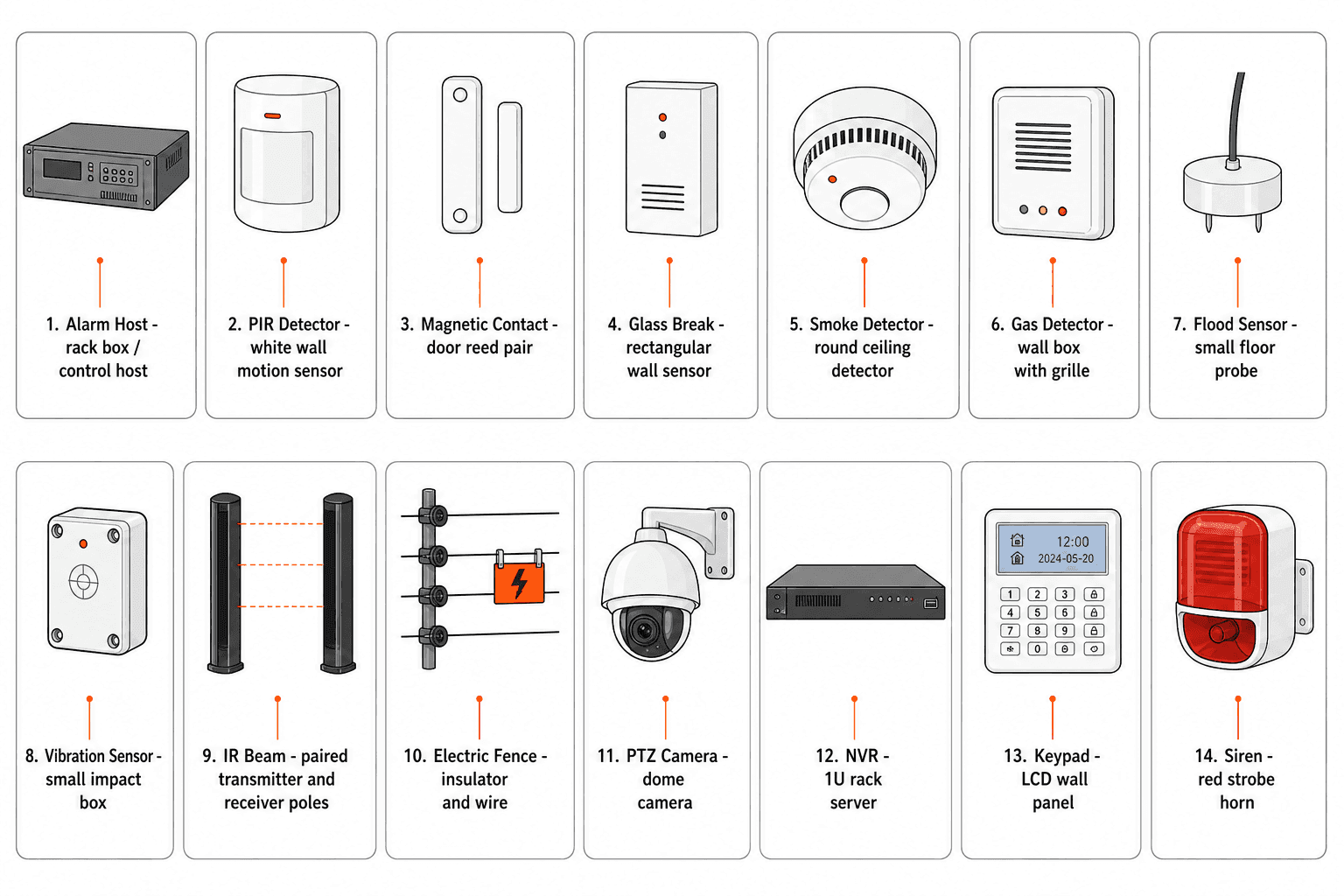
A typical deployment of this scale would consist of one TCP/IP 64-zone hybrid alarm panel expanded for an 88-zone enterprise design, with approximately 9 LCD touch keypads distributed across guard rooms, equipment buildings, and controlled entrances. Interior detection would use approximately 88 PIR sensors, 176 magnetic contacts, 44 glass-break sensors, and 44 photoelectric smoke detectors. This balances motion detection, opening detection, glazing protection, and basic environmental alarm coverage.
For the 1,725m perimeter, approximately 17 quad IR beams rated at 100m provide linear intrusion detection along fence lines, access corridors, and utility boundaries. Approximately 17 electric fence sections using 10kV pulse output add deterrence and event confirmation for exposed segments. This is the correct enterprise-scale use case for electric fence integration; it would be excessive for a villa but appropriate for long industrial, logistics, or public-sector boundaries.
Video verification would use approximately 44 4MP HD bullet/dome cameras with IR, H.265+, and IP67 protection, plus approximately 9 PTZ 2MP cameras with 20x zoom and auto-tracking. Recording should be distributed across approximately 4 16-channel NVRs, each with H.265+ compression and 4TB HDD storage. SOLARTODO’s recommended alarm chain is intrusion detection to alarm in under 2 seconds, then PTZ auto-track, NVR recording, app notification, and basic 24/7 monitoring.
Technical Specifications
The Ashgabat specification is an enterprise 88-zone Smart Security System with 1,725m perimeter coverage and Full Solar + LFP 120hr backup.
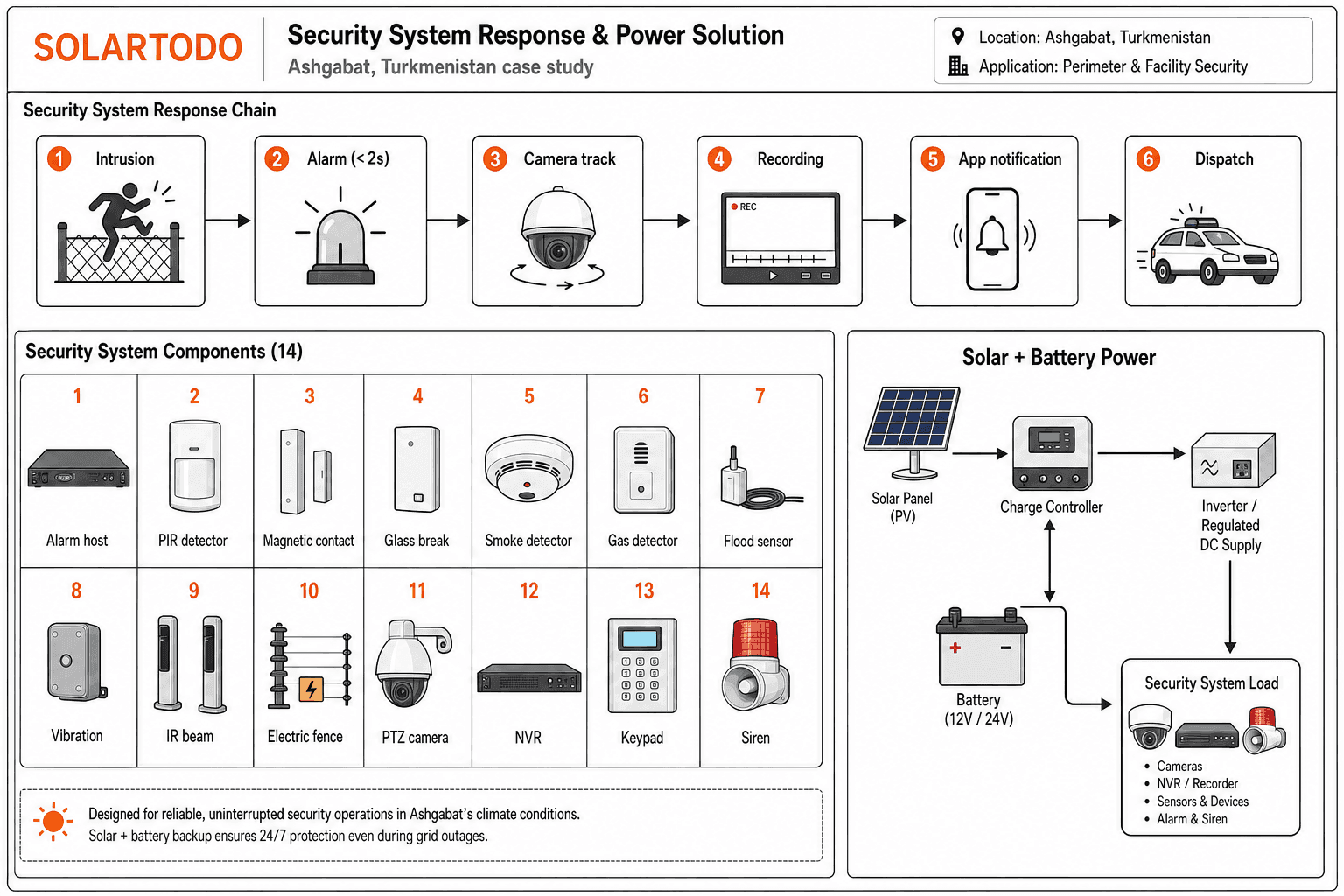
- Control: 1 x 64-zone hybrid alarm panel with TCP/IP communications, configured for an enterprise 88-zone architecture.
- User interface: approximately 9 x LCD touch keypads for distributed arming, disarming, fault review, and zone status.
- Interior intrusion: approximately 88 x dual-element PIR detectors with 12-15m coverage and 25kg pet immunity.
- Opening detection: approximately 176 x magnetic door contacts for doors, gates, hatches, and equipment-room access points.
- Glazing and safety: approximately 44 x glass-break sensors with 7m range and 44 x photoelectric smoke detectors.
- Perimeter: approximately 17 x quad IR beams rated at 100m and 17 x electric fence sections with 10kV pulse output.
- Video: approximately 44 x 4MP HD bullet/dome cameras with IR, H.265+, and IP67 housings.
- Tracking: approximately 9 x PTZ 2MP cameras with 20x optical zoom and auto-tracking.
- Recording: approximately 4 x 16-channel NVR units, H.265+, each with 4TB HDD.
- Outputs: approximately 18 x indoor sirens at 110dB and 9 x outdoor siren/strobes at 120dB.
- Power: Full Solar + LFP Battery, off-grid architecture, 120hr or 5-day autonomy.
- Standards basis: EN 50131 and UL 1023 for alarm system performance alignment.
According to IEC (2006), IEC/EN 50131-1 defines intrusion and hold-up alarm system requirements, which supports structured grading, event handling, and component selection. IEC states, "Alarm systems - Intrusion and hold-up systems - Part 1: System requirements." According to UL (2021), UL 1023 addresses household burglar-alarm system units; it is a useful reference point for control-unit safety expectations even when the Ashgabat profile is a larger enterprise design.
Implementation Approach
A typical Ashgabat rollout would phase engineering, procurement, installation, commissioning, and operator training over roughly 8-14 weeks.
The first phase is a site survey and zone schedule. Engineers would map gates, wall lines, roof access, equipment rooms, glazing, utility rooms, and blind spots, then assign all 88 zones before equipment ordering. The survey should also verify solar-array locations, LFP battery room ventilation, radio or fiber backhaul, and NVR room cooling.
The second phase is procurement and logistics. SOLARTODO can supply the Smart Security System as modular equipment, with detector quantities matched to the final zone list. For Ashgabat import planning, CKD or boxed equipment shipment should separate camera hardware, alarm electronics, LFP batteries, mounting accessories, and fence components so local teams can stage civil, electrical, and low-voltage work in parallel.
The third phase is installation. Perimeter IR beams should be aligned by segment, fence sections should be tested for pulse integrity, and camera fields of view should be matched to alarm zones. Commissioning should include a full cause-and-effect matrix: each PIR, contact, glass-break sensor, beam, and fence section should trigger the correct siren, PTZ preset, recording rule, app alert, and monitoring event.
Expected Performance & ROI
Expected performance is measured by sub-2-second alarm linkage, 5-day autonomy, lower guard workload, and reduced incident investigation time.
The main operational return is not a generic solar payback claim; it is the reduction of unverified alarms, blind perimeter sections, and manual patrol dependency. According to IRENA (2019), Central Asia has significant renewable-energy resource potential, which supports solar-backed auxiliary systems where grid extension or uptime is difficult. According to NREL (2024), PV performance estimation should be based on location, system losses, and load assumptions, so final ROI should be calculated after measured camera, NVR, fence, router, and siren consumption is confirmed.
For a large Ashgabat site, payback is usually assessed through avoided losses, reduced guard hours, fewer nuisance dispatches, and continuity of recording during outages. A typical enterprise owner would compare the system against 24/7 manual perimeter patrols, diesel-backed CCTV rooms, or grid-only alarm systems. SOLARTODO’s recommended ROI model should include equipment life, LFP replacement planning, camera maintenance, monitoring fees, and the value of faster incident verification.
Results and Impact
A properly configured 88-zone system can convert 1,725m of exposed boundary into monitored, recorded, and dispatch-ready security coverage.
The expected impact is a more auditable security operation for high-value Ashgabat facilities. Intrusion events should be detected at the perimeter, confirmed by PTZ and fixed cameras, stored on NVR, and escalated through app and monitoring workflows. Basic 24/7 monitoring is appropriate where the site has guards or facility staff but still needs continuous event review.
The configuration also improves maintenance accountability. With 9 keypads, 4 NVRs, and segmented fence/beam zones, technicians can isolate faults by area rather than shutting down the whole perimeter. For facility owners comparing options, the enterprise system offers a stronger technical fit than grid-only CCTV or an indoor-only alarm panel.
Comparison Table
The Ashgabat enterprise recommendation exceeds medium and large packages by using 88 zones, 53 cameras, and 120hr autonomy.
| Metric | Medium Variant | Large Variant | Ashgabat Recommended Enterprise Variant |
|---|---|---|---|
| Alarm zones | 8-24 | 24-64 | 88 |
| Perimeter length | 200-800m typical | 800-1,500m typical | 1,725m |
| IR beams | Perimeter beams as needed | Expanded beam layout | 17 x 100m quad IR beams |
| Electric fence | Usually not required | Selected sections | 17 x 10kV pulse sections |
| Fixed cameras | Small camera set | Scaled camera set | 44 x 4MP IP67 H.265+ |
| PTZ cameras | About 3 typical | More PTZ coverage | 9 x 2MP 20x auto-track |
| NVR capacity | 1 x 16ch, 4TB | Multi-NVR | 4 x 16ch, 4TB each |
| Power architecture | Hybrid, 24hr | Hybrid, 72hr | Off-grid Full Solar + LFP, 120hr |
| Monitoring | Self or basic | Basic or premium | Basic 24/7 monitoring |
Pricing & Quotation
SOLARTODO provides FOB, CIF, and EPC quotation paths, but final pricing depends on 88-zone design validation and site conditions.
SOLARTODO offers three pricing tiers for this product line: FOB Supply (equipment ex-works China), CIF Delivered (including ocean freight and insurance), and EPC Turnkey (fully installed, commissioned, with 1-year warranty). Volume discounts are available for large-scale deployments. Configure your system online for an instant estimate, or request a custom quotation from our engineering team at [email protected].
Frequently Asked Questions
An Ashgabat enterprise buyer should evaluate zones, perimeter length, autonomy, monitoring workflow, installation timeline, warranty, and EPC scope before ordering.
Q1: Why is the Ashgabat recommendation an enterprise 88-zone system? The profile includes 1,725m of perimeter, 88 PIR detection points, 176 magnetic contacts, 44 glass-break sensors, and 53 cameras. That exceeds the 24-64 zone large class and fits the 64-128 zone enterprise class. The electric fence and multi-NVR architecture are justified by the perimeter length, not by marketing preference.
Q2: What technical standards guide the alarm design? The configuration references EN 50131 for intrusion and hold-up alarm system requirements and UL 1023 for burglar-alarm unit expectations. These standards help frame control-panel behavior, signaling reliability, detector use, and alarm verification. Local code review is still required before installation because import, electrical, and telecom approvals vary by jurisdiction.
Q3: How long would installation typically take in Ashgabat? A typical 88-zone enterprise deployment would take about 8-14 weeks after site survey approval. The timeline includes engineering, procurement, shipping, trenching or mounting preparation, detector installation, camera alignment, solar and LFP setup, NVR configuration, and commissioning. Complex civil works or delayed import clearance can extend the schedule.
Q4: What is the expected ROI or payback period? ROI should be calculated from avoided theft, reduced guard patrol hours, fewer unverified alarms, and continuity of recorded evidence during outages. For enterprise sites, the payback case is usually operational risk reduction rather than electricity savings alone. A final model needs local labor cost, incident history, insurance assumptions, and maintenance cost inputs.
Q5: What maintenance does the system require? Maintenance should include monthly alarm event tests, quarterly IR beam cleaning and alignment checks, semiannual battery health review, camera lens cleaning after dust events, and annual NVR storage inspection. Electric fence sections should be inspected for vegetation, grounding, insulator damage, and pulse performance. Monitoring workflows should be tested during each service visit.
Q6: How does this compare with a grid-only CCTV system? A grid-only CCTV system records video but may miss perimeter detection, alarm zoning, siren escalation, and power resilience. The recommended Smart Security System combines PIRs, contacts, glass-break sensors, IR beams, electric fence sections, PTZ tracking, NVR recording, and app alerts. The 120hr LFP-backed off-grid power design improves continuity for remote or sensitive sites.
Q7: Does SOLARTODO provide EPC pricing for Ashgabat projects? SOLARTODO can quote FOB Supply, CIF Delivered, or EPC Turnkey tiers for the Smart Security System. EPC pricing requires a site layout, perimeter drawing, preferred monitoring model, installation constraints, and local compliance requirements. The article does not publish prices because final cost depends on civil works, cable routes, power sizing, and commissioning scope.
Q8: What warranty should buyers expect? The EPC Turnkey tier includes a 1-year warranty as stated in SOLARTODO’s quotation model. Warranty planning should define replacement handling for cameras, detectors, keypads, NVRs, LFP battery modules, sirens, and fence energizer components. Buyers should also request spare parts lists and service response expectations before procurement.
Q9: Can the system operate without grid power? Yes, the recommended Ashgabat configuration uses Full Solar + LFP Battery off-grid power with 120hr, or 5-day, autonomy. The exact solar array and battery capacity should be finalized from measured loads for cameras, NVRs, routers, alarm panels, fence sections, and sirens. Critical sites should also specify low-battery alert thresholds.
Q10: What information is needed before installation? The engineering team needs a site plan, 1,725m perimeter map, gate list, building count, camera mounting points, expected recording retention, monitoring contact tree, and power-equipment location. A zone schedule should identify all 88 PIR locations, 176 contact points, 44 glass-break positions, and 44 smoke detector locations before shipment.
References
The analysis uses 7 public and standards-based references covering Ashgabat demographics, energy context, solar estimation, and alarm-system requirements.
- Turkmenistan State Statistics / 2022 Census (2023): Ashgabat population reported at 1,030,063 and city area commonly listed at about 470 km2.
- World Bank (2024): Urban population indicator for Turkmenistan, based on UN World Urbanization Prospects methodology.
- IEA (2022): Turkmenistan energy profile indicating a gas-dominated electricity system and national energy-sector context.
- NREL (2024): PVWatts Calculator methodology for estimating photovoltaic energy production from location and system assumptions.
- IRENA (2019): Renewable Energy Prospects for Central Asia, describing regional renewable-resource potential and deployment considerations.
- IEC / EN 50131-1 (2006): Alarm systems - Intrusion and hold-up systems - Part 1: System requirements.
- UL (2021): UL 1023, Household Burglar-Alarm System Units, ANSI-approved May 20, 2021.
Equipment Deployed
- 1 x 64-zone hybrid alarm panel with TCP/IP, configured for enterprise 88-zone architecture
- 9 x LCD touch keypads for distributed arming, disarming, and zone status review
- 88 x dual-element PIR detectors, 12-15m range, pet immune to 25kg
- 176 x magnetic door contacts for doors, gates, hatches, and access points
- 44 x glass-break sensors with 7m range
- 44 x photoelectric smoke detectors for safety-zone integration
- 17 x quad IR beams, 100m range, for 1,725m perimeter segmentation
- 17 x electric fence sections with 10kV pulse output
- 44 x 4MP HD bullet/dome cameras with IR, H.265+, and IP67 housing
- 9 x PTZ 2MP cameras with 20x zoom and auto-tracking
- 4 x 16-channel NVR units with H.265+ and 4TB HDD each
- 18 x indoor sirens rated at 110dB
- 9 x outdoor siren/strobes rated at 120dB
- Full Solar + LFP Battery off-grid power system with 120hr / 5-day autonomy
- Basic 24/7 monitoring workflow with app notification and dispatch escalation