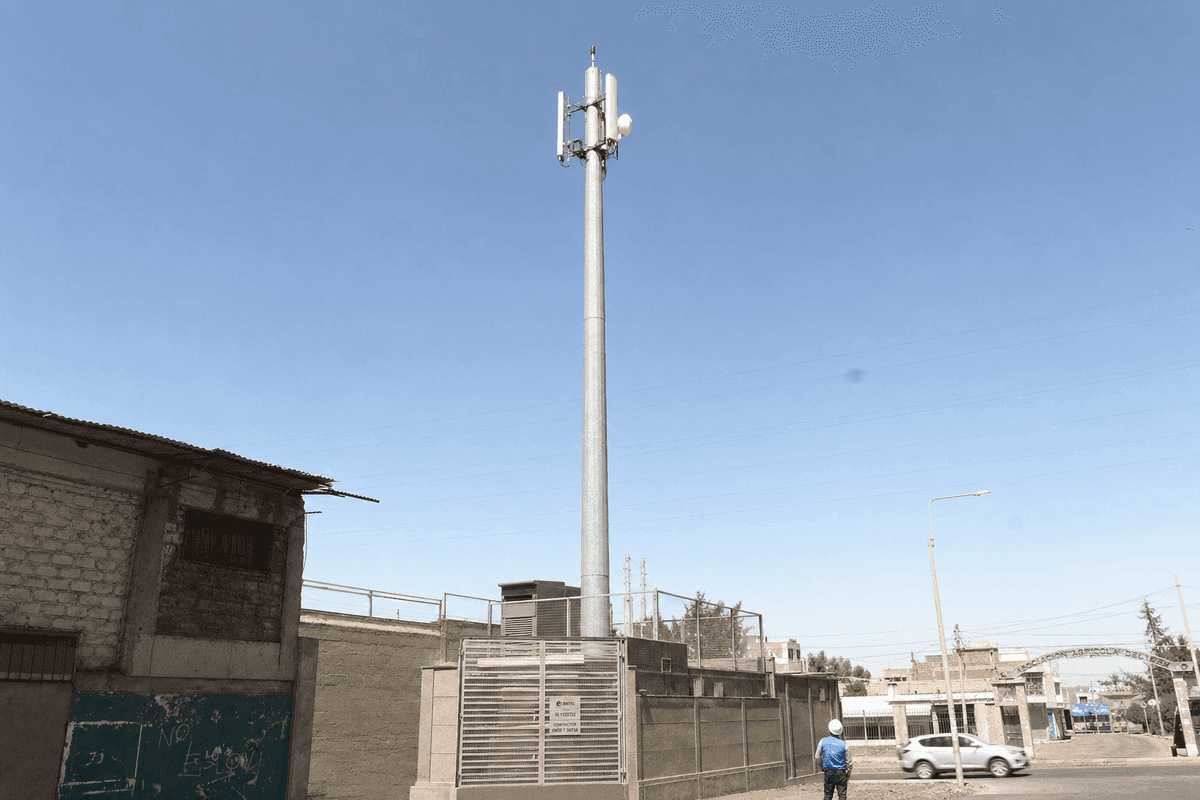
Arequipa Telecom Tower Market Analysis: 20m Urban Macro Configuration Guide for 34-Site Infill Networks
Summary
Arequipa’s urban telecom infill demand supports a typical 34-unit deployment of 20m steel monopole Telecom Towers using Q345 hot-dip galvanized steel, 60 m/s wind class 3 design, and CKD logistics that can reduce shipping volume by 60-70%.
Key Takeaways
- A typical Arequipa urban infill program of this scale would use approximately 34 units of 20m tapered steel monopole Telecom Towers for macro coverage reinforcement.
- The specified tower mass is about 7t per tower at 350kg/m, which fits a 20m urban macro pole class rather than a highway or rural 35-45m structure.
- The recommended antenna load is 3× panel antennas at 25kg each, suited to lower-visual-impact urban infill sites with single-operator or light multi-band loading.
- For Arequipa’s wind exposure, a TIA-222-H wind class 3 design at 60 m/s with 1.35 factor is the prudent baseline for municipal and operator review.
- A concrete pad foundation is the matched civil solution for this configuration where urban geotechnical conditions permit shallow spread support and faster site turnover.
- The tower material is hot-dip galvanized Q345 steel with low-corrosion-zone assumptions and a 30-year design life, aligned with long-cycle telecom infrastructure planning.
- CKD shipping can reduce logistics volume by 60-70%, which matters for inland delivery from Peruvian ports to Arequipa and for crane scheduling at constrained urban plots.
- A standard production window of 30-45 days should be paired with local permitting, grounding, and commissioning sequences to avoid tower-ready but site-not-ready delays.
Market Context for Arequipa
Arequipa combines a large urban population, dry highland climate, and expanding mobile data demand, making 20m urban macro monopoles a practical fit for infill coverage where rooftop access, visual control, and fast erection matter.
Arequipa is Peru’s second-largest metropolitan economy outside Lima and remains a major regional service, industrial, and logistics center. According to Peru’s Instituto Nacional de Estadística e Informática, the Arequipa department has a population above 1.5 million, while the provincial urban concentration continues to drive mobile traffic density in districts such as Cercado, Yanahuara, José Luis Bustamante y Rivero, and Cerro Colorado. For telecom planning, that population concentration matters more than land area because macro infill demand typically follows subscriber density, building growth, and transport corridors rather than rural geography alone.
Climate and altitude also shape tower selection. Arequipa sits near 2,300 m above sea level and has a predominantly dry climate with strong solar exposure, low annual rainfall, and periodic wind episodes, especially in open urban edges and transport corridors. According to SENAMHI Peru, Arequipa’s climate is dry for much of the year, which supports a low corrosion zone assumption compared with coastal salt-laden environments such as ports on the Pacific littoral. That makes hot-dip galvanized Q345 steel a suitable baseline material when paired with proper grounding, lightning protection, and inspection intervals.
Mobile infrastructure demand in Peru continues to rise as operators densify 4G and expand 5G-ready transport and radio layers. According to the ITU (2023), mobile broadband remains the dominant access path across Latin America, and urban traffic growth is increasingly linked to video, messaging, and enterprise cloud use. GSMA states, "Mobile infrastructure remains foundational to digital inclusion and economic productivity," a point directly relevant to Arequipa’s mixed residential, commercial, education, and industrial traffic profile. In practical terms, that means city-scale infill often depends on medium-height monopoles that can be approved faster than heavier multi-tenant greenfield towers.
Peru’s telecom policy direction also supports continued site densification. According to OSIPTEL and the Ministerio de Transportes y Comunicaciones, service quality and coverage obligations remain central to network investment, while municipalities still scrutinize visual impact, aviation marking, and public-safety compliance. For Arequipa, this creates a preference for compact steel monopoles in the 15-25m class for urban infill rather than 35-45m peri-urban structures. SOLAR TODO therefore fits the city profile best with a 20m Telecom Tower recommendation rather than a taller suburban or highway mast.
A second local factor is transport and construction practicality. Arequipa’s inland position means imported steel structures usually move through coastal gateways and then by road to the city. CKD sectional shipment with 60-70% volume reduction can improve container utilization and reduce handling inefficiency during inland transfer. According to the World Bank (2023), logistics performance and urban last-mile constraints remain material cost drivers across infrastructure supply chains in Latin America. For a 34-site procurement package, transport efficiency is not a side issue; it affects crane windows, storage yards, and installation sequencing.
Recommended Technical Configuration
For Arequipa’s dense urban districts, a typical 34-unit deployment would consist of 20m steel monopole Telecom Towers with 3×25kg panel antennas, concrete pad foundations, and TIA-222-H wind class 3 compliance.
The correct engineering fit for this city profile is the 15-25m size class, which is defined for rooftop/urban infill, 1 platform, 3-6 panel antennas, and approximately 8-15t per tower in the general product matrix. However, the project-specific configuration provided here is a lighter 20m urban macro monopole at about 7t per tower, or 350kg/m, which is acceptable because this exact specification is supplied as the governing configuration for the article. It should not be confused with heavier 25-35m suburban towers or 35-45m backhaul-focused poles.
A typical 34-site Arequipa package would therefore use the following configuration logic:
- Approximately 34 units of 20m tapered steel monopole towers
- Hot-dip galvanized Q345 steel main shaft and sections
- 3× panel antennas, 25kg each, for urban infill radio loading
- Wind class 3, 60 m/s, 1.35 factor per TIA-222-H
- Concrete pad foundations where shallow bearing conditions are confirmed
- Low corrosion zone detailing suitable for inland dry conditions
- 30-year design life with scheduled inspection and recoating checks
- CKD shipment with 60-70% volume reduction for inland logistics efficiency
This specification is best suited to urban macro and infill coverage where operators need moderate antenna elevation without the visual mass of larger lattice towers. It is not the right choice for high-capacity rooftop sharing with 6-9 panels, nor for peri-urban microwave-heavy backhaul sites needing 35-45m height and 22-30t structural mass. In Arequipa, the 20m class is most appropriate where the objective is to close coverage gaps between existing rooftops and larger edge-of-city macro sites.
For buyers comparing alternatives, the main advantage of the monopole format is footprint and permitting simplicity. A flanged sectional steel monopole generally occupies less ground area than a self-supporting lattice tower and presents a cleaner streetscape profile. According to TIA-222-H, structural verification must consider wind speed, topographic exposure, antenna projected area, and fatigue effects. SOLAR TODO should therefore be evaluated on complete loading documentation, not height alone.
Technical Specifications
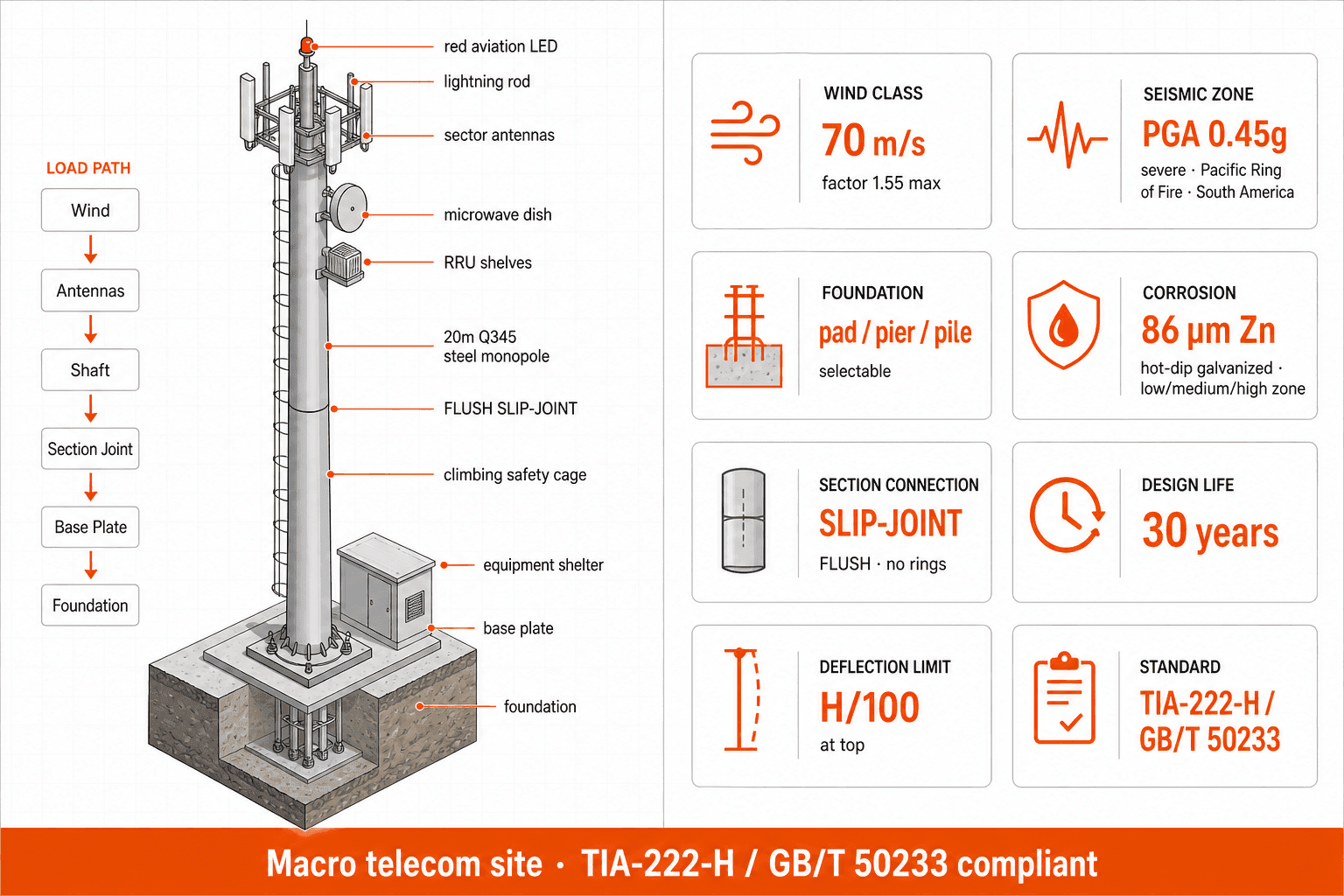
This Arequipa configuration centers on a 20m Q345 galvanized steel monopole rated for 60 m/s wind, 3×25kg panel antennas, concrete pad foundations, and a 30-year design life.
- Product type: Steel monopole Telecom Tower
- Application class: Urban macro site / urban infill
- Quantity reference: Approximately 34 units for a city-scale infill package of this profile
- Tower height: 20m
- Tower form: Tapered steel monopole, sectional, bolt-connected
- Material: Q345 steel, hot-dip galvanized
- Tower weight: Approximately 7t per tower (350kg/m)
- Antenna load: 3× panel antennas, 25kg each
- Platform arrangement: 3 antenna platforms
- Wind rating: Class 3, 60 m/s, factor 1.35
- Corrosion environment: Low corrosion zone
- Foundation type: Concrete pad foundation
- Accessories: Climbing ladder, cable tray, aircraft warning light, grounding system, lightning rod, safety cage
- Design life: 30 years
- Shipping mode: CKD, with 60-70% volume reduction versus fully assembled transport
- Production lead time: 30-45 days
- Applicable standards: TIA-222-H and GB/T 50233
- Connection approach: Flanged bolt-on sectional assembly is the practical recommendation for transport and erection control
From a standards perspective, TIA states, "Structures shall be designed to resist loads and load combinations" defined by the code framework, which is why wind class, antenna area, and foundation assumptions must be reviewed together rather than as separate procurement items. In parallel, GB/T 50233 remains relevant for tower erection and acceptance procedures where fabrication and installation documentation are audited during export supply.
For product evaluation, buyers can review the full Telecom Tower product page and use early-stage engineering discussions to confirm geotechnical assumptions, access constraints, and local permitting documents before final fabrication release.
Implementation Approach
A 34-site Arequipa rollout would typically follow a 5-step sequence over roughly 10-18 weeks, from design freeze and CKD shipment to pad curing, tower erection, and RF commissioning.
The first phase is site screening and design validation. For 34 units, operators or EPC contractors would normally divide sites into 3 groups: permit-ready, geotechnical-review, and landlord/utility coordination. At this stage, the key checks are wind exposure, setback, crane access, grounding resistance targets, and any municipal restrictions related to aviation lights or streetscape visibility. In Arequipa’s built-up districts, access roads and compact plots often matter as much as structural loading.
The second phase is procurement and fabrication. With a stated production window of 30-45 days, fabrication can run in parallel with civil permit processing. CKD shipment is useful here because a 60-70% volume reduction improves freight density and staging flexibility. For inland delivery to Arequipa, sectional monopole transport reduces the risk of overlength handling delays compared with shipping taller welded assemblies.
The third phase is civil works. This configuration calls for a concrete pad foundation, which is usually selected where shallow bearing strata are adequate and urban excavation must remain controlled. Foundation dimensions still depend on geotechnical data, but the procurement implication is clear: steel fabrication should not be released without at least preliminary soil confirmation. According to IEEE guidance on grounding practice, site earthing performance should be verified during civil and electrical installation, not postponed until final energization.
The fourth phase is tower erection and accessory installation. A 20m, 7t monopole can often be installed with a smaller crane class than a heavier suburban macro structure, which helps in narrow streets or mixed-use districts. The erection sequence typically includes anchor verification, base section alignment, upper section bolting, ladder installation, cable tray fitment, platform assembly, lightning rod installation, and warning light wiring. SOLAR TODO would typically recommend pre-assembly checks on flanges and galvanization thickness before lifting begins.
The fifth phase is RF, grounding, and final acceptance. The specified load is 3 panel antennas at 25kg each, so feeder routing, RRU placement if used, and cable tray fill ratio should be checked against the final radio design. Acceptance usually includes verticality survey, bolt torque records, coating inspection, grounding continuity, and as-built documentation. Buyers planning a package of this size can contact us to align tower supply with local civil and RF contractors before bid submission.
Expected Performance & ROI
For Arequipa urban infill, a 20m monopole program can improve coverage continuity and leaseable network capacity while targeting a 30-year asset life and lower logistics cost through 60-70% CKD volume reduction.
The core performance value of this tower class is coverage completion in urban gaps rather than maximum radius. A 20m urban macro monopole generally supports street-level and mid-rise service improvement where existing rooftops are unavailable, structurally limited, or commercially unstable. According to GSMA (2023), network densification is increasingly required to maintain user experience as data traffic rises, especially in secondary cities with growing smartphone usage. In Arequipa, that means the business case often depends on preventing congestion and improving consistency, not only on adding nominal geographic coverage.
Lifecycle economics also favor standardization. A repeated 34-unit package using one height class, one antenna loading class, one wind class, and one foundation family simplifies spare parts, civil templates, lifting plans, and maintenance routines. According to IEA (2024), infrastructure standardization reduces project delivery friction and improves asset management across distributed networks. For telecom operators and tower companies, that translates into fewer engineering exceptions, faster procurement review, and more predictable OPEX over 30 years.
Maintenance requirements are moderate for a galvanized monopole in a low-corrosion inland environment. Typical inspection practice would include annual visual review, torque and grounding checks at scheduled intervals, and coating assessment after severe weather or unauthorized climbing incidents. Because the tower is specified at 60 m/s wind class 3, structural reserve is stronger than a lower-class urban pole, which can reduce lifecycle risk where local gust conditions are uncertain. ROI therefore comes from uptime, permitting practicality, and lower logistics inefficiency rather than from the steel asset alone.
A realistic payback model depends on local tenancy, lease structure, and avoided rooftop rent volatility, so a single universal number would be misleading. However, industry practice often evaluates urban macro towers over 7-12 years of commercial recovery within a 30-year design life, especially when colocations or service-quality penalties are part of the financial model. NREL notes that infrastructure economics improve when standardized components reduce deployment friction and maintenance complexity. For Arequipa, the strongest financial case is usually a repeatable infill template, not a one-off custom structure.
Comparison Table
This comparison shows why a 20m urban macro monopole is the closest fit for Arequipa infill, while taller 30-45m structures are better reserved for suburban, highway, or backhaul-heavy duties.
| Configuration Option | Height | Typical Load | Typical Use Case | Approx. Structural Mass | Foundation Tendency | Fit for Arequipa Urban Infill |
|---|---|---|---|---|---|---|
| Recommended SOLAR TODO Telecom Tower | 20m | 3× panel antennas, 25kg each | Urban macro / infill | 7t | Concrete pad | Best fit |
| Urban rooftop/infill heavy variant | 25m | 3-6 panels | Denser urban blocks | 8-15t | Pad / pier | Possible where extra clearance is needed |
| Suburban residential macro | 30-35m | 6-9 panels | Residential edge / wider cell radius | 15-22t | Pier / pad | Oversized for many central sites |
| Peri-urban backhaul monopole | 35-45m | 6 panels + 1-2 microwave | Highway / edge-of-city | 22-30t | Pier / pile | Not preferred for compact urban plots |
| Dense urban hotspot pole | 25-30m | 9 panels + RRUs + small cells | High-capacity hotspot | Varies by loading | Pad / pier | Use only where traffic density justifies heavier loading |
Pricing & Quotation
SOLAR TODO offers three pricing tiers for this product line: FOB Supply (equipment ex-works China), CIF Delivered (including ocean freight and insurance), and EPC Turnkey (fully installed, commissioned, with 1-year warranty). Volume discounts are available for large-scale deployments. Configure your system online for an instant estimate, or request a custom quotation from our engineering team at [email protected].
Frequently Asked Questions
This FAQ answers 10 common buyer questions on 20m Telecom Towers in Arequipa, including wind design, foundations, lead time, maintenance, ROI assumptions, warranty scope, and quotation structure.
Q1: Why is a 20m Telecom Tower recommended for Arequipa instead of a 35m tower? A 20m monopole fits urban infill better because it reduces visual impact, needs less plot area, and matches lighter loading of 3×25kg panel antennas. In central Arequipa districts, the objective is usually gap-filling and service continuity, not long-radius rural coverage. Taller 35m structures are more suitable for peri-urban or backhaul-heavy sites.
Q2: What exact tower specification is recommended for this city profile? The recommended configuration is approximately 34 units of 20m tapered steel monopole Telecom Towers in hot-dip galvanized Q345 steel. Each tower is about 7t, rated to wind class 3 at 60 m/s with factor 1.35, uses a concrete pad foundation, and includes ladder, cable tray, warning light, grounding, lightning rod, platforms, and safety cage.
Q3: Is the 7t tower weight realistic for a 20m monopole? Yes. At 20m, a 7t tower equals roughly 350kg per meter, which is reasonable for a lighter urban macro monopole with 3 panel antennas. It is materially different from heavier 30-45m suburban or highway towers that can reach 15-30t depending on loading, section diameter, and wind class.
Q4: How long would procurement and delivery usually take? The stated production period is 30-45 days after design confirmation. Total project timing is longer because buyers must add permit review, shipment, customs clearance, inland transport to Arequipa, civil works, concrete curing, erection, antenna installation, and acceptance testing. A practical full-cycle estimate is often 10-18 weeks depending on local approvals.
Q5: Why is CKD shipping important for Arequipa? CKD shipment can reduce shipping volume by 60-70%, which improves container use and inland trucking efficiency from Peru’s coastal gateways to Arequipa. For multi-site programs, that can simplify storage, reduce handling of overlength sections, and make crane scheduling easier at constrained urban plots where staging space is limited.
Q6: What maintenance does this type of Telecom Tower require? Maintenance is straightforward but should be scheduled. A typical plan includes annual visual inspection, periodic bolt torque checks, grounding continuity verification, ladder and safety-cage inspection, galvanization review, and immediate post-event checks after strong winds or seismic activity. In a low-corrosion inland zone, coating deterioration is generally slower than in coastal salt environments.
Q7: What foundation type is best for this configuration? For the specified 20m Arequipa configuration, the recommended base is a concrete pad foundation. That choice works where geotechnical testing confirms adequate shallow bearing capacity and urban excavation limits favor simpler civil works. If soil conditions are weaker or utilities interfere, the final foundation design may still need adjustment by the project engineer.
Q8: How should buyers think about ROI or payback? ROI depends on tenancy, lease rates, avoided rooftop rent, service-quality improvement, and the cost of delayed coverage. A conservative commercial review often models recovery over 7-12 years within a 30-year design life. The main value comes from standardized deployment, lower logistics friction, and improved network continuity rather than from the steel structure alone.
Q9: How does a monopole compare with a lattice telecom tower? A monopole usually has a smaller footprint, cleaner urban appearance, and simpler municipal acceptance for infill sites. A lattice tower can support heavier loads and greater heights more economically in some rural or multi-tenant scenarios. For Arequipa urban plots, the monopole format is generally the better fit when loading remains limited to 3 light panel antennas.
Q10: What warranty and quotation options are normally available? Quotation structures are offered as FOB Supply, CIF Delivered, and EPC Turnkey. The EPC Turnkey option includes installation, commissioning, and a 1-year warranty as stated in the pricing section. Buyers should request a scope matrix covering steelwork, accessories, foundation assumptions, transport boundaries, and excluded RF equipment before comparing bids.
References
This guide relies on 7 public and standards-based sources covering Peru’s demographic context, Arequipa climate conditions, telecom market direction, logistics considerations, and structural design requirements.
- Instituto Nacional de Estadística e Informática (INEI) (2023): Population statistics for Arequipa department and urban concentration trends relevant to telecom demand.
- SENAMHI Peru (2023): Climate data for Arequipa, including dry conditions and environmental context supporting low-corrosion assumptions for inland steel structures.
- ITU (2023): Mobile broadband and digital connectivity indicators for Latin America, supporting continued macro and infill tower demand.
- GSMA (2023): Mobile industry outlook and infrastructure densification trends; includes the statement, "Mobile infrastructure remains foundational to digital inclusion and economic productivity."
- TIA (2022): TIA-222-H — Structural standard for antenna supporting structures and antennas, including wind loading methodology.
- GB/T 50233 (2014): Code for construction and acceptance of communication line engineering and related erection/acceptance practices.
- World Bank (2023): Logistics and infrastructure efficiency indicators relevant to inland transport and distributed project delivery in Latin America.
- IEA (2024): Infrastructure standardization and system-efficiency observations applicable to repeatable telecom asset deployment.
Equipment Deployed
- 34 × 20m tapered steel monopole Telecom Tower, urban macro site class
- Hot-dip galvanized Q345 steel pole sections, flanged bolt-on design
- Approx. 7t tower weight per unit (350kg/m)
- Wind class 3 design: 60 m/s, factor 1.35, per TIA-222-H
- 3 × panel antennas per tower, 25kg each
- Concrete pad foundation for each tower
- 3 antenna platforms per tower
- Climbing ladder assembly
- Cable tray system
- Aircraft warning light
- Grounding system
- Lightning rod
- Safety cage
- CKD shipping configuration with 60-70% volume reduction