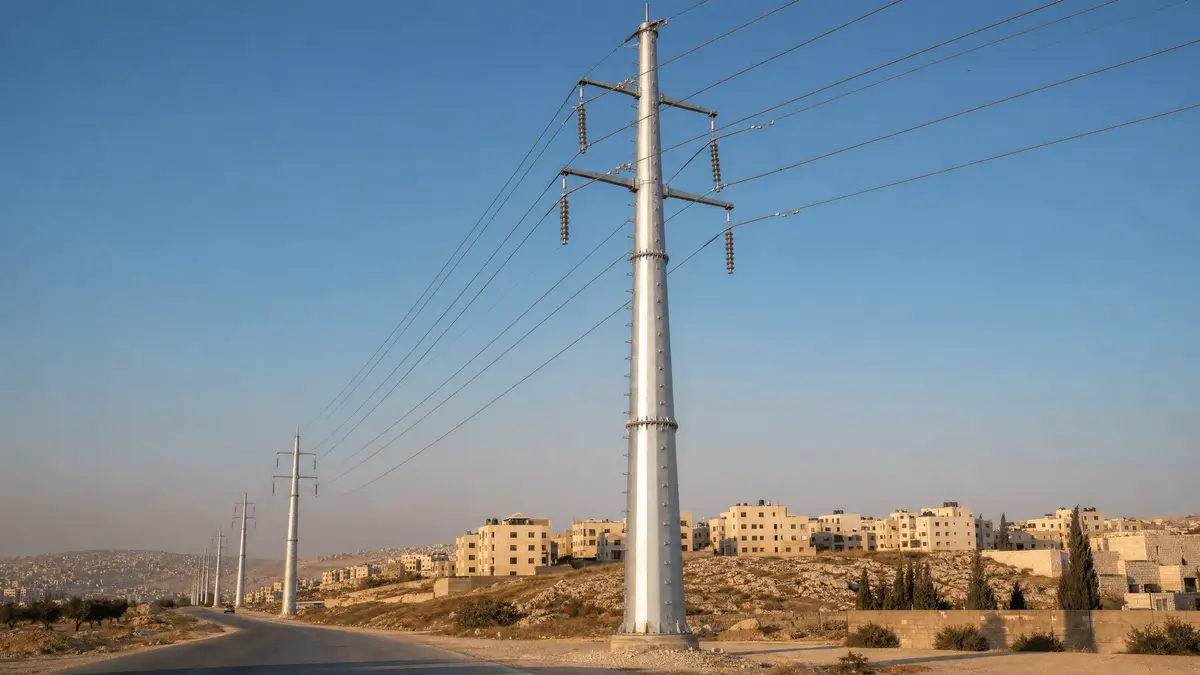
Amman Power Transmission Tower Market Analysis: 110kV Double-Circuit Steel Tubular Pole Configuration Guide
Summary
Amman's grid growth and urban load concentration make 110kV backbone reinforcement a practical priority; a typical 18km corridor would use approximately 88 steel tubular poles, 40m height, 200m spans, and ACSR 240 conductors under 30m/s wind design.
Key Takeaways
- Amman sits at approximately 31.95, 35.93, and Jordan's electricity demand remains concentrated around the capital region, supporting continued 110kV sub-transmission reinforcement planning.
- According to NEPCO grid documentation and Jordanian transmission practice, 110kV is a standard backbone voltage class; a typical urban-fringe line would use single or double circuit steel poles.
- For the specified profile, a typical corridor would consist of approximately 88 units of 40m tapered steel tubular poles across about 18km at 200m average span.
- The given line configuration uses double circuit, Q345 hot-dip galvanized steel, and ACSR 240 conductor rated at 920kg/km with maximum tension 70kN.
- Wind loading should be checked to IEC 60826, with the provided design basis of Wind Class 2, 30m/s, plus local geotechnical verification for anchor-bolt cage foundations.
- The specified accessory package includes climbing steps, cross arm, grounding, bird guard, and vibration damper, with 1.5m insulator length and 4m phase spacing.
- Although the project-specific pole weight is given as about 40t per pole, buyers should note this is a heavy-duty 110kV backbone configuration and should be validated against route angle, loading, and utility clearance requirements.
- SOLAR TODO positions this product line for utility and EPC buyers seeking 110kV steel monopole alternatives to lattice structures, with quotation paths through /products/power-tower and /contact.
Market Context for Amman
Amman, Jordan's capital and largest load center, concentrates population, commerce, and public infrastructure in a metro area that requires stable medium- and high-voltage interconnection capacity.
According to the Jordan Department of Statistics (2023), Amman Governorate remains the country's largest population center, with several million residents and the highest concentration of commercial and service-sector demand. According to the World Bank (2023), Jordan's urbanization rate exceeds 90%, which matters because dense urban systems typically require stronger sub-transmission rings, shorter outage recovery times, and more compact line structures than rural-only networks. In practical utility terms, this pushes planners toward 66-110kV and above for backbone reinforcement around the capital.
According to NEPCO, Jordan's national transmission system includes 132kV, 230kV, and 400kV assets, while city-serving and regional transfer networks rely on sub-transmission interfaces that feed distribution substations around major demand centers. For Amman, that means the market need is not a low-voltage roadside pole discussion; it is a corridor-efficiency and right-of-way question for higher-capacity links. A steel tubular Power Transmission Tower is relevant where utilities want a narrower footprint than lattice towers and a cleaner fit near roads, industrial zones, and urban expansion edges.
Climate also matters. According to the Jordan Meteorological Department, Amman has a semi-arid climate with seasonal wind events, summer heat, and winter rain episodes that affect corrosion planning, foundation drainage, and conductor behavior. According to IRENA (2022), Jordan continues grid modernization to support energy transition goals, which indirectly increases the need for stable evacuation and transfer capacity between generation, substations, and urban loads. For a city like Amman, a 110kV double-circuit steel tubular solution is a practical class to evaluate because it supports substantial power transfer without immediately moving into the larger geometric envelope of 220kV structures.
Two authority statements help frame the market. IEC states, "This part of IEC 60826 establishes general criteria for design of overhead transmission lines", which is directly relevant for wind, load combinations, and reliability checks. IRENA states, "Grid infrastructure needs to expand and modernize to integrate higher shares of renewable energy", a point that applies to Jordan as generation and load balancing requirements become more dynamic.
For procurement teams in Amman, the local question is usually: what tower class fits corridor constraints, utility voltage practice, and lifecycle maintenance expectations? Based on the city's urban density, utility backbone needs, and route conditions, the answer often starts at 110kV sub-transmission rather than 10-35kV distribution. That is the correct engineering sequence: select the voltage class first, then derive structure height, span, and hardware.
Recommended Technical Configuration
For Amman's urban-fringe backbone profile, a typical recommendation is a 110kV double-circuit steel tubular pole line using about 88 poles over 18km with 200m spans and ACSR 240 conductor.
The project-specific configuration supplied for this guide points to a heavy-duty 110kV double-circuit line built around 88 units × 40m tapered steel tubular poles. This is clearly a high-voltage backbone application, not a distribution feeder. A standard engineering table would normally place 66-110kV structures in the 18-30m range with 200-300m spans; however, the provided specification requires 40m poles and must therefore be treated as a route-specific or clearance-driven recommendation for Amman rather than a generic baseline. That distinction is important for utility engineers reviewing corridor constraints.
A typical deployment of this scale would consist of:
- Approximately 88 tapered steel tubular poles
- 110kV double circuit arrangement
- Total line length about 18km
- Average span 200m
- Q345 hot-dip galvanized steel construction
- ACSR 240 conductor at 920kg/km and 70kN max tension
- Phase spacing 4m
- Ground clearance 6m
- Insulator length 1.5m
- Wind Class 2, 30m/s
- Anchor-bolt cage concrete foundation
- 30-year design life
Why would Amman justify this configuration? First, a double-circuit arrangement increases transfer redundancy within the same corridor width. Second, steel tubular poles reduce visual clutter and land take compared with many lattice alternatives, which can matter near peri-urban roads and industrial developments. Third, a 200m span is conservative enough for controlled urban-edge routing while still limiting structure count to around 4.9 poles/km for an 18km line.
SOLAR TODO should present this as a recommended fit where the route needs compact geometry, predictable fabrication, and utility-grade compliance to IEC 60826 / GB 50545 / DL/T 5092. Buyers comparing /products/power-tower options should ask whether the corridor has angle towers, constrained crossings, or special clearance points, because those factors can explain why a 40m 110kV pole is selected instead of a shorter standard sub-transmission pole.
Technical Specifications
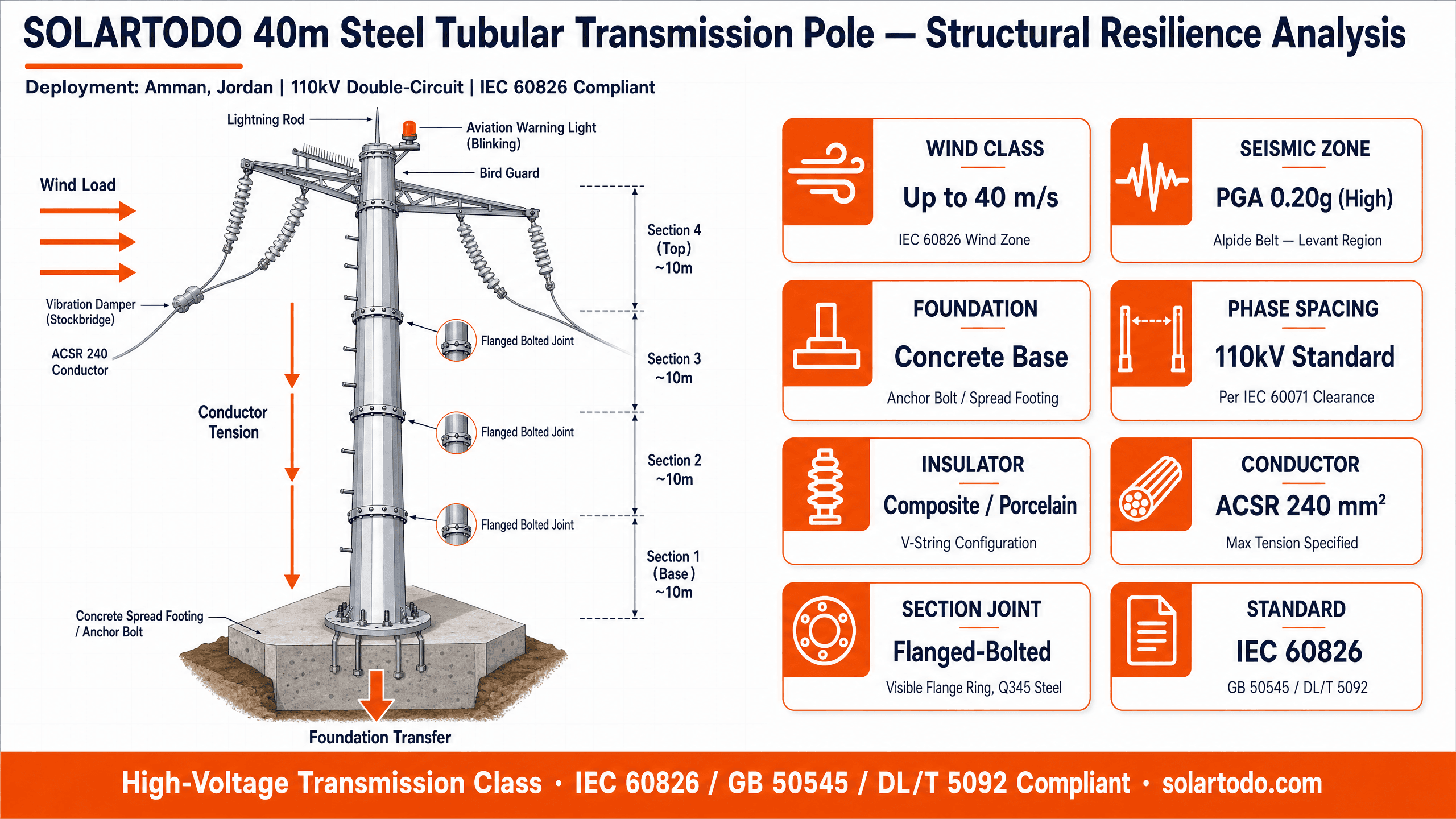
This Amman-oriented configuration centers on a 110kV double-circuit steel tubular pole system with 88 structures, 40m height, 200m span, and ACSR 240 conductor for backbone transfer duty.
Pole and structural system
- Product type: Steel tubular Power Transmission Tower
- Pole form: Tapered round steel monopole
- Quantity basis: approximately 88 units
- Voltage class: 110kV
- Circuit arrangement: Double circuit
- Pole height: 40m
- Linear steel weight basis: 1000kg/m for double-circuit variant
- Approximate pole weight: ~40t/pole as provided in the project-specific configuration
- Steel grade: Q345
- Surface protection: Hot-dip galvanizing
- Design life: 30 years
Electrical and line hardware
- Conductor type: ACSR 240
- Conductor mass: 920kg/km
- Maximum conductor tension: 70kN
- Phase spacing: 4m
- Ground clearance: 6m
- Insulator string length: 1.5m
- Cross-arm support: Bracketed steel cross arm for insulator strings and ACSR conductors
- Grounding: Included
- Bird protection: Bird guard included
- Vibration control: Vibration damper included
Civil and environmental design basis
- Typical span: 200m
- Total route length: ~18km
- Wind class: Class 2
- Basic wind speed: 30m/s
- Foundation type: Concrete foundation with anchor-bolt cage
- Pole assembly: Flanged bolt sections
- Access feature: Climbing steps included
Standards and compliance basis
- IEC 60826 for overhead line loading and design criteria
- GB 50545 for transmission line structural design reference
- DL/T 5092 for transmission line steel support technical reference
Because the supplied project configuration specifies 110kV at 40m, procurement teams should treat this as a special-fit design basis for Amman and verify route-specific clearance, crossing, and right-of-way requirements during detailed engineering.
Implementation Approach
A practical Amman implementation would usually run in 5 phases over roughly 8-14 months, from route survey and soil investigation to erection, stringing, testing, and utility energization.
Phase 1 is route definition and utility interface. This usually includes topographic survey, geotechnical borings every 200-400m depending on soil variability, and crossing analysis for roads, utilities, and built-up parcels. For Amman, terrain transitions and urban-edge land constraints can change foundation dimensions even when the pole family remains fixed at 40m. According to IEC 60826, line reliability depends on load combinations, terrain exposure, and route-specific conditions, so early survey quality matters.
Phase 2 is detailed design and procurement. At this stage, pole taper, flange design, anchor cage geometry, and galvanizing thickness are finalized against the 30m/s wind basis and the 70kN conductor tension. SOLAR TODO would normally advise buyers to lock the bill of materials around the conductor, insulator set, grounding package, and damping hardware before fabrication. This reduces field variation and shortens installation sequencing.
Phase 3 is manufacturing and logistics. Steel tubular poles are typically fabricated in flanged sections to fit container and truck transport limits, then galvanized before shipment. For Jordan-bound cargo, buyers often compare FOB and CIF structures depending on customs handling and inland transport strategy. In an 88-pole line, logistics planning should also include laydown space, crane access, and section labeling by tower schedule.
Phase 4 is civil works and erection. Anchor-bolt cage foundations are cast first, with curing periods often ranging from 14 to 28 days depending on concrete design and site conditions. After foundation acceptance, pole sections are erected by crane, bolts are torqued, grounding is connected, and cross arms and insulator strings are installed. For 18km of line, erection productivity often depends more on access roads than on steel assembly time.
Phase 5 is stringing, testing, and commissioning. ACSR 240 conductors are pulled under controlled tension, sagged to design temperature assumptions, and fitted with damping hardware. Final checks include verticality, bolt torque, earthing resistance, and clearance verification at every critical crossing. Utilities in Jordan typically require documented as-built packages, test records, and energization approval before handover.
Expected Performance & ROI
For a 110kV Amman corridor, the main value case is reduced right-of-way pressure, high transfer reliability, and lower maintenance intensity than many lattice alternatives over a 30-year design life.
The performance case starts with corridor efficiency. An 18km line at 200m span needs about 88 poles, which is a manageable structure count for inspection and maintenance planning. According to the World Bank (2022), transmission bottlenecks increase system losses and reduce flexibility in power transfer; strengthening sub-transmission around large urban centers improves resilience and operational switching options. In Amman, where demand density is high, double-circuit configuration adds redundancy without requiring two separate corridors.
Lifecycle economics depend less on headline steel tonnage and more on outage risk, land constraints, and maintenance access. According to IEA (2023), grid investment increasingly favors assets that reduce congestion and improve reliability for urban load centers. Steel tubular poles can support this objective because they use a compact footprint, fewer small members than lattice structures, and simpler visual inspection routines. Typical utility buyers therefore assess ROI through avoided land acquisition, lower vegetation/interface management, and reduced downtime exposure rather than through tower cost alone.
A realistic ROI framework for Amman would examine:
- 30-year structural life
- Lower corridor footprint versus many lattice alternatives
- Faster visual inspection across 88 units
- Double-circuit redundancy on one alignment
- Lower urban visual impact in sensitive areas
- Reduced outage cost exposure where substations serve dense commercial loads
For maintenance, a tubular pole line often benefits from fewer bolted panel interfaces than lattice towers, though flange, base, grounding, and corrosion checks remain mandatory. According to NREL (2020), transmission asset management improves when components are standardized and inspection points are clearly defined. For buyers evaluating SOLAR TODO products, that means standardizing insulator sets, dampers, grounding hardware, and flange details across the 88-unit schedule can lower spare-parts complexity over the asset life.
Results and Impact
For Amman's grid profile, a properly specified 110kV double-circuit tubular line would improve transfer reliability across about 18km while keeping the structure count near 88 and the corridor geometry comparatively compact.
The expected impact is strongest where the route connects substations, industrial feeders, or urban expansion zones that need dependable backbone capacity. A double-circuit arrangement gives operators more switching flexibility than a single-circuit line on the same corridor. In a city-region context, that supports maintenance planning, load balancing, and outage containment. SOLAR TODO should therefore frame the product as a technical fit for constrained rights-of-way rather than as a generic pole substitute.
For municipal and utility stakeholders, the visible result is a more compact overhead line form with fewer land-use conflicts than broader-footprint structures. For EPC firms, the impact is predictable section fabrication, repeatable anchor-cage foundations, and a standardized hardware package across 88 poles. For asset owners, the longer-term effect is a line that can be inspected and maintained with a clear component schedule over 30 years.
Comparison Table
This comparison shows why a 110kV double-circuit tubular pole is usually the best fit for Amman backbone reinforcement, while 35kV and 220kV classes serve different technical needs.
| Configuration option | Voltage class | Typical height band | Circuit type | Typical span | Typical poles/km | Best use in Amman | Fit vs this guide |
|---|---|---|---|---|---|---|---|
| Distribution steel tubular pole | 10-35kV | 12-18m | Single/Double | 80-150m | 8-12 | Local feeder and distribution exits | Too small for backbone role |
| Sub-transmission steel tubular pole | 66-110kV | 18-30m | Single/Double | 200-300m | 4-5 | Urban-fringe substations and load transfer | Baseline class match |
| Project-specific Amman recommendation | 110kV | 40m | Double | 200m | 4.9 | Clearance-sensitive backbone corridor | Recommended where route needs extra height |
| HV transmission tubular structure | 220kV | 35-55m | Usually Double | 350-450m | 2-3 | Regional bulk transfer | Larger than needed for many city links |
Pricing & Quotation
SOLAR TODO offers three pricing tiers for this product line: FOB Supply (equipment ex-works China), CIF Delivered (including ocean freight and insurance), and EPC Turnkey (fully installed, commissioned, with 1-year warranty). Volume discounts are available for large-scale deployments. Configure your system online for an instant estimate, or request a custom quotation from our engineering team at [email protected].
For buyer preparation, the quotation package should include route length, angle points, geotechnical data, conductor choice, insulator preference, grounding target, and required standards such as IEC 60826. SOLAR TODO can also align the offer with the product page at /products/power-tower and utility tender documentation. For route-specific inquiries, procurement teams can contact us with alignment drawings and substation interface details.
Frequently Asked Questions
This FAQ answers the main procurement questions for an Amman 110kV steel tubular line, including specs, timeline, maintenance, EPC scope, and commercial evaluation points.
Q1: What voltage class is the right fit for Amman backbone power transfer?
For urban-fringe backbone links in Amman, 110kV is often the practical fit because it sits above distribution duty and below large regional transmission classes like 220kV. It supports substation interconnection and load transfer with manageable corridor geometry. Final selection should still follow utility network studies and substation ratings.
Q2: Why use a steel tubular pole instead of a lattice tower?
A steel tubular pole usually takes less visual and ground footprint, which helps in constrained corridors near roads or industrial parcels. It also has fewer small members to inspect than many lattice structures. The trade-off is that heavy monopoles can require careful crane planning and route-specific foundation checks.
Q3: Is 40m height normal for a 110kV line?
A generic 66-110kV line is commonly shorter, often in the 18-30m range under standard conditions. In this guide, 40m comes from the supplied project-specific configuration and should be treated as a clearance- or route-driven design choice. Utility engineers should verify crossings, topography, and statutory clearance requirements.
Q4: How long would an 18km, 88-pole project typically take?
A realistic program is often 8-14 months, depending on permitting, soil conditions, fabrication lead time, and access roads. Survey and design may take 6-10 weeks, foundation and curing 2-3 months, and erection plus stringing another 2-4 months. Import logistics can extend the schedule if customs clearance is slow.
Q5: What conductor is recommended for this configuration?
The specified conductor is ACSR 240, with 920kg/km mass and 70kN maximum tension. That is a common utility-grade choice for 110kV backbone lines where mechanical reliability and current-carrying balance are both important. Final conductor selection should still reflect ampacity targets, temperature assumptions, and utility standards.
Q6: What foundation type is suitable for Amman soil conditions?
The supplied recommendation is a concrete anchor-bolt cage foundation, which is standard for tubular monopoles. However, foundation diameter, depth, and reinforcement must follow geotechnical investigation. In Amman, variable soils and urban-edge cut/fill conditions can materially affect design, so no responsible supplier should finalize footing dimensions without soil data.
Q7: What maintenance should asset owners plan over 30 years?
Routine maintenance usually includes annual visual inspection, grounding checks, bolt torque verification at key intervals, corrosion review of galvanized surfaces, and inspection of insulators, dampers, and bird guards. A more detailed structural review is often scheduled every 3-5 years, especially after severe wind events or conductor faults.
Q8: What is the expected ROI or payback logic for this type of line?
Transmission towers do not create ROI like a generation asset; the value comes from avoided outages, reduced congestion, and better load transfer. Payback is usually assessed through system reliability, corridor efficiency, and lower maintenance burden over 30 years. Utilities often justify the asset through network planning studies rather than simple tariff recovery alone.
Q9: Does EPC scope usually include installation and commissioning?
Yes, under a full EPC structure the scope can include survey support, foundation works, pole erection, conductor stringing, testing, and energization support. Buyers should define whether the EPC package includes civil works, customs handling, and utility approvals. Scope clarity matters more than headline pricing in cross-border projects.
Q10: What warranty terms are typical for this product line?
Commercial warranty terms vary by supply model, but the required quotation paragraph for this product line includes 1-year warranty under EPC Turnkey scope. Buyers should also ask for galvanizing quality records, steel mill certificates, and defect liability terms. Structural design life of 30 years is not the same as commercial warranty duration.
References
- Jordan Department of Statistics (2023): Population and demographic indicators for Amman Governorate and Jordan.
- World Bank (2023): Urban population indicators for Jordan, showing urbanization above 90% and the infrastructure pressure associated with dense cities.
- NEPCO - National Electric Power Company, Jordan (2023): Transmission network information and national grid voltage classes including high-voltage backbone infrastructure.
- IEC (2017): IEC 60826 - Design criteria of overhead transmission lines.
- IEA (2023): Electricity Grids and Secure Energy Transitions, discussing grid reinforcement, reliability, and congestion reduction.
- IRENA (2022): Jordan energy transition and grid modernization context for integrating changing generation and demand patterns.
- GB 50545 / DL/T 5092 (current editions): Chinese technical references for transmission line structural design and steel support application used in international supply specifications.
Equipment Deployed
- 88 × 40m tapered steel tubular Power Transmission Tower poles, 110kV double circuit
- Q345 hot-dip galvanized steel pole structure, flanged bolt sections
- Double-circuit structural loading basis: 1000kg/m
- Approximate pole weight: 40t per pole
- ACSR 240 conductor, 920kg/km, maximum tension 70kN
- Cross arm brackets for insulator strings and conductor attachment
- Insulator strings, 1.5m length
- Phase spacing: 4m
- Ground clearance design basis: 6m
- Concrete anchor-bolt cage foundations
- Climbing steps for maintenance access
- Grounding system set
- Bird guards
- Vibration dampers
- Wind Class 2 design basis, 30m/s
- Standards basis: IEC 60826 / GB 50545 / DL/T 5092