AI-Powered Security Camera Market Report 2026: Detection…

SOLAR TODO
Solar Energy & Infrastructure Expert Team
Watch the video
TL;DR
AI-powered security cameras in 2026 are worth serious B2B consideration when they deliver 90%+ use-case accuracy, reduce false alarms by 60-90%, and support 15-30 days of retention. Solar integration is most valuable where trenching is costly or the grid is weak, with typical payback of 24-48 months and faster returns at fuel retail, ports, and remote perimeter sites.
AI-powered security cameras reached 85-98% detection accuracy in 2025-2026, while solar-powered edge systems cut wiring costs by 20-40% and support 24/7 monitoring. This report compares ROI, standards, and regional demand through 2030.
Summary
AI-powered security cameras reached 85-98% detection accuracy in controlled 2025 deployments, while solar-powered edge systems cut wiring costs by 20-40% and support 24/7 monitoring at remote sites; global video surveillance growth remains strong through 2030.
Key Takeaways
- Prioritize AI camera platforms with 95%+ person and vehicle detection accuracy and false-alarm reduction of 60-90% versus motion-only CCTV in perimeter applications.
- Size solar-powered camera nodes with 80-200 W PV and 1-3 days of battery autonomy to maintain 24/7 uptime in off-grid or weak-grid locations.
- Compare edge AI and cloud AI architectures by bandwidth use; edge analytics can reduce upstream data traffic by 50-90% for multi-site fleets.
- Specify systems against IEC 62676, EN 50131, UL 681, and NFPA 72 principles to improve procurement compliance and integration planning.
- Use retention planning of 15-30 days at 4 MP to 4K resolution, because evidentiary storage often drives 25-40% of total system cost.
- Model ROI by site type; fuel retail and logistics sites commonly recover AI upgrade costs in 24-48 months through lower guard hours, shrinkage reduction, and faster incident response.
- Standardize multi-site dashboards for 5-500 locations to cut operator workload; centralized alarm triage can reduce review time by 30-70%.
- Request three commercial options—FOB Supply, CIF Delivered, and EPC Turnkey—and apply volume discounts of 5% at 50+, 10% at 100+, and 15% at 250+ units.
AI-Powered Security Camera Market Overview 2026
AI-powered security camera demand is expanding in 2026 because modern analytics now deliver roughly 85-98% target classification accuracy, while edge processing can cut bandwidth by 50-90% in multi-site deployments.
The market is being pushed by three practical buyer needs: fewer nuisance alarms, better evidence quality, and lower installation cost per protected zone. According to the International Energy Agency, digitalization and electrification are increasing demand for resilient monitoring across transport, energy, and commercial infrastructure. According to IEA (2024), electricity use from data centres, AI, and digital infrastructure is rising materially through 2030, which also increases the need for physical security around distributed assets.
For procurement teams, the important 2026 shift is not only camera resolution. It is the combination of AI inference at the edge, cloud fleet management, and low-voltage or solar-powered deployment models. According to MarketsandMarkets and multiple industry trackers in 2024-2025, intelligent video analytics and AI surveillance segments are growing faster than conventional CCTV, often in the low- to mid-teens CAGR range through 2030.
SOLAR TODO addresses this demand in project environments where power availability, wide site footprints, and multi-site visibility matter more than consumer-grade camera features. In the security_system category, the Gas Station Chain 32-Zone Cloud, Port Terminal 96-Zone Full Security, and Government Building 128-Zone Maximum packages show how AI video, intrusion zones, and centralized management can be specified for 16, 48, or 64 cameras with 30 days of retention planning.
Global market and regional demand signals
The 2026 AI-powered security camera market is strongest in Asia-Pacific, North America, Europe, and the Middle East, with Latin America growing from a smaller installed base but high demand in fuel retail and logistics.
According to IEA PVPS (2024), distributed energy and digital monitoring are increasingly linked at commercial sites, especially where rooftop PV, storage, and smart infrastructure are deployed together. According to BloombergNEF (2024), energy transition investment remained above USD 1.7 trillion globally in 2023, supporting more hybrid projects where security, power resilience, and remote operations are procured as one package.
| Region | 2025-2026 demand drivers | Typical AI camera use cases | Indicative growth outlook to 2030 |
|---|---|---|---|
| Asia-Pacific | Smart city rollout, industrial parks, logistics growth | Warehouses, ports, campuses, transit | 12-16% CAGR |
| North America | Retail loss prevention, critical infrastructure hardening | Fuel stations, utilities, schools, yards | 10-14% CAGR |
| Europe | Compliance, public-sector modernization, energy sites | Municipal buildings, transport hubs, depots | 9-13% CAGR |
| Middle East & Africa | Perimeter security, remote assets, new infrastructure | Oil and gas, ports, compounds, roads | 11-15% CAGR |
| Latin America | Fuel retail, telecom, logistics, municipal safety | Gas stations, depots, border corridors | 10-15% CAGR |
Year-over-year trend analysis
Detection accuracy, edge processing density, and hybrid power options improved steadily from 2021 to 2026, and the next step through 2030 is wider use of multimodal analytics and autonomous event filtering.
From 2021 to 2023, many deployments still relied on motion triggers plus cloud review, which created high false-alarm volumes in rain, glare, and vehicle-light conditions. By 2024-2025, mainstream commercial AI cameras moved toward on-camera person, vehicle, line-crossing, and intrusion analytics, often on 4 MP to 8 MP sensors. In 2026, buyers increasingly ask for event classification confidence, retention economics, and integration with access control rather than raw megapixel counts.
According to NREL (2024), edge computing and distributed controls improve resilience where communications are constrained, a principle that also applies to remote surveillance nodes. According to Fraunhofer ISE (2024), digital energy systems and local optimization continue to reduce operational waste, which supports the business case for solar-assisted security infrastructure.
| Period | Typical system profile | Detection accuracy trend | Power architecture trend |
|---|---|---|---|
| 2021-2022 | Motion-based CCTV, limited analytics | 70-85% in simple scenes | Grid-only dominant |
| 2023-2024 | Basic AI classification, cloud review | 80-92% | Grid + 4G backup |
| 2025-2026 | Edge AI, multi-class analytics, cloud fleet tools | 85-98% | Grid, hybrid, and solar nodes |
| 2027-2030 | Multisensor fusion, predictive alerts | 90-99% in bounded use cases | Solar + storage + edge standard at remote sites |
| 2030-2040 | Autonomous site orchestration scenarios | 95-99%+ in trained environments | Fully integrated smart infrastructure |
The International Energy Agency states, “Solar PV has become the cheapest source of electricity in many parts of the world,” a point that matters when surveillance must be extended to remote or perimeter zones without trenching. NREL states that distributed solar-plus-storage improves resilience for remote electrical loads, which directly supports off-grid camera and communications cabinets.
Detection Accuracy, False Alarms, and Technical Benchmarks
AI surveillance value depends on measurable performance: 85-98% detection accuracy, 60-90% nuisance alarm reduction, and 15-30 days of evidentiary retention are more useful procurement metrics than resolution alone.
Detection accuracy is highly scene-dependent. A camera that performs at 97% for person detection in daylight may drop below 90% in backlit, foggy, or crowded scenes. Procurement documents should therefore ask for use-case-specific analytics: person, vehicle, license plate, queue density, perimeter crossing, loitering, PPE, or smoke/flame pre-alert. Each analytic has different training limits and different false-positive exposure.
For B2B buyers, the practical benchmark is not “AI yes or no.” It is whether the system reduces operator workload at scale. Integrators commonly report 60-90% fewer nuisance alarms when AI classification replaces motion-only triggers in perimeter and retail applications. In the Government Building 128-Zone Maximum context, layered AI video analytics can reduce nuisance alarms by up to 90% versus legacy motion-only CCTV, which is consistent with current commercial benchmarks.
Camera, storage, and network specification ranges
Commercial AI camera systems in 2026 are commonly specified at 4 MP, 5 MP, or 8 MP, with H.265 compression, 15-30 fps, and IR ranges from 30 m to 150 m depending on lens and scene design.
Storage planning is often underestimated. A 16-camera site recording 24/7 at 4 MP can require roughly 20-60 TB for 30 days depending on bitrate, frame rate, compression, and event recording policy. A 64-camera site can move into 80-240 TB planning territory. This is why NVR sizing, retention policy, and edge recording redundancy should be reviewed before camera count is approved.
| Metric | Entry commercial AI | Mid-range AI deployment | Large-site AI deployment |
|---|---|---|---|
| Camera resolution | 4 MP | 5-8 MP | 4-8 MP mixed fixed + PTZ |
| Detection accuracy | 85-92% | 90-96% | 92-98% in tuned scenes |
| False alarm reduction | 40-70% | 60-85% | 70-90% |
| Retention target | 15 days | 30 days | 30+ days |
| Typical communications | Ethernet/WiFi | Ethernet + 4G | Ethernet + fiber + 4G backup |
| IR / night range | 30-50 m | 50-80 m | 80-150 m with PTZ support |
Standards and compliance baseline
Security camera procurement should align with IEC 62676 for video surveillance, EN 50131 for intrusion systems, UL 681 for installation practice, and NFPA 72 principles where alarm signaling interfaces are required.
According to IEC 62676, video surveillance systems should be specified around image quality, performance, and operational requirements rather than only camera count. According to UL 681, installation practice and classification matter for reliability and serviceability. For public-sector and critical-infrastructure buyers, these standards reduce ambiguity during tender review and FAT/SAT acceptance.
Solar Integration and Off-Grid Security Architecture
Solar integration makes AI cameras practical at remote edges because 80-200 W PV with 1-3 days of battery autonomy can run cameras, radios, and edge processors without trenching 100-1,000 m of cable.
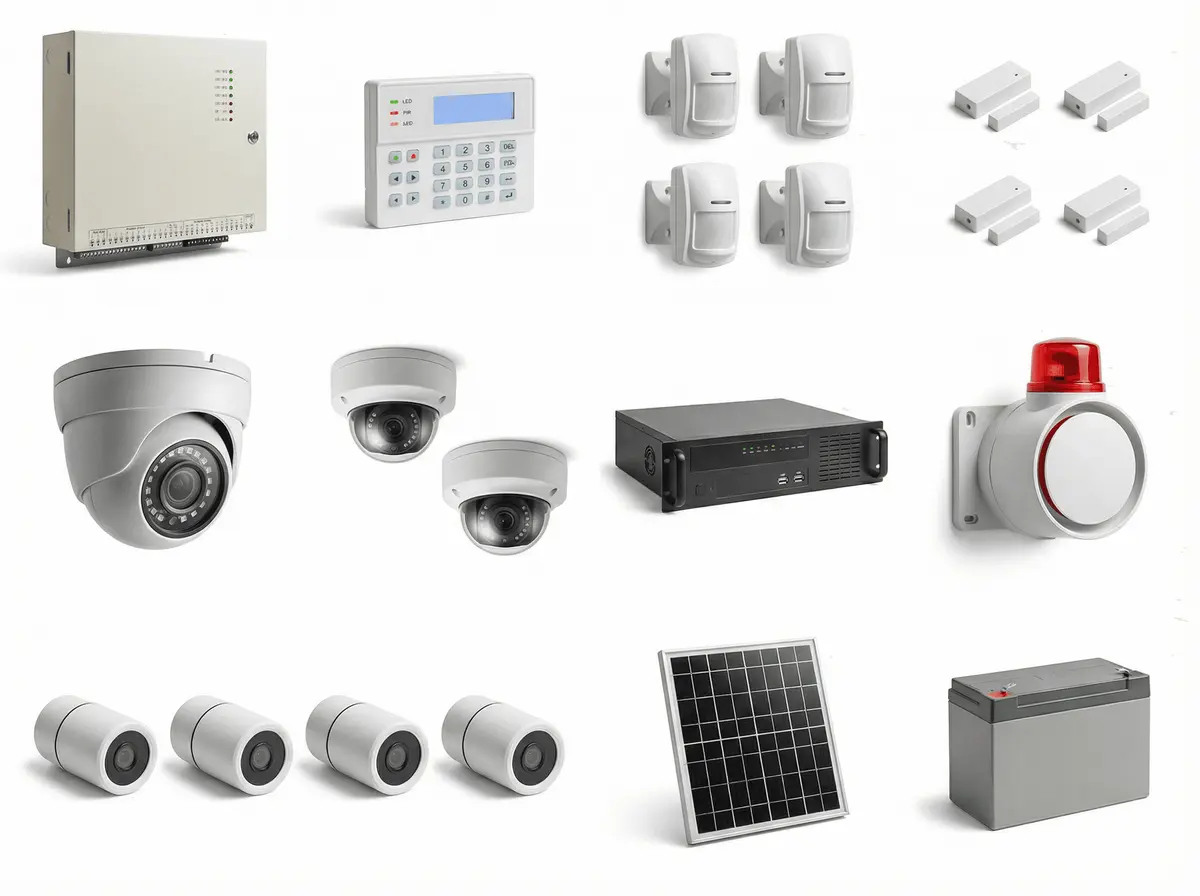
The strongest business case for solar-powered surveillance appears where trenching, utility connection, or civil works are expensive. Perimeter roads, tank farms, rural substations, telecom sites, temporary construction zones, and overflow parking are common examples. A solar node can include PV modules, MPPT controller, LiFePO4 battery, pole cabinet, 4G router, and one or more AI cameras with local recording.
According to IRENA (2024), renewable power remains cost-competitive for distributed applications, especially where diesel or grid extension costs are high. According to NREL (2024), solar-plus-storage improves resilience for critical edge loads and reduces outage exposure. For security buyers, that translates into higher uptime during utility interruptions and lower civil installation cost.
Typical solar sizing logic for AI camera nodes
A single AI bullet or turret camera with communications hardware often draws 8-20 W, while a PTZ plus edge compute package may draw 25-60 W; battery sizing should therefore be based on daily Wh load and worst-month irradiance.
Sample deployment scenario (illustrative): a 15 W fixed AI camera plus 8 W router and 7 W edge device creates a 30 W continuous load, or about 720 Wh/day. With 2 days of autonomy, usable battery should be about 1.4-1.8 kWh after depth-of-discharge margin, and PV may need roughly 250-400 W depending on site irradiance and seasonal losses. For a lighter 12-18 W package in high-sun regions, 80-200 W PV may be enough.
| Solar node type | Continuous load | Suggested PV size | Battery autonomy | Typical use case |
|---|---|---|---|---|
| Single fixed AI camera | 12-18 W | 80-150 W | 1-2 days | Gate, fence corner, rural road |
| Fixed camera + 4G + edge box | 20-35 W | 150-300 W | 2 days | Fuel tank edge, depot lane |
| PTZ + comms + edge compute | 35-60 W | 300-600 W | 2-3 days | Port yard, perimeter tower |
| Multi-camera pole node | 60-120 W | 600-1,200 W | 2-3 days | Parking lot, logistics yard |
SOLAR TODO is relevant here because many buyers do not procure cameras in isolation. They procure a site package that may include solar power, storage, smart poles, telecom structures, and cloud monitoring. That is especially relevant in Latin America, Africa, Southeast Asia, and the Middle East, where mixed grid quality and large outdoor footprints are common.
Use Cases, Regional Economics, and Comparison by Site Type
AI camera ROI is strongest where one system protects high-risk zones for 24/7 operations, with common payback of 24-48 months in fuel retail, logistics, ports, and public facilities.
The Gas Station Chain 32-Zone Cloud package is a clear example of multi-site economics. It supports 32 protected zones, 16 HD IP cameras, 32 primary detector points, and 30 days of 4K video retention with 4G, Ethernet, and WiFi communications. For chain operators managing 5 to 500 stations, the value is standardized visibility, faster alarm verification, and better evidence handling across cashier zones, forecourts, tank fill points, and back-office doors.
The Port Terminal 96-Zone Full Security package fits larger footprints where 48 cameras, 96 detectors, and 1,000 m of electric fence are needed across gates, quays, customs lanes, and perimeter sectors. The Government Building 128-Zone Maximum package expands to 64 cameras and 128 zones for multi-floor public buildings, archives, and administrative compounds. These examples show how AI cameras work best when paired with intrusion logic, not as standalone video islands.
Regional ROI and deployment economics
Regional ROI differs because labor, utility reliability, civil works cost, and shrinkage rates differ, but solar-assisted AI surveillance often improves total cost of ownership in remote and perimeter applications.
| Region | Typical application | AI + solar benefit | Indicative payback |
|---|---|---|---|
| Asia-Pacific | Industrial parks, depots, ports | Lower wiring cost, better fleet monitoring | 24-42 months |
| Europe | Municipal sites, energy assets | Compliance, lower false alarms, power resilience | 30-48 months |
| North America | Fuel retail, schools, utilities | Faster verification, reduced guard dispatch | 24-40 months |
| Middle East & Africa | Remote compounds, roads, terminals | Avoid trenching, maintain uptime in weak-grid areas | 18-36 months |
| Latin America | Gas stations, logistics yards | Lower theft exposure, rapid deployment | 20-36 months |
EPC Investment Analysis and Pricing Structure
Security camera projects are usually bought in three layers—FOB Supply, CIF Delivered, and EPC Turnkey—and buyers should model 24-48 month payback, 5-15% volume discounts, and battery-backed uptime gains before comparing bids.
EPC means Engineering, Procurement, and Construction. In practical terms, EPC turnkey delivery usually includes site survey, bill of materials, pole or bracket design, cable schedule, control panel integration, network design, installation, commissioning, testing, and operator training. For larger security_system projects, it may also include civil works, cabinets, solar power subsystems, and cloud platform setup.
The three-tier commercial structure is straightforward:
- FOB Supply: factory supply only, suitable when the buyer or local integrator handles freight, installation, and commissioning.
- CIF Delivered: equipment plus freight and insurance to destination port, suitable when import and local works are managed by the buyer.
- EPC Turnkey: full delivery including installation and commissioning, suitable for multi-site or compliance-heavy projects.
Using known SOLAR TODO package ranges as references, the Port Terminal 96-Zone Full Security package sits in the USD 16,500-21,300 EPC range, while the Government Building 128-Zone Maximum package sits in the USD 36,300-46,600 EPC range. Supply-only and CIF options are typically lower, depending on camera brand, storage depth, pole quantity, and communications scope.
Volume pricing guidance for standardized fleets:
- 50+ units: about 5% discount
- 100+ units: about 10% discount
- 250+ units: about 15% discount
Payment terms commonly used in export projects are:
- 30% T/T deposit + 70% against B/L
- 100% L/C at sight
Financing may be available for large projects above USD 1,000,000, subject to scope, jurisdiction, and credit review. For pricing, EPC discussion, and warranty terms, buyers can contact [email protected] or SOLAR TODO at +6585559114 for an offline quotation. This is a project supply model, not an online marketplace.
FAQ
A practical AI-powered security camera project in 2026 should target 90%+ relevant detection accuracy, 15-30 days of retention, and a power design that matches either grid reliability or 1-3 days of solar-backed autonomy.
Q: What makes an AI-powered security camera different from standard CCTV? A: An AI-powered camera classifies events such as person, vehicle, or intrusion instead of only recording motion. That can reduce nuisance alarms by 60-90% in many perimeter and retail scenes. Standard CCTV often records everything, but AI systems help operators review fewer, higher-value events.
Q: How accurate are AI security cameras in 2026? A: Most commercial systems deliver about 85-98% detection accuracy in controlled use cases, depending on lighting, scene complexity, and model tuning. Accuracy is usually higher for person and vehicle detection than for complex behaviors such as loitering or crowd analysis. Buyers should request scene-specific test criteria, not generic claims.
Q: Why do false alarms still happen with AI analytics? A: False alarms still occur because weather, shadows, glare, insects, headlight bloom, and poor camera angle can affect inference quality. Even a 95% accurate model can create operational noise if zones are badly configured. Good placement, correct lens selection, and analytics tuning matter as much as the AI label.
Q: When does solar integration make sense for security cameras? A: Solar makes sense when trenching power is expensive, when the grid is unstable, or when cameras are placed 100-1,000 m from the nearest reliable supply. Typical remote nodes use 80-200 W PV for light loads and 300-600 W for PTZ or edge-compute loads. The savings often come from avoided civil works, not only electricity.
Q: How much power does a solar security camera system need? A: A single fixed AI camera with router may draw 12-18 W continuously, while a PTZ with edge processing may draw 35-60 W. That means daily energy use can range from about 288 Wh to 1,440 Wh. Battery sizing should cover 1-3 days of autonomy using worst-month solar assumptions.
Q: What retention period should commercial buyers specify? A: Most B2B projects specify 15-30 days of video retention, with 30 days common for fuel retail, logistics, and public-sector sites. The right number depends on incident reporting cycles, local policy, and insurance requirements. Higher retention increases storage cost, often by 25-40% of total system value.
Q: Which standards should be listed in a tender or RFQ? A: Buyers should usually reference IEC 62676 for video surveillance, EN 50131 for intrusion systems, UL 681 for installation practice, and NFPA 72 principles where alarm signaling is involved. These standards help define performance, acceptance, and integration expectations. They also reduce ambiguity across multi-vendor bids.
Q: What is the ROI for upgrading from conventional CCTV to AI video? A: Many commercial sites see payback in 24-48 months when AI reduces guard dispatches, shortens review time, and improves incident evidence. Fuel stations, depots, and ports often benefit fastest because they operate 24/7 and have multiple risk zones. Actual ROI depends on labor cost, theft exposure, and civil works savings.
Q: How should buyers compare edge AI versus cloud AI? A: Edge AI processes events on the camera or local device, which can cut upstream bandwidth by 50-90% and improve response during network outages. Cloud AI offers easier fleet-wide updates and centralized analytics. Large portfolios often use a hybrid model: edge for first-pass detection and cloud for management and reporting.
Q: What does EPC turnkey include for a security camera project? A: EPC turnkey usually includes engineering, procurement, installation, commissioning, testing, and training. It may also include poles, cabinets, solar power subsystems, networking, and cloud setup. Compared with FOB or CIF supply, EPC gives buyers one accountable scope for delivery and acceptance.
Q: What pricing and payment terms are typical for SOLAR TODO security projects? A: SOLAR TODO usually works on offline quotations with FOB Supply, CIF Delivered, or EPC Turnkey structures. Standard export payment terms are 30% T/T plus 70% against B/L, or 100% L/C at sight. Volume guidance is typically 5% off at 50+, 10% at 100+, and 15% at 250+ units.
Q: How do the SOLAR TODO security_system packages fit different site sizes? A: The Gas Station Chain 32-Zone Cloud fits multi-site fuel retail with 16 cameras and 32 zones. The Port Terminal 96-Zone Full Security fits larger outdoor yards with 48 cameras and 96 detectors. The Government Building 128-Zone Maximum fits public-sector campuses needing 64 cameras and 128 zones under one platform.
References
A 2026 procurement decision should rely on standards-backed specifications and source-cited market data, especially IEC 62676, EN 50131, UL 681, IEA, IRENA, NREL, and Fraunhofer ISE publications from 2024-2025.
- IEA (2024): World Energy Outlook 2024 and related digitalization analysis covering electricity demand growth from AI, data centres, and infrastructure.
- IRENA (2024): Renewable Capacity Statistics 2024 and cost competitiveness data for distributed renewable applications.
- NREL (2024): Distributed energy, solar-plus-storage, and resilience research relevant to remote power for security loads.
- IEC 62676 (latest applicable edition): Video surveillance systems for use in security applications.
- EN 50131 (latest applicable edition): Alarm systems for intrusion and hold-up applications.
- UL 681 (latest applicable edition): Installation and classification of burglary and holdup alarm systems.
- NFPA 72 (2025): National Fire Alarm and Signaling Code principles relevant to alarm transmission and interface planning.
- Fraunhofer ISE (2024): Energy system and digital infrastructure research relevant to distributed optimization and resilient electrical design.
Conclusion
AI-powered security cameras in 2026 deliver the best value when buyers specify 90%+ use-case accuracy, 15-30 days of retention, and solar-backed edge nodes where trenching costs are high.
For multi-site fuel retail, ports, and government facilities, SOLAR TODO can combine AI video, intrusion zones, cloud monitoring, and solar infrastructure into one project scope. Bottom line: if your site has remote perimeters, 24/7 operations, or 5-500 locations, a standards-based AI system with hybrid or solar power usually offers better total cost of ownership than conventional CCTV alone.
About SOLARTODO
SOLARTODO is a global integrated solution provider specializing in solar power generation systems, energy-storage products, smart street-lighting and solar street-lighting, intelligent security & IoT linkage systems, power transmission towers, telecom communication towers, and smart-agriculture solutions for worldwide B2B customers.
About the Author

SOLAR TODO
Solar Energy & Infrastructure Expert Team
SOLAR TODO is a professional supplier of solar energy, energy storage, smart lighting, smart agriculture, security systems, communication towers, and power tower equipment.
Our technical team has over 15 years of experience in renewable energy and infrastructure, providing high-quality products and solutions to B2B customers worldwide.
Expertise: PV system design, energy storage optimization, smart lighting integration, smart agriculture monitoring, security system integration, communication and power tower supply.
Cite This Article
SOLAR TODO. (2026). AI-Powered Security Camera Market Report 2026: Detection…. SOLAR TODO. Retrieved from https://solartodo.com/knowledge/ai-powered-security-camera-market-report-2026-detection-accuracy-solar-integration
@article{solartodo_ai_powered_security_camera_market_report_2026_detection_accuracy_solar_integration,
  title = {AI-Powered Security Camera Market Report 2026: Detection…},
  author = {SOLAR TODO},
  journal = {SOLAR TODO Knowledge Base},
  year = {2026},
  url = {https://solartodo.com/knowledge/ai-powered-security-camera-market-report-2026-detection-accuracy-solar-integration},
  note = {Accessed: 2026-05-03}
}
Published: May 3, 2026 | Available at: https://solartodo.com/knowledge/ai-powered-security-camera-market-report-2026-detection-accuracy-solar-integration
Subscribe to Our Newsletter
Get the latest solar energy news and insights delivered to your inbox.
View All Articles