Agricultural Monitoring Systems ROI Data 2026: Crop Yield…

SOLAR TODO
Solar Energy & Infrastructure Expert Team
Watch the video
TL;DR
Agricultural monitoring systems in 2026 are financially attractive when they convert field data into action. Across orchards, tea plantations, and desert reclamation sites, buyers commonly see 20-50% water savings, 5-25% yield improvement, and 1.5-4.0 year payback, with the strongest ROI coming from 10-minute alerts, enough sensing density, and control-ready system design.
Agricultural monitoring systems in 2026 typically cut irrigation water use by 20-50%, reduce fertilizer or pesticide inputs by 10-30%, and lift crop yield by 5-25%, with payback often reaching 1.5-4.0 years across orchard, plantation, and desert reclamation projects.
Summary
Agricultural monitoring systems in 2026 typically cut irrigation water use by 20-50%, reduce fertilizer or pesticide inputs by 10-30%, and lift crop yield by 5-25%, with payback often reaching 1.5-4.0 years across orchard, plantation, and desert reclamation projects.
Key Takeaways
- Quantify baseline losses first: farms with evapotranspiration above 5-10 mm/day and manual scouting intervals of 3-7 days usually see the fastest ROI from 10-minute monitoring data.
- Prioritize water control: soil-moisture-guided irrigation commonly reduces water use by 20-50%, which materially improves payback where pumping energy exceeds $0.08-0.15/kWh.
- Deploy enough sensing density: 10 sensing points across 40 ha or 15 devices across 30 ha typically capture microclimate variation better than 1-2 manual checks per week.
- Use alert automation: SMS, Email, and App Push alarms can shorten frost or disease response time by 1-24 hours, protecting 20-90% of at-risk yield in sensitive stages.
- Compare communications by site size: LoRaWAN usually fits 30-40 ha blocks with low power demand, while 4G LTE is often justified for 50 ha remote sites needing higher data throughput.
- Model ROI by crop value: a 5-15% yield gain in tea, apple, or citrus often produces faster payback than water savings alone when farm-gate value is high.
- Buy on lifecycle cost, not device price: IP67/IP68 field hardware, solar-powered nodes, and 1-2 year warranty terms reduce truck-roll and battery replacement costs over 5 years.
- Structure procurement correctly: SOLAR TODO supports FOB Supply, CIF Delivered, and EPC Turnkey options, with indicative volume discounts of 5% at 50+, 10% at 100+, and 15% at 250+ units.
2026 ROI Benchmarks for Agricultural Monitoring Systems
Agricultural monitoring systems in 2026 most often deliver 1.5-4.0 year payback, 5-25% yield improvement, and 20-50% water savings when paired with disciplined agronomic action rather than passive data collection.
For B2B buyers, the ROI question is not whether sensors collect data. The real question is whether 10-minute field data changes irrigation, frost response, disease timing, and labor scheduling enough to protect margin per hectare. According to IRENA (2024), digitalization and control improve renewable-powered water and farm infrastructure economics by reducing operating losses, while NREL field-control studies consistently show that better measurement improves dispatch and energy use decisions.
In agriculture, the financial case is strongest where three conditions exist: high crop value, high climate variability, and high water or labor cost. Orchards facing frost losses of 20-90% in severe bloom events, tea gardens with slope-driven microclimate variation across 10-500 m elevation changes, and desert reclamation farms with evapotranspiration above 5-10 mm/day all fit this pattern.
SOLAR TODO focuses on these use cases with smart agriculture packages such as Orchard Frost Early Warning 40ha, Tea Garden Precision Monitoring 30ha, and Desert Reclamation Solar+Agriculture 50ha. These are not consumer gadgets. They are field systems with LoRaWAN or 4G LTE communications, solar-powered outdoor nodes, professional cloud monitoring, and alert logic sized for multi-hectare operations.
According to the International Energy Agency, “Digitalization is becoming an increasingly important tool for improving efficiency, resilience and flexibility across energy systems.” That statement applies directly to irrigation pumping, remote sensing, and low-power field telemetry where every avoided truck roll and every avoided over-irrigation cycle has a measurable cost effect.
2026 market context and adoption trend
The agricultural IoT and monitoring market is growing because water stress, labor shortages, and climate volatility are moving from seasonal issues to balance-sheet issues. According to MarketsandMarkets (2024), the smart agriculture market is projected above $20 billion before 2030 with double-digit CAGR, while BloombergNEF (2024) notes that falling solar-plus-storage costs continue to improve the economics of off-grid and weak-grid monitoring assets.
According to IEA (2024), electricity demand for water pumping and distributed equipment management is rising in many agricultural regions, which makes solar-powered monitoring more attractive where diesel logistics or unstable grid supply increase downtime risk. For procurement teams, this means sensor ROI should be evaluated together with communications uptime, power autonomy, and serviceability.
| Metric | 2022 | 2024 | 2026 | 2030 outlook |
|---|---|---|---|---|
| Typical irrigation water savings from sensor-guided control | 15-35% | 18-45% | 20-50% | 25-55% |
| Typical yield uplift from monitored interventions | 3-15% | 4-20% | 5-25% | 6-28% |
| Typical payback period | 2.5-5.0 years | 2.0-4.5 years | 1.5-4.0 years | 1.3-3.5 years |
| Common field data interval | 30-60 min | 15-30 min | 10 min | 5-10 min |
What Drives ROI: Yield Protection, Water Savings, and Labor Reduction
The three strongest ROI drivers are usually 5-25% yield protection, 20-50% irrigation savings, and 10-30% lower input waste from better timing of fertilizer, pesticide, and field labor.
Yield protection matters more than pure cost savings in high-value crops. If a frost event damages blossoms within 1-3 hours, the cost of one missed alert can exceed the full annual software and telemetry budget. In apple and citrus blocks, action thresholds often sit around 0°C to -2.5°C depending on cultivar and stage, so a 10-minute alert cadence is materially better than dawn scouting.
Water savings are the second major lever. In arid projects, over-irrigation often creates a double cost: excess water application and excess pumping energy. According to FAO and multiple precision-agriculture studies, soil-moisture-based irrigation can reduce water consumption by 20-50% without reducing yield, especially where root-zone monitoring replaces fixed-time irrigation schedules.
Labor reduction is less visible but still important. Manual inspection across 30-50 ha often requires 1-2 weekly visits plus reactive emergency checks. Remote dashboards, threshold alarms, and automated reports reduce low-value travel time and allow agronomists to focus on intervention rather than data collection.
ROI formula used by procurement teams
A practical B2B ROI model should combine direct savings and protected revenue. A common formula is: annual ROI benefit = water savings + energy savings + labor savings + avoided crop loss + yield increase value - annual service cost.
Sample deployment scenario (illustrative): a 40 ha orchard with annual irrigation and pumping cost of $18,000, frost-loss exposure of $40,000, and manual inspection labor of $8,000 may justify a monitoring system if it cuts water cost by 25%, labor by 20%, and avoids only 15% of expected frost loss. That alone can produce annual benefit above $15,000.
| ROI Driver | Typical impact range | Main measurement basis |
|---|---|---|
| Water savings | 20-50% | m3/ha, pump runtime, ET-based scheduling |
| Yield uplift | 5-25% | t/ha, quality grade, harvestable output |
| Fertilizer/pesticide reduction | 10-30% | kg/ha, spray frequency, disease timing |
| Labor reduction | 10-25% | site visits/month, inspection hours |
| Loss avoidance in frost/disease events | 5-30% annualized | protected crop value/event |
Technical Configurations and Performance Data by Use Case
LoRaWAN systems covering 30-40 ha with 10-15 sensing points and 10-minute intervals usually provide the best cost-to-coverage ratio, while 4G LTE suits 50 ha remote sites that need higher bandwidth or independent backhaul.
The technical design must match agronomic risk. A frost-sensitive orchard needs distributed air-temperature, humidity, wind, rainfall, and soil probes plus fast alerts. A tea plantation needs weather, soil, and disease imaging across slope and canopy variation. A desert reclamation site needs weather, 7-parameter soil analysis, water-quality monitoring, and automated drip control tied to a stable solar power source.
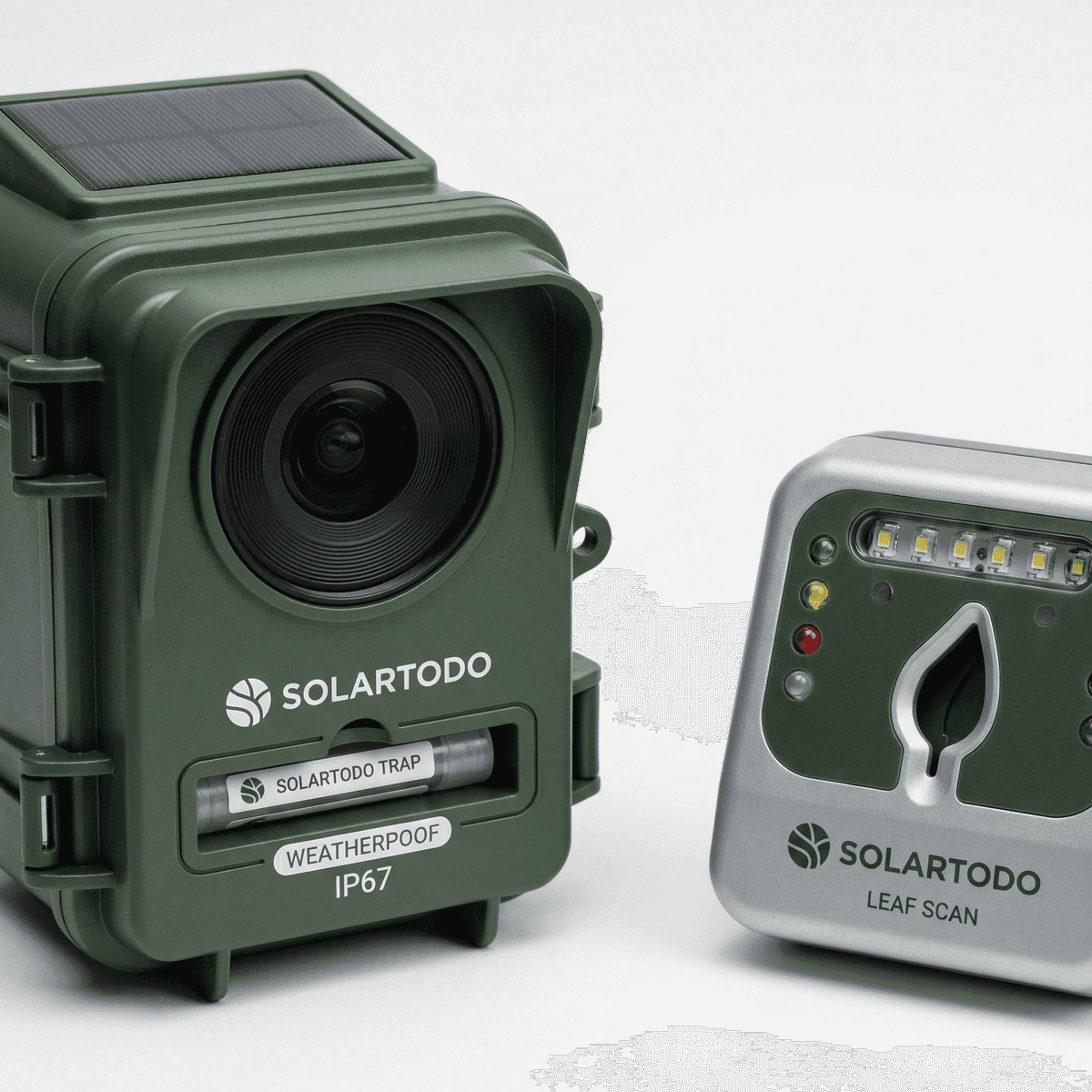
SOLAR TODO offers three relevant reference configurations from its smart agriculture portfolio. The Orchard Frost Early Warning 40ha package covers 40 hectares with 10 field sensing points, LoRaWAN communication, solar-powered outdoor nodes, and SMS + Email + App Push alerts. The Tea Garden Precision Monitoring 30ha package covers 30 hectares with 15 sensors/devices, 10-minute intervals, one multispectral leaf scanner, and a professional cloud tier. The Desert Reclamation Solar+Agriculture 50ha package covers 50 hectares with 20 sensors, 4G LTE communications, 500 kW solar PV support, 4 water-quality points, and automated drip irrigation control.
According to WMO guidance, weather data quality depends on siting, calibration, and maintenance discipline, not just sensor count. According to ISO 11783, data interoperability matters when monitoring outputs must connect to irrigation control, farm management software, or mixed-vendor machinery.
| System | Coverage | Communications | Devices/Points | Data interval | Core ROI use |
|---|---|---|---|---|---|
| Orchard Frost Early Warning 40ha | 40 ha | LoRaWAN | 10 sensing points | 10 min | Frost loss reduction, wind machine control |
| Tea Garden Precision Monitoring 30ha | 30 ha | LoRaWAN | 15 sensors/devices | 10 min | Disease timing, irrigation optimization |
| Desert Reclamation Solar+Agriculture 50ha | 50 ha | 4G LTE | 20 sensors | 10 min | Water-energy control, drip automation |
Technical specification factors that affect ROI
Sensor protection rating matters because IP67/IP68 field hardware survives washdown, dust, and seasonal storms better than lower-grade enclosures. Power architecture matters because solar-powered nodes reduce trenching and AC wiring cost, especially across 30-50 ha. Communications matter because packet loss and dead zones directly reduce trust in alarms.
The International Energy Agency states, “Data and digital technologies can unlock significant efficiency gains when paired with operational decision-making.” For farm operators, that means a dashboard alone is not enough. The system must trigger action through alarms, control outputs, and clear threshold logic.
Regional ROI Data: Asia-Pacific, Europe, North America, Middle East/Africa, and Latin America
Regional ROI in 2026 ranges from roughly 1.5-3.0 years in water-stressed, high-value crop zones to 3.0-5.0 years in lower-value or subsidy-distorted markets where water and labor costs are lower.
Asia-Pacific shows strong adoption because tea, fruit, horticulture, and export crops combine high hectare value with variable rainfall. Europe sees strong frost and compliance-driven demand in orchards and vineyards, with ROI often driven by yield quality and labor efficiency rather than raw water savings. North America benefits from labor cost reduction, irrigation scheduling, and remote operations over larger block sizes. Middle East/Africa has some of the strongest water-saving economics, especially where pumping energy and water scarcity are severe. Latin America shows a mixed profile, with high ROI in export fruit, sugar, coffee, and citrus where disease timing and irrigation precision affect grade and yield.
According to IRENA (2024), regions with weak-grid agricultural infrastructure gain additional value from solar-powered telemetry because avoided diesel use and avoided outages improve system uptime. According to NREL (2024), remote monitoring paired with distributed solar power improves resilience where line extension cost is high.
| Region | Typical payback | Water savings | Yield uplift | Main ROI driver |
|---|---|---|---|---|
| Asia-Pacific | 1.8-3.5 years | 20-40% | 6-20% | irrigation + disease control |
| Europe | 2.5-4.5 years | 15-30% | 5-15% | frost protection + quality retention |
| North America | 2.0-4.0 years | 20-35% | 5-18% | labor reduction + irrigation control |
| Middle East/Africa | 1.5-3.0 years | 30-50% | 8-25% | water-energy savings |
| Latin America | 2.0-4.0 years | 20-40% | 5-20% | export crop yield + disease timing |
Year-over-year trend analysis, 2022-2040
The 2022-2026 period is defined by falling sensor cost, better LPWAN coverage, and more practical cloud dashboards. Between 2027 and 2030, the main change will be wider use of AI classification for crop stress, disease signatures, and irrigation anomalies, with 5-10 minute intervals becoming standard. From 2030 to 2040, the value will shift further from monitoring to semi-automated control, where weather, soil, and energy data directly adjust irrigation valves, pumps, and frost equipment.
For procurement teams, this means the 2026 buying decision should favor expandable architecture. A system that starts with 10 sensing points but supports more nodes, control relays, and API export will usually outperform a closed low-cost package over 5-8 years.
EPC Investment Analysis and Pricing Structure
For 30-50 ha agricultural monitoring projects, EPC Turnkey delivery usually costs more upfront than FOB Supply but reduces commissioning risk, shortens startup by weeks, and improves 1.5-4.0 year ROI through faster usable data.
EPC in this context means Engineering, Procurement, and Construction or full turnkey delivery. It usually includes site survey, bill of materials, mounting design, solar power sizing for field nodes, gateway placement, sensor installation, communications setup, cloud onboarding, alarm configuration, commissioning, and operator training. For remote agricultural sites, this also reduces the risk of poor gateway siting and under-sized solar kits.
SOLAR TODO supports three commercial structures for B2B buyers:
- FOB Supply: hardware supply only, suitable for buyers with local installers and internal agronomy or controls teams.
- CIF Delivered: hardware plus international delivery to destination port, suitable when import handling is centralized.
- EPC Turnkey: supply, installation, commissioning, and training, suitable for multi-zone projects where uptime and acceptance testing matter.
Indicative volume pricing guidance for repeat procurement is:
- 50+ units: 5% discount
- 100+ units: 10% discount
- 250+ units: 15% discount
Typical payment terms are 30% T/T deposit and 70% against B/L, or 100% L/C at sight. Financing is available for large projects above $1,000K. For commercial quotations, buyers can contact [email protected] or call +6585559114.
Sample deployment scenario (illustrative): if a 40 ha orchard monitoring package costs $18,000 FOB, $22,000 CIF, or $29,000 EPC Turnkey, and annual measurable benefit is $8,000-$14,000 from water savings, labor reduction, and avoided frost loss, payback ranges from roughly 1.3 to 3.6 years depending on scope. In a 50 ha desert reclamation project, coupling monitoring with 500 kW solar-backed pumping and drip automation can improve economics further because water and energy savings compound.
| Commercial model | What is included | Best fit | ROI effect |
|---|---|---|---|
| FOB Supply | Equipment only | experienced EPC or farm engineering team | lowest capex, higher execution risk |
| CIF Delivered | Equipment + shipping | import-managed buyers | moderate capex, simpler logistics |
| EPC Turnkey | delivery + install + commissioning + training | remote or multi-zone projects | highest capex, faster realization |
Selection Guidance for Procurement Managers and Engineers
The best agricultural monitoring system is the one that matches crop risk, field size, and control workflow, with 10-minute data, IP67/IP68 hardware, and a payback target below 4 years.
Start with crop economics. If one hectare of crop value is high, prioritize yield protection and alarm speed over lowest hardware price. If water and pumping cost dominate, prioritize soil probes, ET calculation, and irrigation control outputs. If the site is remote, prioritize solar autonomy, gateway redundancy, and local data buffering.
Then check integration scope. A monitoring-only system is cheaper, but a monitor-and-control system often has better ROI because it converts data into valve actions, pump scheduling, or wind machine start commands. For many B2B projects, the difference between 3.5-year payback and 2.0-year payback is not the sensor itself. It is the control logic attached to the sensor.
SOLAR TODO should be evaluated on total delivered scope rather than device count alone. Buyers can review the broader portfolio at View all Smart Agriculture IoT Monitoring System products or Configure your system online when comparing hectare range, crop profile, and communications architecture.
FAQ
Agricultural monitoring systems usually pay back in 1.5-4.0 years because they combine 20-50% water savings with 5-25% yield improvement and lower labor cost when operators act on alerts quickly.
Q: What is an agricultural monitoring system? A: An agricultural monitoring system is a field network of sensors, gateways, power units, and cloud software that measures weather, soil, water, and crop conditions. Typical systems collect data every 10-30 minutes and support alerts for irrigation, frost, disease, and pump control across 30-50 ha sites.
Q: How much ROI can farms expect in 2026? A: Most commercial projects target payback in 1.5-4.0 years. The strongest cases combine 20-50% irrigation savings, 10-25% labor reduction, and 5-25% yield protection or uplift, especially in orchards, tea plantations, and desert reclamation farms.
Q: Why do some farms get poor ROI from monitoring systems? A: Poor ROI usually comes from low sensor density, weak gateway placement, or no operational response plan. If data is reviewed weekly instead of acted on within 10-60 minutes, farms lose most of the value tied to frost, disease, and irrigation timing.
Q: What crops benefit most from these systems? A: High-value and climate-sensitive crops usually benefit most. Apple, citrus, tea, greenhouse vegetables, berries, and export horticulture often justify monitoring because a 5-15% yield gain or one avoided frost event can cover a large share of annual system cost.
Q: How does LoRaWAN compare with 4G LTE for farm monitoring? A: LoRaWAN usually offers lower power use and lower operating cost for 30-40 ha blocks with distributed nodes. 4G LTE is often better for remote 50 ha sites needing higher bandwidth, direct cloud backhaul, or fewer local network dependencies.
Q: What technical specifications matter most in procurement? A: Buyers should check coverage area, sensing-point count, 10-minute data interval, IP67/IP68 enclosure rating, solar autonomy, cloud service terms, and control outputs. Standards alignment such as WMO guidance and ISO 11783 also matters when data must connect to irrigation or farm software.
Q: How much maintenance do agricultural monitoring systems need? A: Most systems need light but regular maintenance. Common tasks include sensor cleaning, calibration checks, battery health review, solar panel cleaning, and communications verification every 3-12 months depending on dust, rainfall, and crop environment.
Q: Can monitoring systems reduce water and chemical use at the same time? A: Yes, if the farm uses the data for scheduling and threshold-based intervention. Soil moisture, weather, and disease-risk data can reduce irrigation water by 20-50% and cut fertilizer or pesticide use by 10-30% by avoiding routine over-application.
Q: What is included in EPC Turnkey delivery from SOLAR TODO? A: EPC Turnkey typically includes site survey, engineering, hardware supply, installation, communications setup, cloud onboarding, alarm logic, commissioning, and training. This option costs more than FOB Supply, but it usually reduces startup errors and shortens time to usable data.
Q: What are the pricing and payment terms? A: SOLAR TODO commonly supports FOB Supply, CIF Delivered, and EPC Turnkey structures. Standard payment terms are 30% T/T and 70% against B/L, or 100% L/C at sight; projects above $1,000K may qualify for financing, and volume discounts reach 5%, 10%, and 15% at 50+, 100+, and 250+ units.
Q: How should buyers compare vendors beyond headline price? A: Compare total 5-year cost, not only initial hardware price. Check enclosure rating, calibration support, alert reliability, cloud fees, warranty length, local service response, spare parts availability, and whether the platform supports future controls, APIs, and additional sensing points.
Conclusion
Agricultural monitoring systems in 2026 create the best business case when they protect 5-25% of yield and reduce water use by 20-50%, producing typical payback in 1.5-4.0 years across high-value crops.
For B2B buyers, the bottom line is simple: choose expandable monitoring with 10-minute data, field-grade IP67/IP68 hardware, and a clear control workflow. SOLAR TODO is a practical option for 30-50 ha deployments where ROI depends on usable alerts, not just installed sensors.
References
- IEA (2024): World Energy Outlook and digitalization analysis covering efficiency, resilience, and system flexibility impacts.
- IRENA (2024): Renewable capacity and energy transition publications with cost and infrastructure context for distributed renewable-powered systems.
- NREL (2024): PVWatts and distributed energy system performance resources relevant to solar-powered agricultural monitoring and pumping.
- WMO (2023): Weather observation guidance for station siting, data quality, and measurement practice in outdoor environments.
- ISO 11783 (2024): Agricultural machinery and data communication framework supporting interoperability across farm equipment and digital systems.
- BloombergNEF (2024): Energy transition investment and distributed energy cost trend analysis relevant to off-grid and weak-grid agricultural infrastructure.
- FAO (2023): Irrigation efficiency and water productivity guidance relevant to sensor-based irrigation scheduling.
- Wood Mackenzie (2024): Power and distributed infrastructure market analysis relevant to communications, storage, and remote energy economics.
About SOLARTODO
SOLARTODO is a global integrated solution provider specializing in solar power generation systems, energy-storage products, smart street-lighting and solar street-lighting, intelligent security & IoT linkage systems, power transmission towers, telecom communication towers, and smart-agriculture solutions for worldwide B2B customers.
About the Author

SOLAR TODO
Solar Energy & Infrastructure Expert Team
SOLAR TODO is a professional supplier of solar energy, energy storage, smart lighting, smart agriculture, security systems, communication towers, and power tower equipment.
Our technical team has over 15 years of experience in renewable energy and infrastructure, providing high-quality products and solutions to B2B customers worldwide.
Expertise: PV system design, energy storage optimization, smart lighting integration, smart agriculture monitoring, security system integration, communication and power tower supply.
Cite This Article
SOLAR TODO. (2026). Agricultural Monitoring Systems ROI Data 2026: Crop Yield…. SOLAR TODO. Retrieved from https://solartodo.com/knowledge/agricultural-monitoring-systems-roi-data-2026-crop-yield-resource-savings
@article{solartodo_agricultural_monitoring_systems_roi_data_2026_crop_yield_resource_savings,
  title = {Agricultural Monitoring Systems ROI Data 2026: Crop Yield…},
  author = {SOLAR TODO},
  journal = {SOLAR TODO Knowledge Base},
  year = {2026},
  url = {https://solartodo.com/knowledge/agricultural-monitoring-systems-roi-data-2026-crop-yield-resource-savings},
  note = {Accessed: 2026-05-18}
}
Published: May 17, 2026 | Available at: https://solartodo.com/knowledge/agricultural-monitoring-systems-roi-data-2026-crop-yield-resource-savings
Subscribe to Our Newsletter
Get the latest solar energy news and insights delivered to your inbox.
View All Articles