Solar LiDAR Security Systems: Storage & Performance

SOLAR TODO
Solar Energy & Infrastructure Expert Team
Watch the video
TL;DR
Advanced solar-powered security systems with LiDAR are best for B2B sites that need 24/7 resilience, accurate perimeter detection, and lower nuisance alarms. Most projects should size storage for 24-72 hours, match PV arrays to daily load with a 1.2-1.4 design factor, and compare 32-zone, 96-zone, or 128-zone architectures based on risk, camera count, and uptime requirements.
Advanced solar-powered security systems with LiDAR can protect 32-128 zones using 16-64 cameras, while 24-72 hours of battery storage improves uptime and can cut nuisance alarms by up to 90% in high-risk B2B sites.
Summary
Advanced solar-powered security systems with LiDAR can protect 32 to 128 zones using 16 to 64 cameras, while battery storage sized for 24 to 72 hours improves uptime and cuts false alarms by up to 90% when AI analytics are properly configured.
Key Takeaways
- Size battery storage for 24-72 hours of autonomy; a 2.5-5.0 kW security load typically needs about 60-360 kWh depending on irradiance, backup policy, and night operation.
- Combine LiDAR with 16-64 HD cameras to improve perimeter classification accuracy and reduce nuisance alarms by up to 90% versus motion-only legacy CCTV.
- Use 32-zone, 96-zone, or 128-zone architectures to separate forecourt, office, gate, fence, and utility risks instead of merging all events into 1 alarm queue.
- Specify hybrid communications with 4G, Ethernet, and WiFi so alarm reporting and cloud access remain available during single-network failures.
- Design solar arrays with at least 1.2-1.4x the average daily energy demand to cover seasonal variation, battery charging losses, and LiDAR night-duty cycles.
- Compare FOB Supply, CIF Delivered, and EPC Turnkey pricing; projects above 50 units typically qualify for 5% discounts, 100+ for 10%, and 250+ for 15%.
- Verify compliance with EN 50131, IEC 62676, UL 681, and NFPA 72 principles to improve procurement confidence, integration quality, and insurer acceptance.
- Prioritize high-risk sites such as gas stations, ports, and government compounds where 24/7 monitoring, 30-day retention, and rapid evidence retrieval materially improve incident response.
Why Solar-Powered LiDAR Security Systems Matter
Advanced solar-powered security systems with LiDAR typically deliver 24/7 perimeter awareness, 16-64 video channels, and 24-72 hours of battery-backed autonomy, making them suitable for remote or resilience-critical B2B sites.
For procurement managers and engineers, the core question is not whether solar can run security equipment, but how much storage is required to maintain detection performance through cloudy periods, nighttime operation, and communications outages. LiDAR adds a precise ranging layer that complements cameras, PIR detectors, beam sensors, and analytics, especially where lighting conditions are inconsistent or where false alarms create high operating costs.
According to NREL (2024), solar resource modeling remains accurate enough for professional pre-design when paired with site-specific load profiles and loss assumptions. According to IEA (2024), digitalization and electrification are increasing the value of resilient distributed energy systems for critical infrastructure. For security buyers, that means solar-plus-storage is no longer only an off-grid option; it is a business continuity tool.
SOLAR TODO applies this approach across security and surveillance system deployments for fuel retail, government, logistics, and smart infrastructure projects. In practical terms, a solar-powered architecture can support cameras, NVRs, control panels, keypads, sirens, communications gateways, and LiDAR edge processors under one engineered power budget.
The International Energy Agency states, "Solar PV is expected to become the largest renewable power source by installed capacity." That matters because falling PV costs improve the economics of security uptime. IRENA states, "Renewables are powering economic opportunity," and that logic extends directly to lower operating costs for distributed surveillance assets.
System Architecture and Technical Performance
A properly engineered solar LiDAR security system balances 4 variables—load, autonomy, solar yield, and battery depth of discharge—and most commercial sites land in the 2.5-15 kW operating range depending on camera count and analytics intensity.
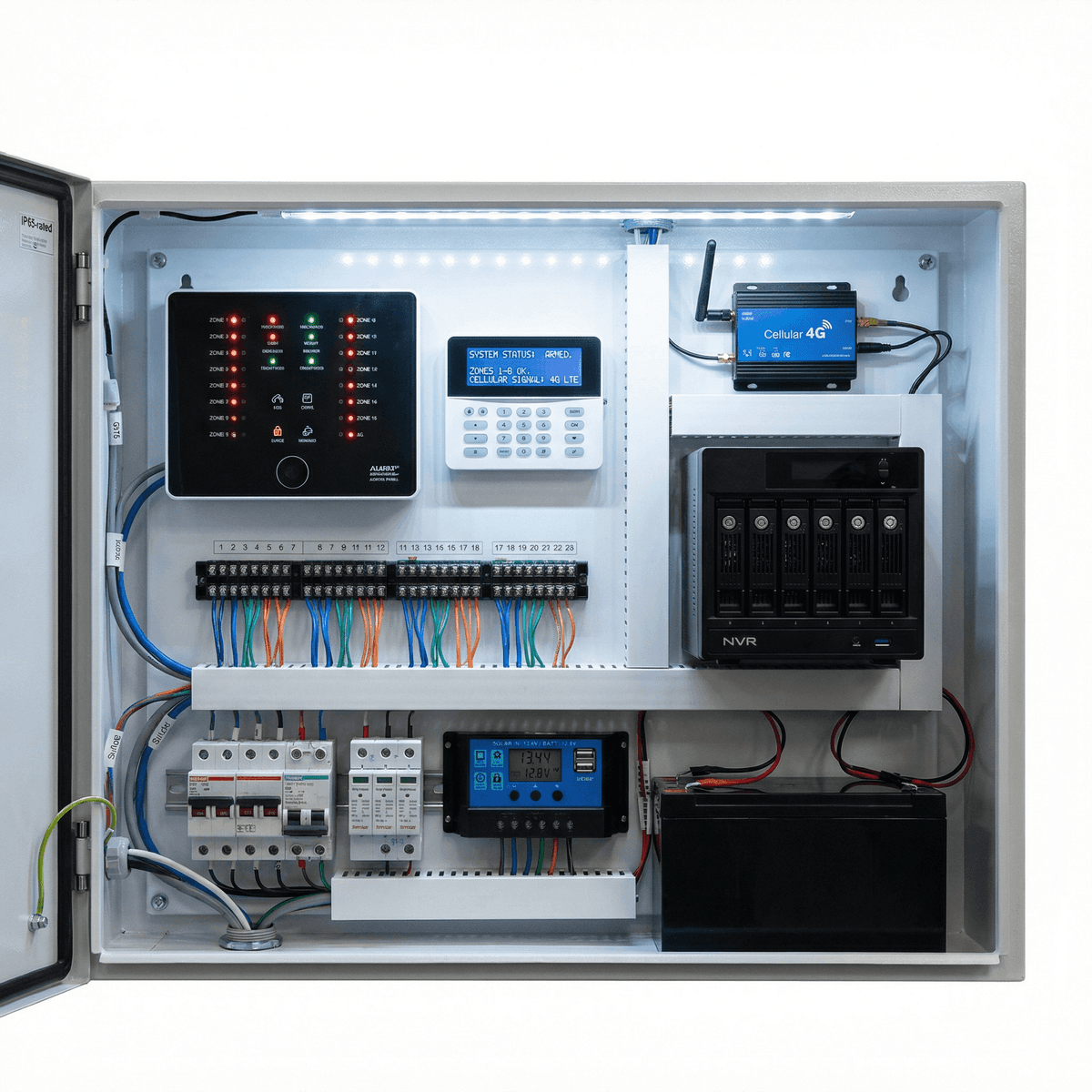
A modern architecture usually includes these subsystems:
- Solar PV array
- MPPT charge controllers or hybrid inverter-chargers
- Lithium battery bank
- DC and AC distribution
- LiDAR sensors for ranging and object mapping
- HD IP cameras and NVR
- Intrusion panel with detectors and sirens
- 4G, Ethernet, and WiFi communications
- Cloud dashboard and local edge analytics
How LiDAR Improves Security Performance
LiDAR improves perimeter security by measuring distance in real time, enabling more reliable detection across 50-300 meters than video-only systems in low light, glare, or partial obscuration.
For ports, fuel depots, substations, and campuses, LiDAR can create virtual intrusion zones with depth awareness. That helps distinguish a person approaching a fence from rain, shadow movement, or small animals. When fused with video analytics, operators gain both spatial coordinates and visual evidence, which improves dispatch quality and reduces wasted guard response.
In B2B deployments, LiDAR is most valuable where there are long perimeters, hazardous areas, or strict response protocols. A gas station chain may use LiDAR to monitor tanker delivery lanes and perimeter edges. A port terminal may use it for fence-line mapping and vehicle corridor monitoring. A government compound may use it to protect layered standoff zones before a person reaches the building envelope.
Load and Storage Sizing Logic
Storage capacity should be calculated from daily energy demand, required autonomy, system losses, and allowable battery depth of discharge; for lithium systems, planners often target 80-90% usable capacity with 10-20% reserve.
A simplified sizing method is:
- Daily load in kWh = sum of all device wattage x operating hours
- Required storage = daily load x autonomy days / usable battery fraction
- PV array size = daily load / peak sun hours x design factor
Example for a medium remote site:
- 24 cameras at 12 W each = 288 W
- 1 NVR and network gear = 250 W
- 1 control panel and detectors = 120 W
- 2 LiDAR units = 160 W
- Communications and auxiliaries = 180 W
- Total continuous load = 998 W, rounded to 1.0 kW
- Daily energy = 24 kWh
- 48-hour autonomy = 48 kWh usable
- At 85% usable lithium capacity, installed battery = about 56.5 kWh
If the site has 5 peak sun hours and a 1.3 design factor for losses and weather margin:
- PV array = 24 / 5 x 1.3 = about 6.24 kW
This is why storage planning cannot be separated from performance analysis. If the battery is undersized, the LiDAR processor or NVR may shut down first, degrading evidence quality even if basic alarms remain active.
Reference Product Classes for B2B Buyers
Commercial buyers typically compare 32-zone, 96-zone, and 128-zone classes because these map well to single-site retail, industrial perimeter, and campus-scale security requirements.
SOLAR TODO commonly aligns system design with these reference classes:
| System class | Typical use case | Zones | Cameras | Key power design note |
|---|---|---|---|---|
| Gas Station Chain 32-Zone Cloud | Fuel retail and convenience sites | 32 | 16 | Grid or hybrid solar backup with 30-day retention |
| Port Terminal 96-Zone Full Security | Ports, yards, bonded logistics | 96 | 48 | Larger battery bank for perimeter and PTZ duty cycles |
| Government Building 128-Zone Maximum | Multi-floor public buildings | 128 | 64 | Highest continuous load and strongest uptime requirement |
According to IEC 62676, video surveillance performance depends not only on camera count but also on scene coverage, recording quality, and operational purpose. In other words, 16 cameras poorly placed are less effective than 12 integrated with LiDAR and well-zoned alarm logic.
Storage Capacity and Performance Analysis by Use Case
For most B2B security projects, the best storage target is not the biggest battery but the lowest-cost capacity that still guarantees 24/7 detection, recording, and communications through the defined outage window.
Gas Station Chains
A 32-zone gas station package with 16 cameras, 32 detector points, and cloud connectivity usually requires about 1.2-2.5 kW continuous power and 30-120 kWh of storage depending on autonomy targets.
Gas stations have mixed risk areas: dispensers, cashier zones, tank fill points, stockrooms, back-office doors, and perimeter gates. LiDAR is useful for vehicle path monitoring, after-hours perimeter intrusion, and tanker interface supervision. Because these sites are often grid-powered, solar may be configured as a resilience layer rather than the sole energy source.
A typical design objective is to maintain 24/7 operation during utility failure while preserving 30 days of video retention locally or in hybrid cloud workflows. For chain operators with 5 to 500 sites, standardizing power architecture reduces maintenance complexity and improves spare-parts planning.
Port Terminals and Logistics Yards
A 96-zone port security system with 48 cameras, electric fence interfaces, and LiDAR perimeter mapping often operates in the 4-10 kW range and may need 100-500 kWh storage for 24-48 hour resilience.
Ports are demanding because PTZ cameras, long fence lines, beam sets, network switches, and edge analytics all add load. Salt-air exposure and high winds also affect enclosure selection, cable routing, and maintenance intervals. LiDAR helps where scene depth is large and where operators must classify people, vehicles, and approach vectors across open yards.
According to BloombergNEF (2024), battery system economics continue to improve, which supports larger resilience-oriented installations. However, the right answer is still project-specific: some terminals prefer a solar-hybrid system that carries core detection loads only, while others power the full surveillance stack.
Government Buildings and Campuses
A 128-zone government deployment with 64 cameras, multiple partitions, and layered analytics can exceed 8-15 kW continuous demand, making solar contribution, battery segmentation, and critical-load prioritization essential.
Government sites often require separate partitions for lobby, archive, executive area, IT room, perimeter, and public service halls. LiDAR is useful for standoff detection and layered approach monitoring before a threat reaches controlled doors. In these projects, the storage strategy often separates mission-critical loads from convenience loads so that detection, recording, and alarm signaling remain active longer than nonessential devices.
According to UL 681, installation quality and system classification are central to dependable alarm performance. That is why B2B buyers should review not only battery kWh but also transfer logic, surge protection, grounding, enclosure ratings, and maintenance access.
EPC Investment Analysis and Pricing Structure
For advanced solar-powered security systems, EPC turnkey delivery combines engineering, procurement, construction, commissioning, and performance verification into 1 contract structure, reducing interface risk and shortening deployment timelines.
For B2B buyers, the three common commercial models are:
| Pricing model | What it typically includes | Best for |
|---|---|---|
| FOB Supply | Equipment only, factory handover, packing list, manuals | Experienced local integrators |
| CIF Delivered | Equipment plus sea freight and insurance to destination port | Importers managing local installation |
| EPC Turnkey | Design, supply, installation, testing, training, commissioning | End users seeking single-point accountability |
A practical pricing framework for security_system projects is:
- 32-zone class: lower capital range, especially for hybrid backup at grid-powered sites
- 96-zone class: mid-range due to perimeter devices, PTZ cameras, and larger storage
- 128-zone class: highest range due to camera density, partitions, and critical-load engineering
Based on SOLAR TODO project practice and the listed reference packages, buyers can expect turnkey pricing to vary significantly by battery capacity, LiDAR count, communications redundancy, civil works, and retention requirements. The Government Building 128-Zone Maximum is positioned in the EPC turnkey range of USD 36,300 to USD 46,600, while the Port Terminal 96-Zone Full Security is positioned around USD 16,500 to USD 21,300 for turnkey EPC scope.
Volume pricing guidance:
- 50+ units: 5% discount
- 100+ units: 10% discount
- 250+ units: 15% discount
Standard payment terms:
- 30% T/T deposit + 70% against B/L
- Or 100% L/C at sight
Financing is available for large projects above USD 1,000K. For quotations, EPC discussions, and project financing support, contact cinn@solartodo.com.
ROI and Operating Economics
Solar-hybrid security systems usually produce ROI through avoided downtime, lower diesel or grid backup costs, fewer nuisance dispatches, and better incident evidence rather than through energy savings alone.
A simple ROI model should include:
- Avoided outage losses from uninterrupted surveillance
- Reduced guard dispatches due to better detection accuracy
- Lower fuel and generator maintenance costs
- Lower incident investigation cost through better evidence retrieval
- Longer asset life from stable power conditioning
If LiDAR and analytics reduce nuisance alarms by up to 90% compared with motion-only legacy CCTV, the labor savings can materially shorten payback. For remote or generator-dependent sites, replacing part of backup fuel use with solar can further improve economics. Many projects reach acceptable payback in 3-6 years when security labor, outage risk, and fuel logistics are included.
Comparison and Selection Guide
The best system choice depends on whether your highest priority is perimeter depth, multi-site standardization, or maximum zone density, and that decision usually determines whether storage should be 24, 48, or 72 hours.
Use the following comparison to guide specification:
| Selection factor | Basic camera + alarm | Solar-powered camera + alarm | Solar-powered LiDAR + camera + alarm |
|---|---|---|---|
| Detection quality | Moderate | Moderate to high | High |
| Low-light performance | Camera-dependent | Camera-dependent | Strong due to ranging layer |
| False alarm resistance | Low to moderate | Moderate | High |
| Battery requirement | Low | Medium | Medium to high |
| Best use case | Small indoor sites | Standard remote sites | Critical perimeters and complex outdoor zones |
| Typical autonomy target | 8-24 h | 24-48 h | 24-72 h |
Procurement Checklist
A professional procurement checklist should verify 8 core items: load profile, autonomy hours, LiDAR coverage, camera retention, network redundancy, standards alignment, maintenance plan, and commercial terms.
Before issuing an RFQ, confirm:
- Total continuous and peak load in kW
- Required autonomy in hours or days
- Number of zones, cameras, and detector points
- LiDAR range, field of view, and integration method
- Recording retention target such as 30 days
- Communications paths: 4G, Ethernet, WiFi, or fiber
- Compliance targets: EN 50131, IEC 62676, UL 681, NFPA 72 principles
- Delivery model: FOB, CIF, or EPC turnkey
SOLAR TODO can support this process for multi-site B2B projects where security, solar, storage, and smart infrastructure need to be coordinated under one supplier workflow.
FAQ
Advanced solar-powered LiDAR security systems usually need 24-72 hours of storage autonomy, and the right answer depends on continuous load, site irradiance, and whether the system must keep cameras, NVR, and cloud links active during outages.
Q: What is an advanced solar-powered security system with LiDAR integration? A: It is a security and surveillance system that combines solar PV, lithium battery storage, cameras, alarms, communications, and LiDAR sensors in one power-managed architecture. The LiDAR layer adds distance-based detection, which improves outdoor perimeter awareness and supports more reliable analytics than video-only systems in difficult lighting.
Q: How much battery storage does a solar security system usually need? A: Most commercial systems are sized for 24 to 72 hours of autonomy, not just one night of operation. A site with a 1 kW continuous load needs about 24 kWh per day, so a 48-hour lithium design typically lands near 50 to 60 kWh after usable-capacity and reserve margins are included.
Q: Why add LiDAR if the site already has HD cameras? A: LiDAR adds depth and distance measurement, which helps classify movement more accurately across open outdoor spaces. This is especially valuable at ports, fuel stations, and campuses where glare, shadows, rain, or headlight bloom can reduce the reliability of video-only analytics.
Q: Can solar run a 32-zone or 96-zone security system continuously? A: Yes, if the PV array and battery are engineered around the actual load profile and local solar resource. A 32-zone system may operate in the 1.2-2.5 kW range, while a 96-zone system can reach 4-10 kW, so storage and array size must be matched to autonomy requirements.
Q: What standards should buyers request in tender documents? A: Buyers should reference EN 50131 for intrusion systems, IEC 62676 for video surveillance, UL 681 for installation practices, and NFPA 72 principles for signaling integration. These standards do not replace local code, but they give procurement teams a recognized technical baseline for comparing bids.
Q: How does LiDAR affect system power consumption? A: LiDAR increases load, but usually by a manageable amount compared with the total demand of cameras, NVRs, switches, and communications equipment. In many commercial designs, one or two LiDAR units add tens to low hundreds of watts, which is significant for storage sizing but often justified by better perimeter performance.
Q: What is the difference between FOB, CIF, and EPC turnkey pricing? A: FOB Supply covers equipment at factory handover, CIF adds freight and insurance to the destination port, and EPC Turnkey includes engineering, installation, testing, and commissioning. End users with limited local integration capacity usually prefer EPC because it reduces coordination risk and simplifies accountability.
Q: What payment terms are common for these projects? A: Standard international terms are often 30% T/T in advance and 70% against B/L, or 100% L/C at sight. For larger programs above USD 1,000K, financing support may be available depending on project scope, country risk, and buyer profile.
Q: How long is the typical ROI period for solar-powered security systems? A: Many projects reach practical payback in about 3 to 6 years when avoided downtime, reduced diesel use, and fewer false dispatches are included. The ROI is usually stronger at remote sites or high-risk sites where a single outage or missed event has material operational cost.
Q: Are these systems suitable for gas stations and hazardous areas? A: Yes, but the design must separate hazardous-area considerations from standard electronics placement and follow the applicable local safety rules. In gas station projects, LiDAR and cameras are often positioned to monitor forecourts, tanker delivery interfaces, cashier zones, and perimeter approaches without compromising operational safety.
Q: What maintenance is required for solar-powered LiDAR security systems? A: Maintenance usually includes PV cleaning as needed, battery health checks, firmware updates, detector testing, camera cleaning, and network verification. Most B2B operators schedule quarterly visual checks and at least one deeper preventive maintenance visit every 6 to 12 months.
Q: How should a buyer compare suppliers for a multi-site program? A: Compare them on total uptime design, not just equipment count or lowest capex. The best evaluation matrix includes zone architecture, storage autonomy, standards alignment, cloud management, local service capability, spare-parts strategy, and whether the supplier can support solar, storage, and security integration under one scope.
References
Advanced solar-powered LiDAR security system design should be benchmarked against at least 5 authoritative sources, and the references below cover solar performance, surveillance standards, alarm installation, and renewable energy economics.
- NREL (2024): PVWatts and solar resource modeling methodology used for estimating PV output, losses, and site-specific production.
- IEC 62676 (2024): Video surveillance systems for use in security applications; framework for performance, system design, and operational requirements.
- EN 50131 (2024): Intrusion and hold-up systems standard family covering system requirements and grading concepts.
- UL 681 (2023): Installation and classification standard for burglary and holdup alarm systems.
- NFPA 72 (2022): National Fire Alarm and Signaling Code principles relevant to alarm signaling pathways and integration practices.
- IEA (2024): Energy sector analysis showing the growing role of distributed electrification and resilient power systems.
- IRENA (2024): Renewable power cost and market analysis supporting the economic case for solar-powered infrastructure.
- BloombergNEF (2024): Market intelligence on battery and clean energy cost trends relevant to storage-backed security systems.
Conclusion
Advanced solar-powered security systems with LiDAR deliver the strongest value when 24-72 hours of storage, 16-64 cameras, and standards-based design are matched to the site’s real risk profile and uptime target.
For gas stations, ports, and government sites, SOLAR TODO recommends specifying storage from the load profile first, then selecting LiDAR, cameras, and EPC scope around that power budget. The bottom line is simple: a well-sized solar-plus-storage security system improves resilience, reduces nuisance response, and protects evidence quality better than an undersized camera-only design.
About SOLARTODO
SOLARTODO is a global integrated solution provider specializing in solar power generation systems, energy-storage products, smart street-lighting and solar street-lighting, intelligent security & IoT linkage systems, power transmission towers, telecom communication towers, and smart-agriculture solutions for worldwide B2B customers.
About the Author

SOLAR TODO
Solar Energy & Infrastructure Expert Team
SOLAR TODO is a professional supplier of solar energy, energy storage, smart lighting, smart agriculture, security systems, communication towers, and power tower equipment.
Our technical team has over 15 years of experience in renewable energy and infrastructure, providing high-quality products and solutions to B2B customers worldwide.
Expertise: PV system design, energy storage optimization, smart lighting integration, smart agriculture monitoring, security system integration, communication and power tower supply.
Cite This Article
SOLAR TODO. (2026). Solar LiDAR Security Systems: Storage & Performance. SOLAR TODO. Retrieved from https://solartodo.com/knowledge/advanced-solar-powered-security-systems-with-lidar-integration-storage-capacity-and-performance-analysis
@article{solartodo_advanced_solar_powered_security_systems_with_lidar_integration_storage_capacity_and_performance_analysis,
  title = {Solar LiDAR Security Systems: Storage & Performance},
  author = {SOLAR TODO},
  journal = {SOLAR TODO Knowledge Base},
  year = {2026},
  url = {https://solartodo.com/knowledge/advanced-solar-powered-security-systems-with-lidar-integration-storage-capacity-and-performance-analysis},
  note = {Accessed: 2026-04-20}
}
Published: April 20, 2026 | Available at: https://solartodo.com/knowledge/advanced-solar-powered-security-systems-with-lidar-integration-storage-capacity-and-performance-analysis
Subscribe to Our Newsletter
Get the latest solar energy news and insights delivered to your inbox.
View All Articles