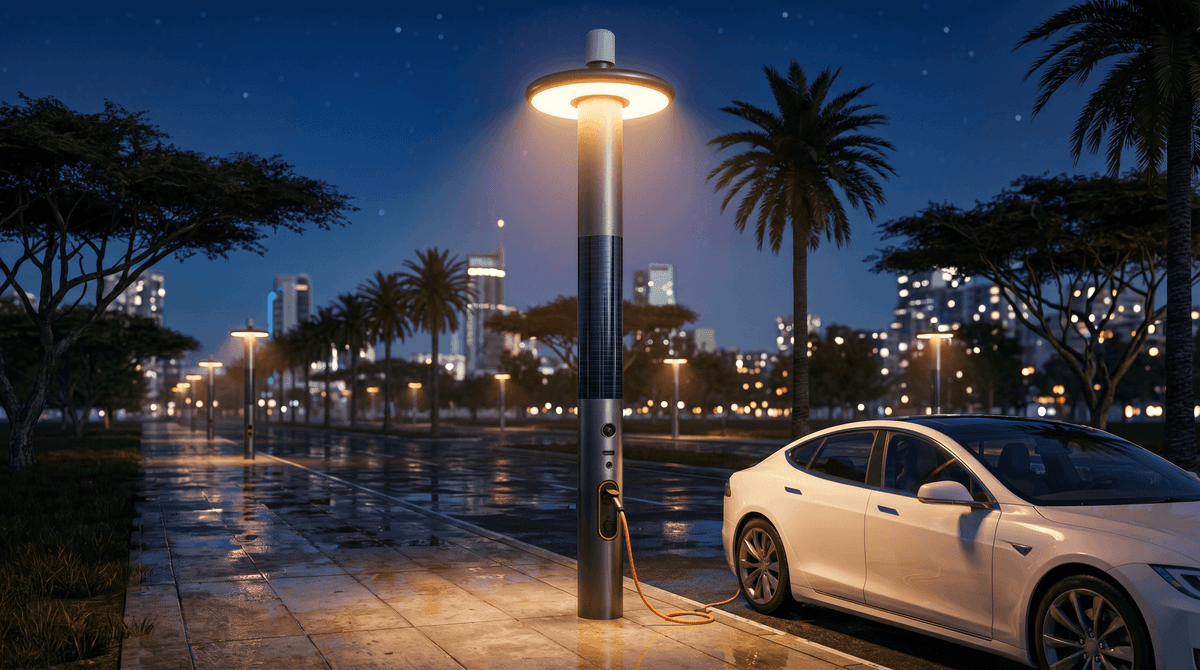
225-Unit Smart Streetlight Deployment in Addis Ababa, Ethiopia Featuring 11m Seamless Round Poles and 7kW×2 EV Charging
Summary
This Addis Ababa project deployed 225 SOLAR TODO Smart Streetlight units on 11m seamless round poles at 25m spacing, combining 80W/12,000lm lighting, 4MP cameras, 12-parameter sensors, dual 7kW EV charging, and 5G-ready communications on one street asset.
Key Takeaways
- 225 SOLAR TODO Smart Streetlight units were installed in Addis Ababa using 11m Φ219mm round tubular steel poles with 6mm wall thickness and hot-dip galvanized silver-grey finish.
- Each pole integrates an 80W LED head delivering 12,000 lumens at 4000K and 150 lm/W through a circular PMMA diffuser dome flush with the pole top.
- Environmental monitoring is handled by a 12-parameter top sensor measuring temperature, humidity, wind, pressure, noise, PM2.5, PM10, CO, NO2, O3, rain, and illuminance.
- Safety modules include a recessed 4MP vandal-proof turret camera with 30m IR range and a 30W, 93dB TCP/IP networked IP audio column for public address and emergency communication.
- Mobility services are built in through a dual-gun AC charger rated at 7kW×2 with OCPP 1.6J support, plus dual USB ports rated at 5V/2.4A × 2.
- Communications infrastructure includes a standalone 4G gateway with RS485 + 4G uplink and a 5G NR n78 small cell configuration using 4T4R MIMO with 200m coverage.
- The project used 25m pole spacing and a clean seamless cylindrical design with flush-mounted modules, reducing streetscape clutter compared with separate light, CCTV, display, telecom, and charging assets.
Project Background
Addis Ababa at coordinates 9.02, 38.75 requires higher-capacity urban street infrastructure because one corridor often has to support lighting, traffic safety, environmental monitoring, public communication, and telecom expansion within limited right-of-way. In dense corridors, conventional deployment means separate poles for luminaires, CCTV, speakers, displays, telecom equipment, and EV charging, which increases visual clutter, civil works complexity, and maintenance overhead.
The city also faces practical infrastructure constraints common to fast-growing African capitals: mixed pedestrian and vehicle traffic, variable road widths, pressure on public safety systems, and a need for better digital visibility of street conditions. According to the World Bank (2023), cities that improve core urban service delivery and digital infrastructure can strengthen operational efficiency and resilience, especially in rapidly urbanizing environments. According to the International Energy Agency, or IEA (2023), efficient public lighting remains one of the most accessible municipal energy upgrades because LED systems materially reduce electricity demand compared with legacy lighting.
Addis Ababa's challenge was not simply to add brighter lights. It was to consolidate multiple street-level functions into a single engineered asset that could fit modern corridors without large protruding brackets or inconsistent add-on equipment. SOLAR TODO was selected to deploy a Smart Streetlight configuration tailored to this requirement, with a seamless cylindrical profile and flush-mounted modules designed for urban roads where aesthetics, safety, and maintainability matter equally.
Solution Overview
SOLAR TODO delivered a 225-unit Smart Streetlight deployment in Addis Ababa using 11m seamless cylindrical poles that combine lighting, surveillance, environmental sensing, public audio, EV charging, digital display, and 5G-ready communications in one structure.
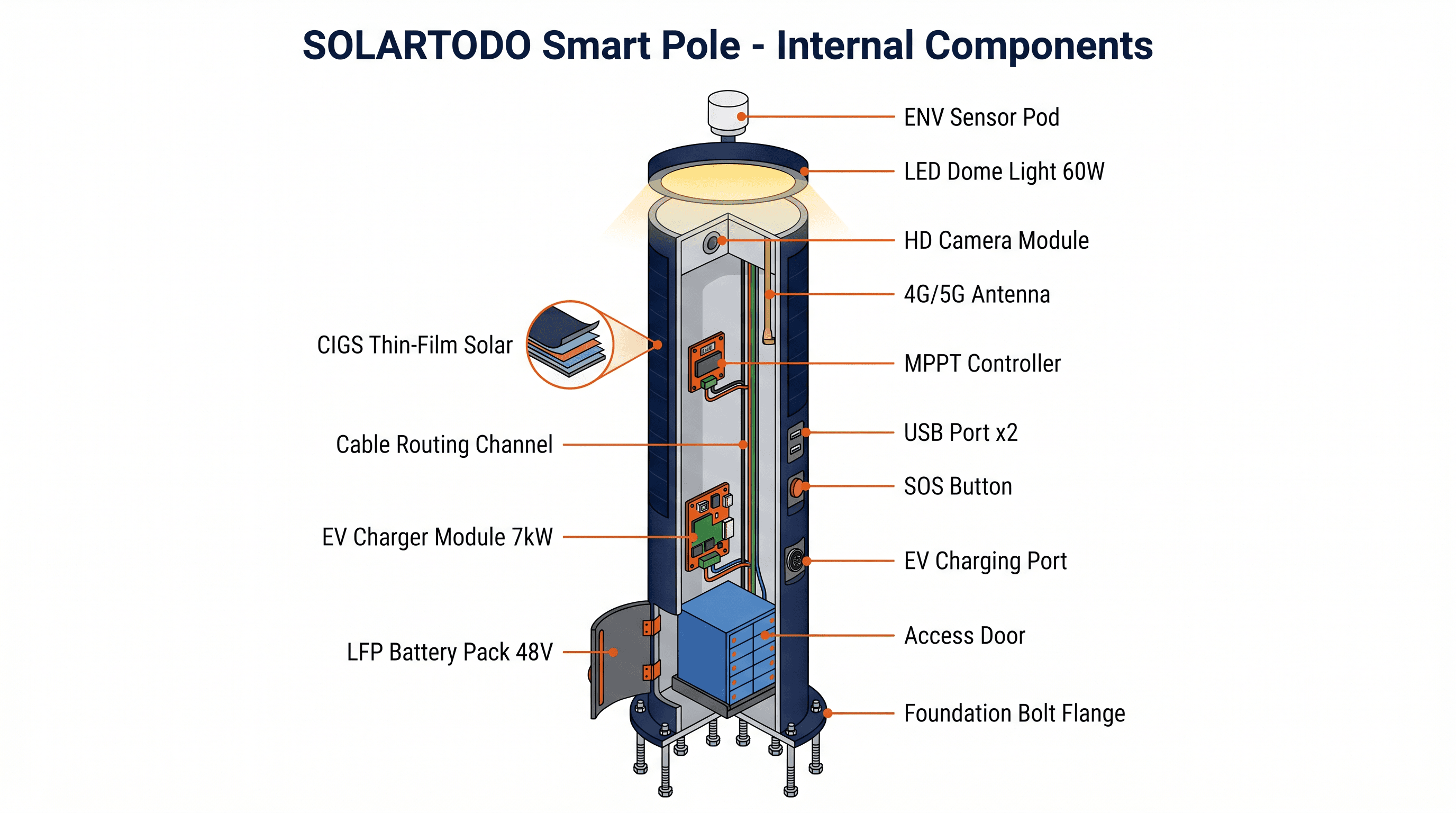
The deployed system uses a project-specific configuration rather than a generic catalog pole. Each unit is built around an 11m Φ219mm round tubular steel pole with 6mm wall thickness, hot-dip galvanized construction, and a silver-grey galvanized original finish. The light head is integrated directly into the pole body with no arm bracket, using a circular PMMA diffuser dome of the same Φ219mm diameter as the pole for a flush, monolithic appearance.
This Addis Ababa installation prioritized corridor uniformity and reduced streetscape obstruction. All major modules are recessed, flush-mounted, or attached with minimal clamp brackets. That matters in urban environments where protruding equipment can create maintenance risks, increase vandalism exposure, and complicate pedestrian clearance.
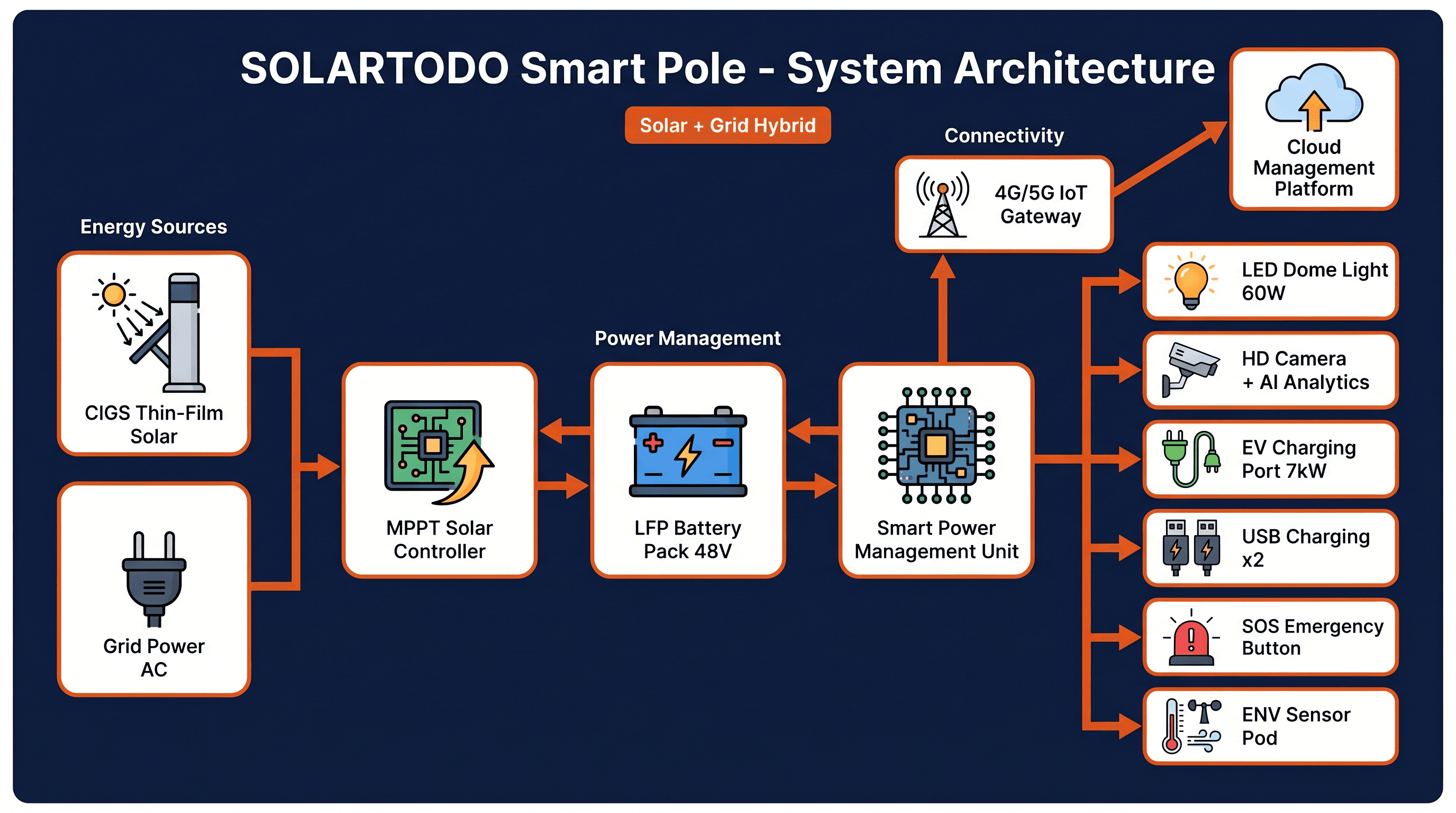
In functional terms, each Smart Streetlight acts as a compact roadside node. It provides 80W downward-distribution lighting, a 4MP recessed camera with 30m infrared range, a 12-parameter environmental sensor, a 30W IP audio column, a double-sided P3 LED display, dual-gun 7kW AC EV charging, USB charging, a standalone 4G gateway, and 5G NR n78 small cell readiness. For product details, see the Smart Streetlight product page, or contact us for project engineering support.
Technical Specifications
This Addis Ababa Smart Streetlight configuration uses 225 units of 11m Φ219mm seamless round poles with integrated 80W lighting, 4MP surveillance, 12-parameter sensing, dual 7kW AC charging, and 5G NR n78 small-cell capability.
- Quantity: 225 units
- Deployment location: Addis Ababa, Ethiopia
- Coordinates: 9.02, 38.75
- Pole height: 11m
- Pole type: round tubular steel pole
- Pole diameter: Φ219mm
- Wall thickness: 6mm
- Pole finish: hot-dip galvanized + silver-grey (galvanized original) finish
- Pole profile: seamless cylindrical profile
- Pole spacing: 25m
- Design language: clean seamless cylinder, all modules flush-mounted or on minimal clamp brackets, no large protrusions
- Lighting head: integrated with pole body, no arm bracket
- Light diffuser: circular PMMA diffuser dome, flush on top, Φ219mm same diameter as pole
- Light distribution: downward distribution
- LED power: 80W
- Luminous flux: 12,000lm
- CCT: 4000K
- Luminous efficacy: 150 lm/W
- Power subsystem: monocrystalline side-mount panel 60W on short tilted bracket at pole top
- Battery: LFP battery 2400Wh inside pole base
- Controller: MPPT controller
- Camera type: recessed turret camera behind flush glass window in pole
- Camera resolution: 4MP
- IR distance: 30m
- Camera protection: vandal-proof
- Environmental sensor: 12 parameters
- Sensor parameters: temperature, humidity, wind, pressure, noise, PM2.5, PM10, CO, NO2, O3, rain, illuminance
- Audio module: IP audio column, TCP/IP networked, cylindrical design
- Audio power: 30W
- Audio output: 93dB
- EV charger: dual-gun EV AC charger
- Charging capacity: 7kW×2
- Charger protocol: OCPP 1.6J
- Display type: P3 LED display, double-sided
- Display size: 1280×960mm
- Display use: advertising + emergency information
- Communications gateway: standalone 4G gateway
- Gateway interfaces: RS485 + 4G uplink
- 5G module: 5G NR n78 small cell
- 5G radio configuration: 4T4R MIMO
- 5G coverage: 200m
- USB charging: 5V/2.4A × 2
- Platform: cloud platform for remote management
- Applicable standards: IEC 60598, GB/T 37024, CJJ 45-2015
Deployment Process
The Addis Ababa rollout was executed in phased corridor deployment, with 225 Smart Streetlight units installed at 25m spacing to standardize civil works, wiring interfaces, and commissioning procedures.
The first phase focused on route survey, pole foundation verification, and utility coordination. Because the design uses an 11m seamless cylindrical pole with integrated top lighting and minimal protrusions, foundation positioning and orientation were simpler than multi-arm smart pole systems. Flush-mounted camera windows, sensor placement at the top, and double-sided display alignment were coordinated before erection to avoid rework during commissioning.
The second phase covered pole erection and module integration. SOLAR TODO supplied each round tubular pole with the light head integrated into the pole body, eliminating separate arm-bracket assembly. The recessed 4MP turret camera, cylindrical IP audio column, LED display, dual-gun EV charger, USB charging interface, and 4G gateway were installed as part of the pole package so that the field team could work from a repeatable installation sequence.
The third phase covered communications and functional testing. The standalone 4G gateway with RS485 + 4G uplink was configured to connect edge devices to the cloud platform for remote management. The 5G NR n78 small cell hardware was prepared for corridor-level connectivity expansion, with each node designed around 4T4R MIMO and an estimated 200m coverage footprint under the specified configuration.
The final phase was acceptance testing and corridor optimization. Lighting output, camera visibility, audio intelligibility, sensor calibration, display operation, and EV charging handshakes under OCPP 1.6J were verified by subsystem. SOLAR TODO also trained the operating team on routine inspection intervals, remote fault identification, and replacement procedures for flush-mounted modules.
Performance & Results
The 225-unit Addis Ababa Smart Streetlight deployment consolidated at least 7 street functions into one 11m pole, improving corridor uniformity while reducing the need for separate lighting, CCTV, speaker, display, charging, and telecom structures.
From a lighting standpoint, each unit delivers 12,000 lumens from an 80W LED engine at 150 lm/W, which aligns with the broader municipal shift toward higher-efficacy public lighting. According to IEA (2023), LEDs can significantly reduce electricity demand for public lighting compared with conventional technologies when municipalities modernize at scale. According to NREL (2022), connected outdoor lighting systems also improve maintenance planning because faults and performance trends can be monitored remotely.
The communications layer is equally important in this case. According to ITU (2023), integrated digital infrastructure in cities improves service coordination by enabling shared assets and interoperable communications. The Addis Ababa deployment uses a standalone 4G gateway for RS485 device aggregation and is physically prepared for 5G NR n78 small-cell operation with 4T4R MIMO and 200m coverage, allowing the same pole to support future network densification without adding new roadside steel.
Environmental visibility improved because each pole includes 12 sensing parameters rather than a single-purpose weather or air-quality node. According to the World Health Organization (2022), urban air pollution monitoring is essential for evidence-based public health response, particularly for particulate matter such as PM2.5 and PM10. In this project, temperature, humidity, wind, pressure, noise, PM2.5, PM10, CO, NO2, O3, rain, and illuminance are gathered at street level from the same asset used for lighting and safety.
Public safety response also benefits from device consolidation. The recessed 4MP camera with 30m IR range is better protected than exposed bracket-mounted cameras, while the 30W, 93dB TCP/IP audio column enables corridor-wide messaging and emergency announcements from the same node. IEC states, "IEC 60598 specifies general requirements and tests for luminaires," which is directly relevant to durable outdoor lighting deployments. ITU states, "Digital technologies can help cities become more sustainable, resilient and inclusive," a principle reflected in the multi-function architecture adopted here.
Operationally, the EV charging feature changes the role of the street pole from passive lighting asset to active mobility infrastructure. Each unit includes a dual-gun AC charger rated at 7kW×2 with OCPP 1.6J support, making the corridor suitable for distributed curbside charging rather than isolated charging islands. According to IRENA (2023), transport electrification requires broader charging availability integrated into urban infrastructure, especially in dense city environments where stand-alone charging sites are harder to scale.
Comparison Table
This comparison shows why Addis Ababa used a 225-unit integrated Smart Streetlight system instead of deploying separate roadside assets for each urban function.
| Metric | SOLAR TODO Smart Streetlight in Addis Ababa | Conventional Separate Assets |
|---|---|---|
| Pole quantity for core functions | 225 integrated poles | Multiple poles or cabinets for lighting, CCTV, audio, display, charging, and telecom |
| Pole design | 11m seamless Φ219mm round tubular steel, 6mm wall | Mixed pole types, brackets, cabinets, and external mounts |
| Lighting configuration | Integrated top light, no arm bracket, 80W/12,000lm | Separate luminaire arm and independent lighting pole |
| Surveillance | Recessed 4MP camera behind flush glass, IR 30m | External bracket-mounted camera |
| Environmental monitoring | 12 parameters on one top sensor | Separate sensor mast or no monitoring |
| Public communication | 30W, 93dB TCP/IP IP audio column | Separate speaker pole or building-mounted PA |
| EV charging | Dual-gun AC charger 7kW×2, OCPP 1.6J | Separate charging pedestal and civil works |
| Digital messaging | Double-sided P3 LED display, 1280×960mm | Separate digital sign structure |
| Telecom readiness | 5G NR n78, 4T4R MIMO, 200m coverage | Additional telecom pole or rooftop unit |
| Streetscape impact | Flush-mounted modules, minimal protrusions | More visual clutter and more roadside hardware |
| Maintenance model | Cloud-managed, centralized asset view | Multiple vendors and separate maintenance workflows |
Pricing & Quotation
SOLAR TODO offers three pricing tiers for this product line: FOB Supply (equipment ex-works China), CIF Delivered (including ocean freight and insurance), and EPC Turnkey (fully installed, commissioned, with 1-year warranty). Volume discounts are available for large-scale deployments. Configure your system online for an instant estimate, or request a custom quotation from our engineering team at cinn@solartodo.com.
Frequently Asked Questions
This FAQ answers the most common buyer questions about the 225-unit Addis Ababa Smart Streetlight project, including specifications, installation, maintenance, ROI logic, warranty scope, and EPC quotation options.
Q1: What exactly was deployed in Addis Ababa?
A total of 225 SOLAR TODO Smart Streetlight units were deployed. Each uses an 11m Φ219mm round tubular steel pole with 6mm wall thickness, integrated 80W top lighting, a recessed 4MP camera, 12-parameter environmental sensor, IP audio column, double-sided P3 LED display, dual 7kW AC EV charger, USB charging, 4G gateway, and 5G-ready small-cell capability.
Q2: Why was this design suitable for Addis Ababa roads?
The seamless cylindrical profile reduces visual clutter and limits large protrusions, which is useful on busy urban corridors with mixed pedestrian and vehicle activity. The integrated top light has no arm bracket, while the camera and other modules are flush-mounted or minimally clamped, making the streetscape cleaner and the hardware less exposed than conventional multi-device pole assemblies.
Q3: What are the lighting specifications of each Smart Streetlight?
Each unit uses an integrated top-mounted LED head with a circular PMMA diffuser dome flush with the pole top. Output is 80W, 12,000 lumens, 4000K, and 150 lm/W with downward light distribution. The diffuser diameter matches the pole at Φ219mm, maintaining a continuous cylindrical appearance without a separate luminaire arm.
Q4: What monitoring and safety functions are included?
Each pole includes a recessed 4MP vandal-proof turret camera with 30m IR range, a 12-parameter environmental sensor, and a 30W TCP/IP networked IP audio column rated at 93dB. Together, these modules support surveillance, emergency broadcasting, environmental monitoring, and corridor-level operational awareness from a single roadside asset.
Q5: How long does installation typically take for a project like this?
Timeline depends on foundation readiness, utility coordination, customs clearance, and network integration scope. For a 225-unit program, deployment is usually phased: survey and civil preparation first, then pole erection, device commissioning, and cloud integration. Because this Addis Ababa design uses repeatable 25m spacing and integrated modules, field assembly is more standardized than separate-asset rollouts.
Q6: How is ROI or payback usually evaluated for this type of project?
Municipal buyers typically assess ROI through combined savings and avoided infrastructure duplication rather than a single device metric. The main factors are LED lighting efficiency, fewer separate poles and cabinets, centralized maintenance, telecom co-location potential, advertising use of the P3 display, and added utilization from dual 7kW EV charging. Actual payback depends on local power tariffs and operating model.
Q7: What maintenance does the system require?
Routine maintenance includes cleaning the PMMA diffuser and display surfaces, checking charger connectors, verifying camera glass clarity, inspecting audio output, and reviewing sensor calibration intervals. The cloud platform helps operators identify faults remotely, while the recessed and flush-mounted design reduces exposure compared with external bracket-mounted components on traditional smart poles.
Q8: How does this compare with a standard streetlight plus separate devices?
A standard streetlight usually provides only illumination, requiring separate structures for CCTV, speakers, displays, telecom equipment, and EV charging. This SOLAR TODO Smart Streetlight consolidates those functions into one 11m pole. That reduces roadside clutter, simplifies asset management, and lowers the number of independent civil interfaces that must be built and maintained.
Q9: Do you provide EPC pricing and quotation support?
Yes. SOLAR TODO supports FOB Supply, CIF Delivered, and EPC Turnkey quotation models depending on project scope. For city deployments, the quotation normally reflects pole configuration, communications scope, charger requirements, display integration, standards compliance, shipping destination, and installation responsibilities. Buyers can use the online configurator or contact the engineering team for a tailored proposal.
Q10: What warranty and standards apply to this project type?
The product line is specified to IEC 60598, GB/T 37024, and CJJ 45-2015 for this Addis Ababa configuration. For commercial supply models, warranty terms depend on the quotation structure and scope of work. The EPC Turnkey option includes a 1-year warranty as stated in the pricing section, with project-specific service terms confirmed during contract review.
References
- International Energy Agency (2023): Global lighting efficiency trends and the role of LED upgrades in reducing electricity demand in public lighting systems.
- National Renewable Energy Laboratory (2022): Connected and smart outdoor lighting systems improve monitoring, maintenance visibility, and operational control for municipalities.
- International Telecommunication Union (2023): Digital infrastructure and smart sustainable city frameworks support integrated urban services and interoperable communications.
- International Electrotechnical Commission (2023): IEC 60598 specifies general requirements and tests for luminaires used in outdoor and public lighting applications.
- World Bank (2023): Urban service delivery and digital infrastructure are key enablers of more resilient and efficient city operations in fast-growing urban areas.
- World Health Organization (2022): Air-quality monitoring, including PM2.5 and PM10 measurement, is essential for urban public health management.
- International Renewable Energy Agency (2023): Urban transport electrification requires broader, distributed charging infrastructure integrated into city environments.
Equipment Deployed
- 225 × 11m Φ219mm round tubular steel poles, 6mm wall thickness, hot-dip galvanized + silver-grey finish
- Integrated top LED light head, no arm bracket, circular PMMA diffuser dome, 80W, 12,000lm, 4000K, 150 lm/W
- Monocrystalline side-mount panel 60W on short tilted top bracket
- LFP battery 2400Wh inside pole base with MPPT controller
- Recessed turret camera behind flush glass window, 4MP, IR 30m, vandal-proof
- 12-parameter environmental sensor: temp, humidity, wind, pressure, noise, PM2.5, PM10, CO, NO2, O3, rain, illuminance
- IP audio column, TCP/IP networked, cylindrical design, 30W, 93dB
- Dual-gun EV AC charger, 7kW×2, OCPP 1.6J
- P3 LED display, double-sided, 1280×960mm, advertising + emergency information
- 5G NR n78 small cell, 4T4R MIMO, 200m coverage
- USB phone charging port, 5V/2.4A × 2
- Standalone 4G gateway with RS485 + 4G uplink
- Cloud platform for remote management
- Compliance with IEC 60598, GB/T 37024, CJJ 45-2015