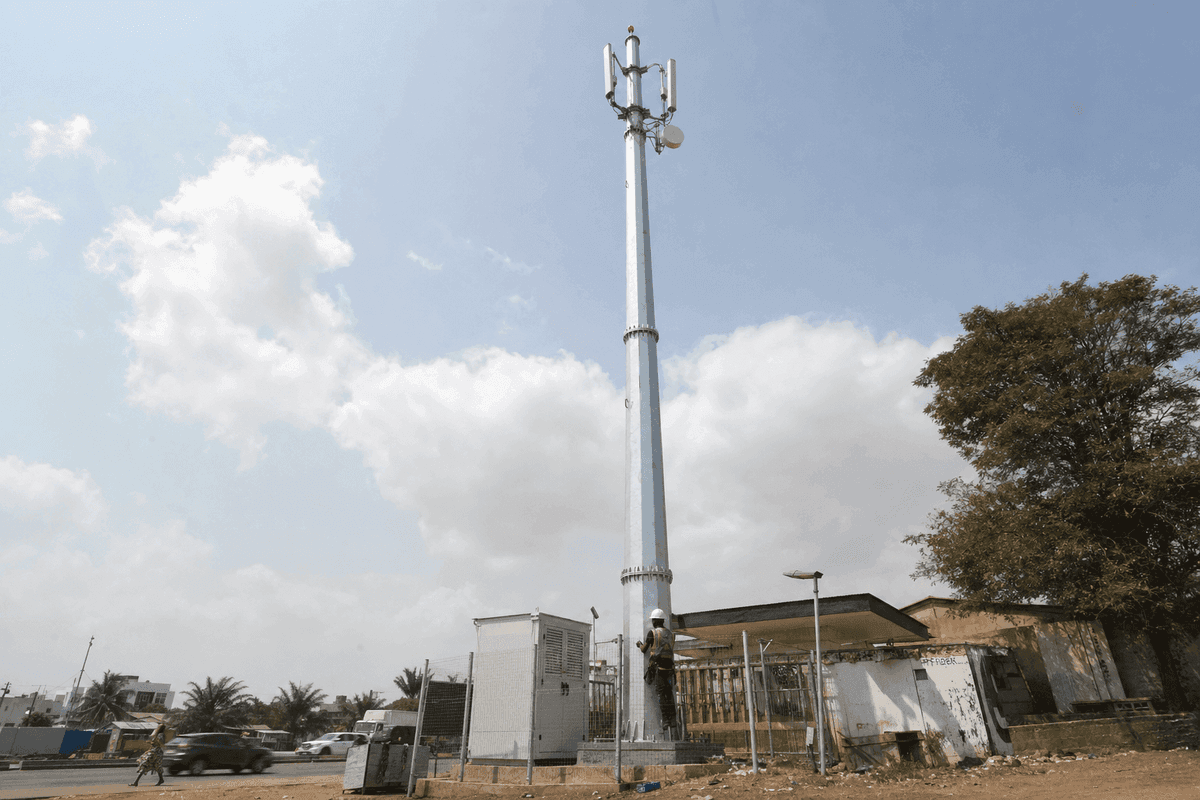
Accra Telecom Tower Market Analysis: 25m Steel Monopole Configuration Guide
Summary
Accra's 5.46m Greater Accra market and 91.7% urbanization support approximately 61 units of 25m steel monopoles for 40m/s urban macro coverage. The fit uses 9t Q345 towers, CKD shipping, pile foundations, and 30-45 day production.
Key Takeaways
This Accra Telecom Tower guide recommends a 25m, 9t, wind-class 1 steel monopole package for approximately 61 urban macro sites.
- A typical 61-unit deployment would use 25m tapered steel monopoles, not lattice, FRP, or joint-use poles.
- Each tower weighs approximately 9t, equal to about 350kg/m and within the 15-25m urban infill class of 8-15t.
- The recommended antenna load is 3 panel antennas, 1 microwave dish, RRU, and small cell per urban macro site.
- Wind class 1 means 40m/s basic wind speed with factor 1.0 under TIA-222-H structural design logic.
- CKD sectional shipping can reduce transport volume by 60-70%, relevant for China-to-Tema port logistics.
- Pile foundations are recommended for 25m coastal urban sites where fill, drainage, or variable bearing soil may occur.
- Accessories should include 3 antenna platforms, climbing ladder, cable tray, aircraft warning light, grounding, lightning rod, and safety cage.
- SOLARTODO should frame this as a 30-year design-life technical configuration with 30-45 day production, not a completed Accra deployment.
Market Context for Accra
Accra's telecom infrastructure demand is shaped by a 5.46m regional population, high urban density, and Ghana's 113.1% mobile-connection ratio. According to Ghana Statistical Service (2021), Greater Accra recorded 5,455,692 people, 3,245km2 of land area, and 1,681.3 people per km2 in the 2021 census. The same report shows Greater Accra had 5,001,141 urban residents, equal to 91.7% of the regional population, making macro-site spacing, rooftop constraints, and right-of-way control central tower-planning issues.
According to DataReportal and GSMA Intelligence (2024), Ghana had 24.06 million internet users, 69.8% internet penetration, and 38.95 million active cellular mobile connections in early 2024. That mobile-connection level, equivalent to 113.1% of population, indicates multi-SIM usage and strong mobile dependency rather than fixed-line substitution. For Accra, this favors compact urban macro towers that can carry 4G/5G radio layers while preserving options for microwave backhaul.
According to the National Communications Authority (2026), the NCA is the statutory regulator for electronic communications in Ghana. NCA states, 'statutory body mandated to license and to regulate electronic communications activities and services'. This matters because an Accra Telecom Tower plan must align with site permitting, radio authorization, type approval, aviation marking, and co-location rules before procurement.
Accra's coastal setting also affects structural detailing. Public climate summaries for Accra report about 730mm average annual rainfall, 27.6C average annual temperature, 65-95% relative humidity, and local thunderstorm gust exposure. For a low-corrosion but humid coastal zone, the practical response is hot-dip galvanized Q345 steel, sealed bolted flanges, proper grounding, lightning protection, and maintenance access that does not require dismantling the antenna payload.
Recommended Technical Configuration
A typical Accra urban macro build would specify approximately 61 units of 25m hot-dip galvanized Q345 steel monopoles with pile foundations. The correct size class is the 15-25m rooftop/urban infill class because the project height is 25m, the mass is approximately 9t, and the antenna count remains within the 3-6 panel range. Although the product family also includes 30m, 35m, 40m, and 45m variants, a 25m pole is the conservative fit for dense Accra streets, institutional compounds, commercial roofs with ground compounds, and suburban infill near high-traffic corridors.
A typical 61-unit deployment in this profile would consist of tapered round or octagonal steel tube monopoles, flanged bolt-on sectional design, CKD packing, and site-specific pile foundations. The tower would use Q345 steel with hot-dip galvanizing, wind class 1 at 40m/s, and a 30-year design life. SOLARTODO should position this Telecom Tower package as an urban macro steel monopole recommendation, not as a claimed installed project.
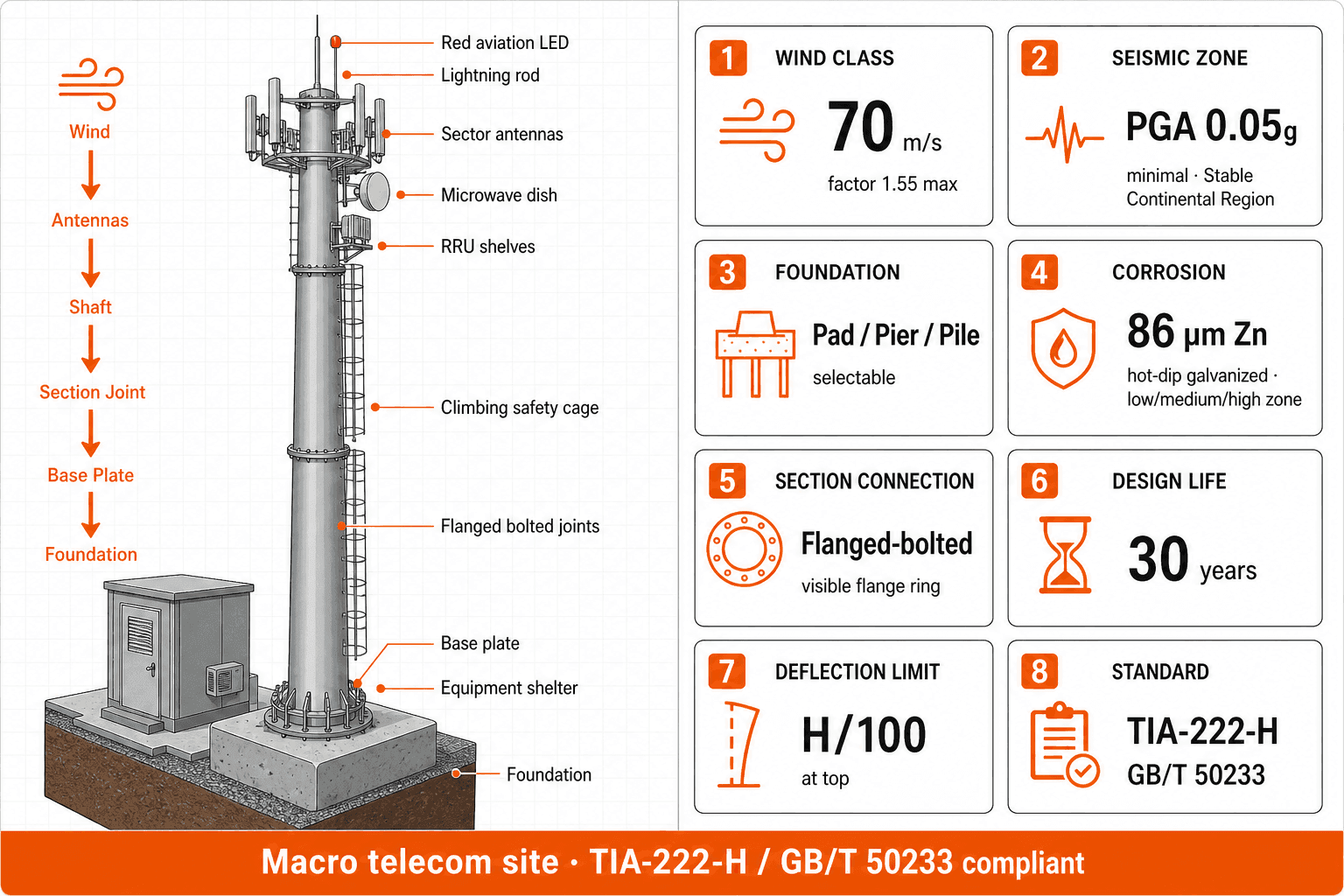
The antenna configuration is heavier than a basic single-tier rural site but lighter than a dense hotspot structure. Each pole would carry 3 panel antennas, 1 microwave dish, RRU, and small cell, supported by 3 antenna platforms for vertical separation, maintenance access, and future minor amendments. The recommended accessories are climbing ladder, cable tray, aircraft warning light, grounding system, lightning rod, and safety cage.
Technical Specifications
The Accra configuration uses 25m towers, approximately 9t per tower, 40m/s wind class, and a 30-year design life. According to TIA (2018), TIA-222-H is the accepted U.S. structural standard family for antenna-supporting structures and wind-resistance checks. GB/T 50233 is also listed for construction and acceptance practice where Chinese steel fabrication and tower documentation are used.
- Product form: steel monopole Telecom Tower, tapered round or octagonal steel tube.
- Quantity basis: approximately 61 units for market-planning and quotation purposes.
- Height: 25m, selected from SOLARTODO height variants of 25m, 30m, 35m, 40m, and 45m.
- Size class: 15-25m urban infill, 1 platform baseline, 3-6 panel antennas, 8-15t per tower.
- Project-specific mass: approximately 9t per tower, about 350kg/m.
- Material: hot-dip galvanized Q345 steel.
- Tower class: urban macro site.
- Wind rating: wind class 1, 40m/s, factor 1.0 per TIA-222-H design basis.
- Corrosion zone: low, with hot-dip galvanizing specified for coastal humidity resilience.
- Connection: flanged bolt-on sectional design for CKD shipping and controlled erection tolerance.
- Foundation: pile foundation, selected for urban soils, drainage variability, and 25m tower stiffness.
- Antenna load: 3 panel antennas, 1 microwave dish, RRU, and small cell.
- Accessories: climbing ladder, cable tray, aircraft warning light, grounding system, lightning rod, 3 antenna platforms, and safety cage.
- Logistics: CKD shipping with 60-70% volume reduction.
- Production window: 30-45 days before shipment, subject to approved drawings and galvanizing schedule.
SOLARTODO should verify final bolt grades, flange thickness, foundation pile depth, and lightning protection continuity after geotechnical data is available. The 9t weight is acceptable within the 8-15t urban infill class for a 25m telecom monopole, but it should not be generalized to taller towers without structural recalculation.
Implementation Approach
A typical 61-unit Accra rollout would move through survey, design approval, CKD logistics, foundation works, tower erection, and telecom commissioning. The first phase is desktop planning: map traffic corridors, candidate lease compounds, backhaul paths, flood-prone zones, aviation-light requirements, and grid access. According to Ghana Statistical Service (2021), census data supports decentralized planning; GSS states, 'only national data collection exercise that can provide the lowest levels of disaggregation'.
The second phase is engineering validation. Each site should receive a geotechnical check for pile foundation sizing, a wind exposure review, grounding-resistance target, and confirmation that the 25m height meets radio-planning needs without triggering avoidable aviation or planning objections. For SOLARTODO, fabrication should start only after general arrangement drawings, foundation reactions, antenna loading, and CKD packing lists are frozen.
The third phase is supply and construction. CKD tower sections are packed to reduce volume by 60-70%, shipped to Ghana, cleared through port logistics, and moved to site in manageable sections. A typical installation sequence would cast or drive pile foundations, install anchor cages, assemble flanged tower sections, torque bolts, install platforms and cable tray, mount antenna steel, connect grounding and lightning rod, then hand over for radio equipment commissioning.
Expected Performance & ROI
A 25m Accra Telecom Tower configuration should improve macro coverage economics by enabling 3-sector antenna loading, microwave backhaul, and small-cell augmentation on one steel structure. According to DataReportal (2024), Ghana's median mobile internet speed was 13.17Mbps at the start of 2024, while mobile speed increased 66.7% over the previous year. That demand trajectory supports structures that allow radio upgrades without replacing the tower body.
The ROI logic should be expressed as conditional economics, not a guaranteed payback claim. A typical 25m monopole can support one anchor tenant plus later lease amendments for microwave, RRU upgrades, or small-cell equipment. According to Vantage Towers (2025), a European tower portfolio reported a 1.53x tenancy ratio, showing how shared passive infrastructure can increase revenue potential when regulation and operator demand permit co-location.
For Accra, expected value comes from speed of deployment, reduced visual footprint, and future amendment capacity. CKD shipping may lower freight volume by 60-70%, and a 30-45 day production window helps operators synchronize civil works, import logistics, and radio rollout. Lifecycle planning should assume annual inspection, bolt-torque checks after initial loading, grounding tests before rainy season, and coating repair at scratches or drilled surfaces.
Comparison Table
The 25m Accra recommendation balances 9t mass, 40m/s wind rating, and urban infill coverage better than taller rural macro towers. The comparison below separates the project-specific Accra fit from other SOLARTODO height classes so buyers can avoid mismatched tower height, payload, or mass assumptions.
| Option | Typical fit | Height | Antenna load | Tower mass range | Foundation | Accra suitability |
|---|---|---|---|---|---|---|
| Recommended Accra urban macro | Dense urban and infill | 25m | 3 panel + 1 microwave + RRU + small cell | ~9t project-specific | Pile | High: compact, 40m/s wind class 1 |
| Suburban residential class | Residential edge coverage | 30-35m | 6-9 panels | 15-22t | Pier or pile | Medium: useful where compounds allow |
| Highway/peri-urban class | Transport corridors | 35-45m | 6-9 panels + 1-2 microwave | 22-30t | Pier or pile | Medium-low for dense Accra streets |
| Rural wide coverage class | Long-radius coverage | 45-55m | 9-12 panels | 30-40t | Pile | Low for central Accra, better outside metro |
Pricing & Quotation
SOLARTODO provides 3 quotation paths for the 25m Accra Telecom Tower package while avoiding published unit prices in technical guidance. SOLARTODO offers three pricing tiers for this product line: FOB Supply (equipment ex-works China), CIF Delivered (including ocean freight and insurance), and EPC Turnkey (fully installed, commissioned, with 1-year warranty). Volume discounts are available for large-scale deployments. Configure your system online for an instant estimate, or request a custom quotation from our engineering team at [email protected].
For Accra, quotation inputs should include 61-unit quantity basis, 25m height, Q345 hot-dip galvanized steel, 9t mass, wind class 1, pile foundation reactions, accessory list, and CKD packing. Buyers can contact us with soil data, antenna weights, microwave dish diameter, and target delivery port to reduce engineering assumptions.
Frequently Asked Questions
These 10 FAQ answers cover the 25m, 61-unit Accra Telecom Tower recommendation, including specs, installation, pricing tiers, warranty, and ROI.
Q1: What Telecom Tower configuration is recommended for Accra? A typical Accra configuration would use approximately 61 units of 25m tapered steel monopole towers. Each tower would be hot-dip galvanized Q345 steel, approximately 9t, wind class 1 at 40m/s, and fitted for 3 panel antennas, 1 microwave dish, RRU, and small cell. This is a technical recommendation, not a claim of completed deployment.
Q2: Why is a 25m steel monopole better than a lattice tower for this profile? A 25m steel monopole has a smaller ground footprint, cleaner urban appearance, and faster sectional erection than many lattice alternatives. For Accra's 91.7% urbanized Greater Accra context, compact right-of-way use matters. The recommended SOLARTODO form is strictly a tapered steel monopole, not lattice, FRP, or joint-use construction.
Q3: How long would production and deployment typically take? Production for the specified tower package is typically 30-45 days after drawing approval, material confirmation, and accessory freeze. Site deployment depends on permitting, pile foundation curing or testing, import clearance, and radio equipment availability. A practical rollout would sequence civil works before CKD tower arrival to avoid storing galvanized sections onsite for extended periods.
Q4: What foundation type is recommended in Accra? Pile foundations are recommended for this 25m Accra urban macro configuration because coastal urban soils, drainage variability, and filled plots can create uneven bearing conditions. Final pile depth and reinforcement should be based on geotechnical data. The tower supplier should provide foundation reactions, while the local civil engineer validates soil capacity and constructability.
Q5: What maintenance is required over the 30-year design life? Maintenance should include annual visual inspection, bolt-torque checks, platform and ladder inspection, grounding resistance testing, aviation light checks, and coating repair where galvanizing is scratched. After major storms, operators should inspect antenna brackets, microwave mounts, cable trays, and lightning protection continuity. This routine supports the 30-year design-life assumption.
Q6: What is the expected ROI or payback period? ROI depends on site rent, tenant count, lease amendments, backhaul use, and operator traffic demand, so this guide should not state a guaranteed payback. A typical financial model evaluates anchor tenancy first, then upside from microwave, RRU, and small-cell amendments. CKD logistics and 30-45 day production can improve project schedule economics.
Q7: Does SOLARTODO publish EPC pricing for Accra towers? No unit price should be published in this technical guide. SOLARTODO offers FOB Supply, CIF Delivered, and EPC Turnkey quotation tiers, with volume discounts for large-scale deployments. An accurate EPC quotation needs site count, soil data, foundation scope, tower accessory list, port terms, installation responsibility, and warranty requirements.
Q8: What warranty and design-life assumptions apply? The specified tower package has a 30-year design life, assuming correct foundation design, installation, inspection, and maintenance. The EPC Turnkey quotation tier includes a 1-year warranty as stated in SOLARTODO's product-line quotation language. Warranty coverage should be confirmed against final contract terms, exclusions, and site acceptance documentation.
Q9: Can the tower support 5G equipment later? Yes, conditionally. The recommended payload already includes panel antennas, RRU, microwave dish, and small cell equipment, which aligns with urban macro upgrade pathways. Any future 5G amendment should be checked against reserved wind area, bracket capacity, cable loading, platform access, and tower utilization under TIA-222-H structural criteria.
Q10: What standards should buyers reference? Buyers should reference TIA-222-H for telecom tower structural loading and GB/T 50233 for construction and acceptance documentation where Chinese fabrication is used. Local Ghana permitting, NCA authorization, aviation marking, and site-owner requirements also apply. Final compliance should be documented in drawings, material certificates, galvanizing records, and installation checklists.
References
These 7 references support Accra population, mobile demand, telecom regulation, structural design, and logistics assumptions for the 25m tower recommendation.
- Ghana Statistical Service (2021): 2021 Population and Housing Census, Volume 3A; Greater Accra population 5,455,692, density 1,681.3/km2, and 91.7% urban population. https://statsghana.gov.gh/gssmain/fileUpload/pressrelease/2021%20PHC%20General%20Report%20Vol%203A_Population%20of%20Regions%20and%20Districts_181121.pdf
- National Communications Authority (2026): About Us; Ghana's statutory electronic communications regulator and licensing authority. https://nca.org.gh/about-us-2/
- DataReportal / GSMA Intelligence (2024): Digital 2024 Ghana; 24.06m internet users, 69.8% penetration, 38.95m mobile connections, and 113.1% mobile-connection ratio. https://datareportal.com/reports/digital-2024-ghana
- TIA (2018): ANSI/TIA-222-H, Structural Standard for Antenna Supporting Structures and Antennas; wind and structural design basis for telecom towers.
- GB Standards (2014): GB/T 50233, construction and acceptance code reference for overhead line and steel structure documentation in Chinese engineering supply chains.
- Climate & Development Knowledge Network (2015): Coastal Ghana climate information used in Accra public climate summaries, including rainfall, humidity, and coastal exposure context.
- Vantage Towers (2025): Annual reporting on macro-site tenancy ratios; 1.53x consolidated tenancy ratio used as shared-infrastructure benchmark.
Equipment Deployed
- Approximately 61 units x 25m tapered steel monopole Telecom Tower
- Hot-dip galvanized Q345 steel, approximately 9t per tower, about 350kg/m
- Wind class 1: 40m/s basic wind speed, factor 1.0, TIA-222-H basis
- Antenna load: 3 panel antennas + 1 microwave dish + RRU + small cell
- Pile foundation package for 25m urban macro sites
- Flanged bolt-on sectional design for CKD shipping with 60-70% volume reduction
- Accessories: climbing ladder, cable tray, aircraft warning light, grounding system, lightning rod
- Three antenna platforms plus safety cage for maintenance access
- 30-year design life and 30-45 day production window
- Standards basis: TIA-222-H / GB/T 50233