4G/5G vs Alternatives: Solar-Powered Security Systems…

SOLAR TODO
Solar Energy & Infrastructure Expert Team
Watch the video
TL;DR
For most remote border sites, 4G/5G is the fastest option for 16-camera, 32-zone deployment, but fiber is better for permanent high-bandwidth corridors and microwave is often best for 5-50 km backhaul. Solar systems should be sized for 24/7 operation with 2-3 days of battery autonomy, and buyers should compare FOB, CIF, and EPC pricing before selecting the communications path.
Solar-powered border and fence security systems typically protect 16-128 zones using 4G/5G, fiber, microwave, or LoRa links; the right choice depends on 5-50 km coverage, sub-100 ms latency needs, and EPC budgets from USD 7,100 to 46,600.
Summary
Solar-powered border and fence security systems typically protect 16-128 zones using 4G/5G, fiber, microwave, or LoRa links; the right choice depends on 5-50 km coverage, sub-100 ms latency needs, and EPC budgets from USD 7,100 to 46,600.
Key Takeaways
- Compare communication paths by distance first: use 4G/5G for dispersed sites within carrier coverage, fiber for fixed corridors over 1-20 km, and microwave for 5-50 km backhaul where trenching cost is high.
- Size solar power for 24/7 duty with at least 2-3 days of battery autonomy, especially for border nodes running 8-16 cameras, radios, and hybrid alarm panels.
- Select detector architecture by risk level: deploy 32 zones for medium checkpoints, 64 spare/active expansion points for phased growth, and 128 zones for multi-perimeter government compounds.
- Prioritize latency and uptime targets: choose 5G or licensed microwave when PTZ control and live video need sub-100 ms response, but use store-and-forward NVR logic when links are intermittent.
- Verify standards early: align intrusion design with EN 50131, video with IEC 62676, installation practice with UL 681, and signaling interfaces with NFPA 72 where required.
- Model total cost in three tiers: compare FOB supply, CIF delivered, and EPC turnkey, then apply volume discounts of 5% at 50+ units, 10% at 100+, and 15% at 250+.
- Reduce nuisance alarms by combining 16 PIR, 16 dual-tech, beam sets, and AI video analytics; layered logic can cut false events by up to 90% versus motion-only legacy CCTV.
- Plan procurement around resilience: specify dual communications such as 4G plus Ethernet or microwave plus local recording, and require payment terms of 30% T/T and 70% against B/L or 100% L/C at sight.
4G/5G vs Alternatives for Solar-Powered Border Security
4G/5G is usually the fastest route for remote border security when sites need 16 cameras, 32 detectors, and deployment in weeks rather than months, but fiber, microwave, and LPWAN can deliver lower lifecycle cost in 1-50 km corridors.
Border and fence security projects fail more often from wrong communications selection than from camera or detector hardware. A 32-zone site with 16 cameras can tolerate intermittent telemetry, but it cannot tolerate repeated video dropouts during an intrusion event. Procurement teams therefore need to compare not only bandwidth, but also latency, carrier dependence, power draw, trenching cost, and maintenance burden over 5-10 years.
For off-grid deployments, the communications layer directly affects solar array size, battery autonomy, and service intervals. A 5G router with high-throughput uplink can draw materially more power than a low-rate telemetry modem, while a fiber node may reduce radio power but add civil works cost. SOLAR TODO typically advises buyers to start with the operational question: do you need live video everywhere, alarm verification at selected points, or only event data from the fence line?
According to the International Energy Agency, "solar PV is expected to remain the largest source of renewable capacity expansion" in current energy planning, which matters because remote security systems increasingly rely on solar-plus-storage rather than diesel-only power. According to NREL (2024), solar resource and load modeling accuracy improves when hourly profiles are used, which is important for communications equipment that has night-time peaks during alarm events.
Communication Architecture Options and Technical Trade-Offs
The best communication architecture for border and fence security is usually a hybrid design combining 1 primary link and 1 backup link, because single-path systems expose 16-64 cameras and alarm traffic to one point of failure.
4G/5G cellular
4G/5G is practical when carrier coverage is stable and the site needs rapid deployment, mobile patrol access, and cloud visibility. For a medium checkpoint, a cellular path can support alarm signaling, health monitoring, and selected live streams from 4-16 cameras. It is less attractive where monthly SIM cost, weak signal, or network congestion affect uptime during peak periods.
5G offers lower latency than 4G and better support for PTZ control, but it usually increases modem complexity and can raise average power demand. In solar-powered nodes, that means larger battery banks or stricter duty-cycle control. Sample deployment scenario (illustrative): a gate area with 4 PTZ cameras and 12 fixed cameras may use event-triggered high-resolution upload while keeping continuous recording local on a 32-channel NVR.
Fiber optic links
Fiber is the strongest option when a border corridor is fixed, civil works are permitted, and buyers need high bandwidth with low latency over 1-20 km or more. It supports dense camera counts, central recording, and lower exposure to RF interference. The trade-off is trenching, ducting, splice work, and repair time if the cable route is damaged.
For permanent border installations, fiber often wins on total performance even if capex is higher in year 1. It also simplifies future expansion from 32 active zones to 64 or 128 zones. SOLAR TODO generally recommends fiber for high-value assets such as inspection buildings, command posts, and fixed gate complexes where uptime targets exceed 99% and lane operations depend on real-time video.
Point-to-point and point-to-multipoint microwave
Microwave backhaul is useful when the site spans 5-50 km, line of sight is available, and trenching cost is difficult to justify. Properly designed links can carry multiple HD streams and alarm traffic with predictable latency. The main constraints are tower height, path clearance, spectrum licensing in some markets, and storm resilience.
Microwave pairs well with solar-powered fence sectors because it centralizes bandwidth at aggregation points instead of powering many high-throughput cellular nodes. A design might place detectors and cameras on distributed poles, then backhaul traffic to one solar-powered relay tower. That reduces recurring SIM fees and can simplify cybersecurity policy because fewer WAN endpoints are exposed.
LoRa, narrowband, and other low-power alternatives
LoRa and similar low-rate links are useful for telemetry, tamper status, battery state of charge, and simple alarm contacts across long distances with low power draw. They are not substitutes for full-motion video. If the requirement is only fence breach indication across 10-30 km with sparse event data, LPWAN can materially reduce solar and battery sizing.
The limitation is payload and latency consistency under network load or interference. For layered security, low-power links work best as a secondary path or for non-video sensors such as gate contacts, vibration loops, weather stations, and power telemetry. SOLAR TODO uses this approach when buyers want low operating cost but still need local video recording at the edge.
Solar Power System Sizing for Border and Fence Nodes
Solar-powered border security should be sized for 24/7 operation with 2-3 days of battery autonomy, because communications uptime is only as reliable as the DC power budget behind cameras, detectors, routers, and NVRs.
A communications decision changes the power model immediately. A low-rate telemetry node with 2 detectors and 1 control board may be a small daily load, while a video pole with 2 cameras, IR illumination, and a 4G/5G gateway can be several times larger. Designers should model daytime and night-time loads separately because IR lighting, PTZ movement, heater loads, and higher event traffic often peak after sunset.
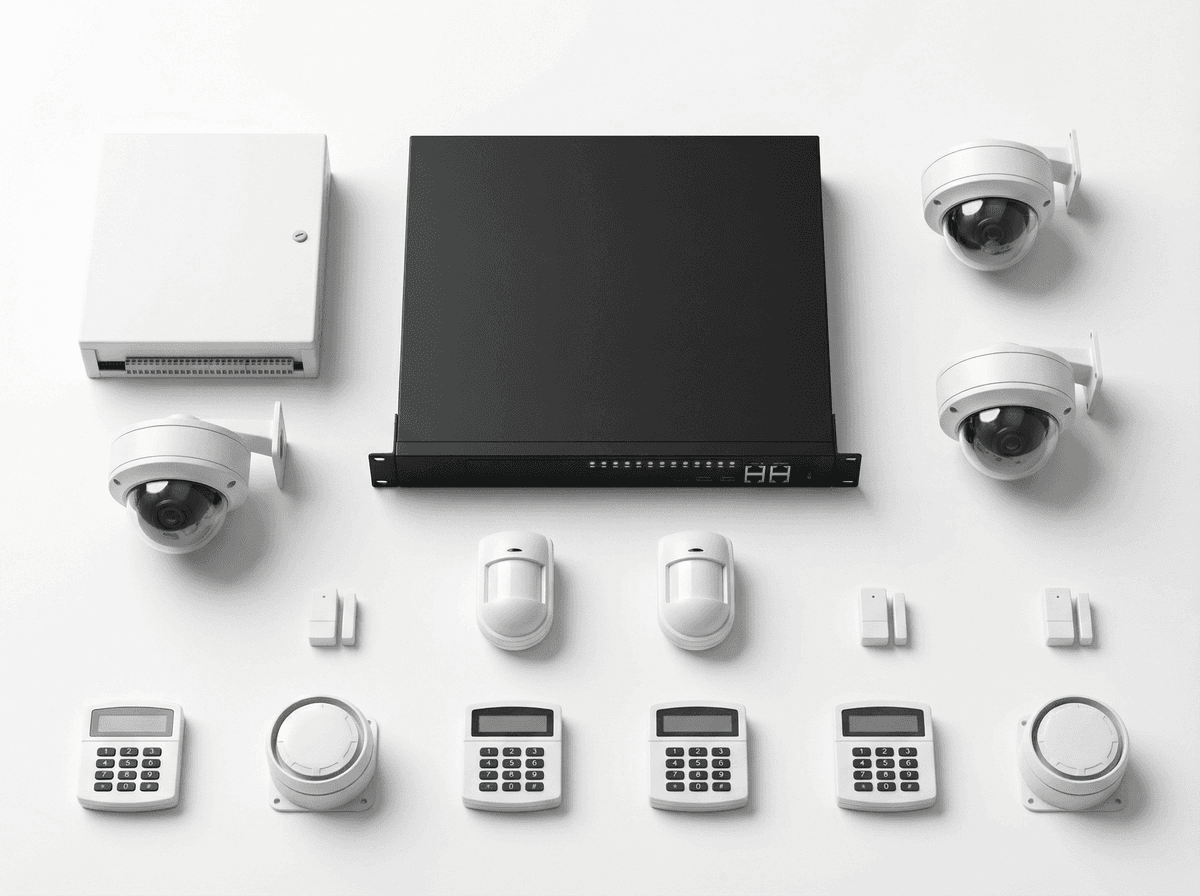
For a medium off-grid checkpoint such as the Border Checkpoint 32-Zone Off-Grid package, the system baseline includes 12 HD fixed IP cameras, 4 PTZ cameras, 8 perimeter beam sets, 16 PIR detectors, 16 dual-technology detectors, a 32-channel NVR, and a 64-zone hybrid alarm panel configured for 32 active zones. In this class, local recording is essential because it protects evidentiary continuity when the backhaul path degrades.
According to IRENA (2024), renewable power economics continue to favor solar in remote applications where fuel logistics are expensive. According to NREL (2024), storage sizing should reflect load variability and criticality rather than average energy alone. For border projects, that means using battery autonomy targets based on worst-month irradiance and alarm-event duty cycles, not annual average sunshine.
The National Fire Protection Association states that signaling pathways and supervisory functions must be evaluated as part of overall system reliability where life-safety interfaces exist. That matters when a border site combines intrusion, fire, and access control on one communications backbone. A low-cost modem decision can create a high-cost operational problem if supervisory messages are delayed or dropped.
System Selection by Use Case, Risk Level, and Expansion Plan
The right border security system is selected by matching 32, 64, or 128-zone architecture to site geometry, response time, and expansion plans rather than by choosing the highest camera count first.
A medium checkpoint usually needs one primary gate, 2-4 vehicle lanes, one inspection building, one perimeter strip, and several controlled access points. In that case, a 32-zone architecture with 16 cameras and 32 detectors is often enough for current scope while leaving spare capacity in a 64-zone hybrid panel. This is where 4G/5G can be effective if the site needs fast deployment and the carrier signal is proven during survey.
For long fence lines with sparse infrastructure, distributed sectors often perform better than one centralized system. Each sector can use beam sets, PIR or dual-tech detectors, local solar power, and either microwave or LPWAN telemetry back to a command node. This reduces trenching and allows phased capex. It also limits the impact of any single node failure to a defined segment.
For government compounds or border administration campuses, a 128-zone architecture is more appropriate. The Government Building 128-Zone Maximum package uses 64 cameras, 128 detector points, 32 dual-technology detectors, 20 perimeter beam sets, and a 128-zone control architecture. In these cases, fiber plus redundant cellular or microwave is usually the safer choice because public occupancy, evidence retention, and response coordination all raise uptime requirements.
According to IEC 62676, video surveillance design should consider image quality, scene purpose, and recording requirements rather than camera quantity alone. That is why SOLAR TODO generally separates detection zones from video channels during design review. A fence may need dense sensor zoning but only selective camera coverage at high-risk sectors.
Comparison Guide and EPC Investment Analysis and Pricing Structure
For most border and fence projects, 4G/5G wins on deployment speed, fiber wins on bandwidth and stability, microwave wins on long-distance backhaul, and LPWAN wins on low-power telemetry below full-video requirements.
The table below summarizes the main selection criteria for B2B buyers.
| Option | Typical distance | Video suitability | Latency profile | Power demand | Main capex driver | Main opex driver | Best-fit use case |
|---|---|---|---|---|---|---|---|
| 4G | 1-20 km within carrier area | Moderate to good for selected streams | Medium | Medium | Router, antenna, SIM setup | Monthly data plan | Fast deployment at remote checkpoints |
| 5G | 1-20 km within strong coverage | Good for higher bitrate and PTZ | Low to medium | Medium to high | 5G CPE, antenna, signal survey | Monthly data plan | Live video and responsive control |
| Fiber | 1-20+ km fixed route | Excellent | Low | Low at endpoint | Civil works and splicing | Low maintenance after build | Permanent corridors and command posts |
| Microwave | 5-50 km line of sight | Good to excellent | Low | Medium | Towers, alignment, radios | Periodic alignment/service | Long backhaul without trenching |
| LoRa/LPWAN | 2-15+ km depending on terrain | Poor for video | Medium to high for payload limits | Low | Gateways and sensor nodes | Low | Telemetry, alarms, battery data |
EPC scope should be defined before comparing quotes. In border security, Engineering, Procurement, and Construction usually includes site survey, load analysis, communications design, solar and battery sizing, pole or tower foundation review, equipment supply, installation, commissioning, and operator training. It may also include integration with access control, fire signaling, or central monitoring software.
SOLAR TODO commonly structures offers in three tiers:
- FOB Supply: equipment only, factory handover, buyer manages freight and installation.
- CIF Delivered: equipment plus freight and cargo delivery to named port, buyer manages inland works and commissioning.
- EPC Turnkey: design review, supply, installation, testing, commissioning, and handover.
Known package pricing provides a useful benchmark. The Border Checkpoint 32-Zone Off-Grid package is available as turnkey EPC at USD 7,100-9,200, depending on scope and logistics. The Government Building 128-Zone Maximum package is available in the EPC turnkey range of USD 36,300-46,600. These figures help procurement teams compare communications choices against total project scope rather than modem cost alone.
Volume pricing guidance should also be built into frame agreements:
- 50+ units: 5% discount
- 100+ units: 10% discount
- 250+ units: 15% discount
Payment terms for export projects are typically:
- 30% T/T deposit and 70% against B/L
- 100% L/C at sight for qualified transactions
Financing is available for large projects above USD 1,000K, subject to project review. For pricing, EPC scope, and financing discussion, buyers can contact [email protected] or reach SOLAR TODO at +6585559114.
ROI should be measured against conventional alternatives such as diesel-only surveillance trailers, trench-powered CCTV, or manually patrolled fence sectors. Solar-powered systems reduce fuel logistics, lower unplanned outages, and can shorten deployment time by weeks where grid extension is slow. In many remote sites, the payback case is driven less by electricity savings and more by avoided trenching, reduced patrol hours, and fewer incident losses.
FAQ
The most common buyer questions focus on link reliability, solar sizing, EPC scope, and whether 4G/5G can replace fiber or microwave in 24/7 border surveillance.
Q: What is the best communication option for a solar-powered border security system? A: The best option depends on distance, bandwidth, and uptime targets. 4G/5G is usually best for fast deployment and dispersed checkpoints, while fiber is stronger for permanent high-bandwidth corridors and microwave is often better for 5-50 km backhaul where trenching is expensive.
Q: Can 4G or 5G support live video from 16 cameras at a border checkpoint? A: Yes, but usually not all 16 cameras at full bitrate continuously without careful bandwidth control. A practical design records all channels locally on a 32-channel NVR and sends selected live views, alarm clips, and PTZ streams over 4G/5G to manage data cost and stability.
Q: When should fiber be chosen instead of cellular for fence security? A: Fiber should be chosen when the route is fixed, civil works are allowed, and the project needs high uptime with low latency. It is especially suitable for command posts, permanent gates, and multi-camera sectors where 32-128 zones may expand over time.
Q: Is microwave better than 5G for long border corridors? A: Microwave is often better for 5-50 km corridors if clear line of sight is available. It avoids recurring SIM charges, supports predictable latency, and can aggregate multiple sectors, but it needs tower height, alignment work, and weather-resilient mounting.
Q: How much battery autonomy is recommended for off-grid security nodes? A: Most border and fence projects should use 2-3 days of battery autonomy as a minimum design target. Sites with poor irradiance, high night-time IR loads, or difficult service access may require more reserve to protect communications and recording continuity.
Q: Can low-power networks like LoRa replace 4G/5G in border security? A: LoRa can replace 4G/5G only for low-data tasks such as alarm contacts, tamper alerts, battery telemetry, and simple sensor status. It cannot replace cellular, fiber, or microwave where live or recorded video transport is part of the operational requirement.
Q: What standards should a border security system comply with? A: Buyers should usually check EN 50131 for intrusion systems, IEC 62676 for video surveillance, UL 681 for installation practice, and NFPA 72 where signaling or life-safety interfaces exist. These standards help align procurement, installation quality, and acceptance testing.
Q: What does EPC turnkey delivery include for a solar-powered security project? A: EPC turnkey delivery normally includes engineering review, communications design, solar and battery sizing, equipment supply, installation, testing, commissioning, and training. For border projects, it may also include pole or tower works, central software setup, and integration with access control or supervisory alarms.
Q: How should buyers compare FOB, CIF, and EPC pricing? A: Buyers should compare total installed cost, not equipment price alone. FOB is lowest at factory handover, CIF adds freight to the named port, and EPC includes installation and commissioning; for example, a 32-zone off-grid checkpoint package is typically USD 7,100-9,200 as turnkey EPC.
Q: What payment terms and financing are available for large projects? A: Standard export terms are usually 30% T/T and 70% against B/L, or 100% L/C at sight. For projects above USD 1,000K, financing may be available after technical and commercial review, which is useful for phased border modernization programs.
Q: How can false alarms be reduced on windy or thermally unstable fence lines? A: False alarms are reduced by using layered detection rather than a single sensor type. A mix of beam sets, 16 PIR units, 16 dual-tech detectors, and AI-assisted video verification can materially improve event quality, with some intelligent surveillance benchmarks reporting up to 90% fewer nuisance alarms.
Q: Why should SOLAR TODO be considered for border and fence security procurement? A: SOLAR TODO supplies equipment-only, delivered cargo, and EPC turnkey packages across security, energy storage, towers, and solar infrastructure. That matters for border projects because communications, power, mounting, and surveillance need to be specified together rather than purchased as isolated components.
References
- NREL (2024): PV performance and solar resource modeling guidance used for load and autonomy estimation in off-grid systems.
- IEC 62676 (2024): Video surveillance system standards covering system requirements, application guidelines, and performance considerations.
- EN 50131 (2024): Intrusion and hold-up alarm system framework used for alarm design and zoning logic.
- UL 681 (2024): Installation and classification practices for burglary and holdup alarm systems.
- NFPA 72 (2025): National Fire Alarm and Signaling Code covering signaling pathways, supervisory functions, and integration principles.
- IRENA (2024): Renewable power cost and deployment analysis relevant to solar-powered remote infrastructure.
- IEA (2024): Energy system outlook and renewable deployment data supporting solar use in remote and resilient infrastructure planning.
Conclusion
For border and fence security, 4G/5G is usually the best fast-deployment option for 16-camera and 32-zone remote sites, while fiber and microwave deliver stronger long-term performance in fixed 1-50 km corridors.
The bottom line is simple: choose communications after defining video load, autonomy target, and corridor geometry, then compare FOB, CIF, and EPC economics. For buyers needing 24/7 solar-powered surveillance with 32-128 zones, SOLAR TODO can help match the right link strategy to project risk, budget, and expansion plan.
About SOLARTODO
SOLARTODO is a global integrated solution provider specializing in solar power generation systems, energy-storage products, smart street-lighting and solar street-lighting, intelligent security & IoT linkage systems, power transmission towers, telecom communication towers, and smart-agriculture solutions for worldwide B2B customers.
About the Author

SOLAR TODO
Solar Energy & Infrastructure Expert Team
SOLAR TODO is a professional supplier of solar energy, energy storage, smart lighting, smart agriculture, security systems, communication towers, and power tower equipment.
Our technical team has over 15 years of experience in renewable energy and infrastructure, providing high-quality products and solutions to B2B customers worldwide.
Expertise: PV system design, energy storage optimization, smart lighting integration, smart agriculture monitoring, security system integration, communication and power tower supply.
Cite This Article
SOLAR TODO. (2026). 4G/5G vs Alternatives: Solar-Powered Security Systems…. SOLAR TODO. Retrieved from https://solartodo.com/knowledge/4g5g-vs-alternatives-solar-powered-security-systems-selection-guide-for-borders-and-fences
@article{solartodo_4g5g_vs_alternatives_solar_powered_security_systems_selection_guide_for_borders_and_fences,
  title = {4G/5G vs Alternatives: Solar-Powered Security Systems…},
  author = {SOLAR TODO},
  journal = {SOLAR TODO Knowledge Base},
  year = {2026},
  url = {https://solartodo.com/knowledge/4g5g-vs-alternatives-solar-powered-security-systems-selection-guide-for-borders-and-fences},
  note = {Accessed: 2026-05-20}
}
Published: May 19, 2026 | Available at: https://solartodo.com/knowledge/4g5g-vs-alternatives-solar-powered-security-systems-selection-guide-for-borders-and-fences
Subscribe to Our Newsletter
Get the latest solar energy news and insights delivered to your inbox.
View All Articles