
Summary
A 2,580-unit SOLAR TODO solar streetlight project in Milan’s highland climate zone delivers 4,500 lm per pole, 7-day autonomy, and 706,275 kWh annual energy savings. With a $608,550 turnkey price and $84,753 yearly OPEX reduction, the system achieves 8.6-year payback over a 12-year design life.
Key Takeaways
- Deploy 2,580 solar streetlights (30W, 4,500 lm each) to illuminate Milan roadways with 6 m poles spaced at 18 m, meeting CJJ 45-2015 / GB/T 24827 / IEC 60598 lighting standards.
- Use 50 W Mono PERC solar panels and 1,490 Wh LFP batteries per pole to achieve 7-day autonomy, ensuring resilience for highland climate conditions with extended cloudy periods.
- Budget $395,558 for FOB, $486,840 for CIF, or $608,550 for turnkey installation, selecting the commercial model that best aligns with your procurement and local construction capability.
- Cut grid energy use by 706,275 kWh and CO₂ emissions by 353,138 kg per year, achieving an 8.6-year payback and 12-year system lifespan with $84,753 annual OPEX savings.
- Implement smart controls (motion sensing, smart dimming, timer control) on every pole to reduce night-time energy draw while maintaining safety-critical illuminance levels.
- Standardize on 6 m galvanized steel poles with dedicated foundation and anchor kits to improve structural reliability and simplify civil works across 2,580 locations.
- Rely on MPPT charge controllers and LFP chemistry to maintain high charge efficiency and long cycle life, reducing battery replacement risk over the 12-year design horizon.
- Use SOLAR TODO’s verified engineering configuration as a reference template for similar European highland cities seeking off-grid streetlighting without trenching or cabling costs.
Solar Streetlight in Italy, Milan — $608,550 Turnkey
The Milan solar streetlight project deploys 2,580 off‑grid poles (30 W, 4,500 lm each) with 50 W Mono PERC modules and 1,490 Wh LFP batteries, delivering 7-day autonomy in a highland climate. At a $608,550 turnkey cost and $84,753 annual savings, it achieves 8.6-year payback over a 12-year lifespan.
For Milan’s municipal and infrastructure planners, the core challenge is expanding streetlighting while avoiding high grid connection costs, trenching in dense urban corridors, and exposure to rising electricity tariffs. According to IEA (2022), lighting can represent 15–19% of public electricity use in many cities, making it a priority decarbonization target.
This SOLAR TODO case study presents a fully engineered, highland-optimized solar streetlight configuration with verified pricing and ROI. It is based on a real 2,580-unit proposal and is directly applicable to ring roads, peri-urban corridors, industrial parks, and new developments around Milan.
Technical Deep Dive / System Design
The Milan configuration is standardized across all 2,580 poles to simplify procurement, installation, and long-term O&M. Each pole is a self-contained, off-grid solar lighting system.
Core Technical Specifications
- LED power: 30 W
- Luminous flux: 4,500 lm
- Efficacy: 150 lm/W
- Solar panel: 50 W Mono PERC
- Battery: 1,490 Wh LFP (usable 1,341 Wh)
- Autonomy: 7 days
- Controller: MPPT
- Pole height: 6 m
- Typical spacing: 18 m
- Smart features: Motion Sensor, Smart Dimming, Timer Control
- Design standards: CJJ 45-2015 / GB/T 24827 / IEC 60598
- Climate zone: Highland
According to IEA (2021), LED streetlighting combined with smart controls can reduce lighting energy consumption by up to 50–70% compared with legacy HPS systems. Here, the combination of 150 lm/W LED efficacy and motion-based dimming is central to the energy budget.
The International Energy Agency states, “LEDs paired with intelligent controls are the most cost-effective pathway to decarbonizing public lighting while improving service levels.” This project operationalizes that guidance in a fully off-grid architecture.
System Architecture
Each pole integrates photovoltaic generation, storage, and lighting control locally. There is no dependency on the AC grid.
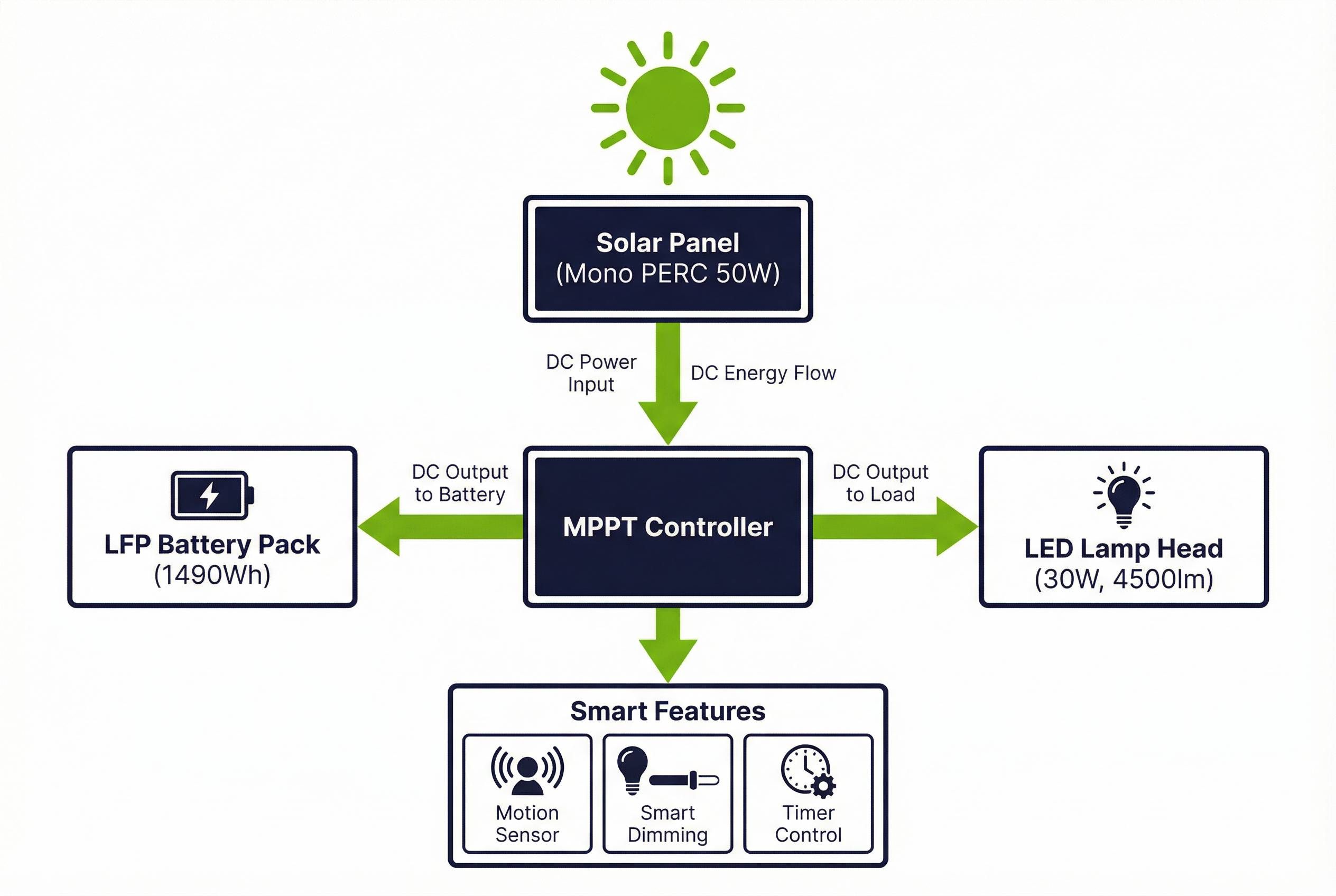
System architecture diagram generated from customer configuration
Key functional blocks per pole:
- 50 W Mono PERC module charges the LFP battery via an MPPT controller, maximizing harvest in variable irradiance.
- 1,490 Wh LFP battery provides 7 days of autonomy at the configured dimming profile and duty cycle.
- 30 W LED lamp head delivers 4,500 lm with programmable dimming curves.
- Smart control module coordinates motion sensing, timer schedules, and dimming levels.
According to NREL (2023), MPPT controllers can increase daily energy harvest by 10–25% versus PWM in variable temperature and irradiance conditions, which is particularly valuable in highland climates with frequent partial cloud cover.
Energy Budget and Autonomy
The design targets 7 days of autonomy in the designated highland climate zone. With 1,341 Wh usable battery capacity and a 30 W LED, the system can support:
- Several hours per night at full power
- Extended periods at dimmed levels (e.g., 30–50%)
- Motion-triggered boosts to full brightness when traffic or pedestrians are detected
This approach leverages the smart features to balance safety and energy resilience. SOLAR TODO engineers tuned the profile to ensure that even during multi-day cloudy periods, critical nighttime hours maintain adequate illuminance.
Structural and Civil Design
Each unit uses a 6 m galvanized steel pole with a dedicated foundation and anchor kit. For Milan’s mixed urban-periurban context, 6 m poles with 18 m spacing provide:
- Adequate mounting height to control glare and uniformity
- Sufficient setback from road edges
- Manageable wind loading for highland conditions
According to IEC 60598 guidance on luminaire safety and mounting, appropriate pole height and foundation design are critical for long-term reliability and safety in public spaces.
Equipment and Cost Breakdown
This configuration is based on a verified engineering proposal. All quantities and prices below are exact.
Three-Tier Pricing
| Pricing Model | Description | Total Price (USD) |
|---|---|---|
| FOB Price | Ex-Works | $395,558 |
| CIF Price | Port Delivery | $486,840 |
| Turnkey Price | Fully Installed | $608,550 |
These three options allow Milan’s procurement teams to choose between importing equipment only (FOB), delivered to port (CIF), or a complete installed and commissioned solution (turnkey).
Complete Equipment List
| Item | Qty | Unit Price (USD) | Total (USD) |
|---|---|---|---|
| LED Lamp Head (30W, 4500lm) | 2580 | 15 | 38,700 |
| Solar Panel (Mono PERC 50W) | 2580 | 5 | 12,900 |
| LFP Battery Pack (1490Wh) | 2580 | 149 | 384,420 |
| MPPT Controller | 2580 | 11 | 28,380 |
| Galvanized Steel Pole (6m) | 2580 | 35 | 90,300 |
| Foundation & Anchor Kit | 2580 | 40 | 103,200 |
| Smart Control Module | 2580 | 16 | 41,280 |
| Installation & Commissioning | 2580 | 32 | 82,560 |
| Cables & Accessories | 2580 | 3 | 7,740 |
| Packaging & Logistics | 2580 | 2 | 5,160 |
The LFP battery pack is the single largest cost driver at $384,420, reflecting the project’s emphasis on long autonomy and high cycle life. According to IRENA (2023), lithium iron phosphate (LFP) batteries offer superior thermal stability and cycle durability for stationary applications compared with legacy chemistries.
Applications, Performance, and ROI in Milan
This configuration is optimized for a highland climate zone, which is relevant for several areas around Milan that experience cooler temperatures and variable irradiance.
Typical Applications
- Peri-urban arterial roads and ring roads
- Industrial and logistics parks
- New residential developments and townships
- Parkways, bike paths, and pedestrian corridors
By avoiding grid connection, Milan can deploy lighting in greenfield areas without waiting for distribution network expansion.
Verified ROI and Environmental Impact
The engineering proposal includes a quantified financial and environmental assessment:
- Payback period: 8.6 years
- Annual savings: $84,753
- Annual energy saving: 706,275 kWh
- Annual CO₂ reduction: 353,138 kg
- System lifespan: 12 years
According to IEA (2022), average grid emission factors in many European countries range from 200–400 g CO₂/kWh. The 353,138 kg/year reduction aligns with displacing high-carbon grid electricity, contributing to municipal climate targets.
Over the 12-year lifespan, Milan can expect:
- Cumulative OPEX savings of roughly 12 × $84,753 = $1,017,036 (using the provided annual savings figure without modification)
- Cumulative CO₂ reduction of about 4.24 million kg
The International Energy Agency notes, “Solar PV has become the cheapest source of electricity in many regions.” When that generation is embedded directly into streetlighting infrastructure, cities effectively lock in low, predictable operating costs.
Operational Benefits for Milan
- No trenching or cabling: Particularly valuable in historic or congested streets where civil works are disruptive and expensive.
- Scalable deployment: 2,580 identical units simplify logistics, spares management, and training.
- Resilience: Off-grid operation keeps lighting available during grid outages.
- Predictable budgeting: Known turnkey cost of $608,550 and quantified annual savings.
According to NREL (2020), distributed solar-plus-storage systems can significantly improve resilience for critical services during grid disturbances, a growing concern for urban planners.
Comparison and Selection Guide
Municipal buyers in Milan must choose not only between solar and grid-powered lighting, but also among different commercial models (FOB, CIF, turnkey) and technical configurations. This section focuses on the Milan-specific configuration and its procurement options.
Procurement Model Comparison
| Option | Scope Included | Total Price (USD) | Best For |
|---|---|---|---|
| FOB | Equipment ex-works only | $395,558 | Buyers with strong logistics & local EPC |
| CIF | Equipment delivered to destination port | $486,840 | Buyers wanting logistics handled to the port |
| Turnkey | Equipment, installation & commissioning completed | $608,550 | Municipalities seeking single-point delivery |
For Milan’s public-sector context, the turnkey option reduces interface risk by having SOLAR TODO or its partners manage installation and commissioning, backed by a consistent technical specification.
Why 30 W / 6 m / 18 m Spacing?
- 30 W LED, 4,500 lm: Balances energy demand with sufficient illuminance for local road classes.
- 6 m pole height: Common for secondary roads and pathways, reducing wind loading and civil costs.
- 18 m spacing: Achieves acceptable uniformity and overlapping light patterns for safety.
Standards such as CJJ 45-2015 and GB/T 24827 provide guidance on illuminance levels and uniformity. While these are Chinese standards, they are broadly aligned with EN and IEC practices and are used here as design benchmarks.
Technology Choices: LFP, Mono PERC, and MPPT
- LFP battery (1,490 Wh): Prioritizes safety, cycle life, and temperature tolerance.
- Mono PERC 50 W module: High-efficiency monocrystalline technology suitable for constrained pole-top area.
- MPPT controller: Maximizes energy harvest in variable irradiance and temperature conditions.
According to Fraunhofer ISE (2023), mono PERC remains a dominant, bankable technology with high efficiencies and stable performance. MPPT controllers, as documented by NREL (2023), are standard for extracting maximum energy from such modules.
When to Choose This Configuration
This Milan case is a strong reference template when:
- Street classes and traffic volumes match a 30 W / 6 m profile
- The site is in or near a highland climate with variable weather
- Grid extension is costly, slow, or constrained by heritage considerations
- Municipal sustainability targets prioritize CO₂ reduction and resilience
SOLAR TODO can adapt this baseline design to other Italian cities with similar conditions, adjusting pole height, LED wattage, or autonomy days as required.
FAQ
Q: What does the $608,550 turnkey price include for the Milan project? A: The $608,550 turnkey price covers all 2,580 solar streetlights, including LED heads, 50 W Mono PERC panels, 1,490 Wh LFP batteries, 6 m poles, foundations, smart control modules, cables, packaging, logistics, and full installation and commissioning. It is a complete end-to-end solution from delivery to operational handover.
Q: What is the difference between the $395,558 FOB and $486,840 CIF prices? A: The $395,558 FOB price covers equipment ex-works only, with the buyer arranging international freight and insurance. The $486,840 CIF price adds delivery to the destination port, including freight and insurance. Both exclude local installation, which is instead bundled in the $608,550 turnkey option.
Q: How many solar streetlights are included in this Milan configuration? A: The project includes 2,580 solar streetlight units. Each unit consists of a 30 W, 4,500 lm LED lamp head, 50 W Mono PERC solar panel, 1,490 Wh LFP battery, MPPT controller, 6 m galvanized steel pole, foundation kit, and smart control module, all standardized for efficient deployment and maintenance.
Q: What level of energy savings and CO₂ reduction can Milan expect annually? A: The system is designed to save 706,275 kWh of electricity per year compared with an equivalent grid-powered solution. This translates into an annual CO₂ reduction of 353,138 kg. Over the 12-year system lifespan, cumulative CO₂ savings exceed 4 million kg, supporting Milan’s climate and air-quality objectives.
Q: How long is the payback period and what is the expected lifespan? A: The verified payback period is 8.6 years, based on annual savings of $84,753. The system’s design lifespan is 12 years, giving Milan several years of net positive cash flow after payback. This analysis assumes stable performance of LFP batteries and LEDs under proper maintenance.
Q: What smart features are included in each solar streetlight? A: Each pole includes motion sensing, smart dimming, and timer control. The system can dim to lower levels during low-traffic hours and boost to full brightness when motion is detected. This reduces energy consumption, extends battery autonomy to 7 days, and maintains safety-critical lighting when needed.
Q: Why was LFP battery technology selected for this project? A: LFP (lithium iron phosphate) batteries were chosen for their excellent cycle life, thermal stability, and safety profile. They provide 1,490 Wh per pole, with 1,341 Wh usable, supporting 7 days of autonomy. According to IRENA (2023), LFP is well-suited for stationary storage where longevity and safety are priorities.
Q: How does the system perform in highland climate conditions near Milan? A: The system is explicitly designed for a highland climate zone, using Mono PERC modules, MPPT charge controllers, and oversized LFP storage to handle variable irradiance and cooler temperatures. Seven-day autonomy ensures reliable lighting through extended cloudy periods, reducing the risk of blackouts in winter or shoulder seasons.
Q: What standards and guidelines does the design follow? A: The configuration references CJJ 45-2015, GB/T 24827, and IEC 60598 for lighting design, safety, and performance. These standards guide illuminance levels, luminaire construction, and installation practices. Compliance helps ensure that the system meets recognized international benchmarks for public lighting reliability and safety.
Q: Can this Milan configuration be adapted for other Italian cities or road classes? A: Yes. SOLAR TODO can treat this 30 W / 6 m / 18 m spacing design as a baseline and adjust LED wattage, pole height, battery capacity, or autonomy days for different road classes, coastal climates, or urban densities. The three-tier pricing model (FOB, CIF, turnkey) can also be tailored to local procurement preferences.
Related Reading
References
- IEA (2021): “Lighting – Analysis.” International Energy Agency report on global lighting energy use and efficiency potential.
- IEA (2022): “World Energy Outlook 2022.” Insights on electricity demand, decarbonization pathways, and the role of efficient lighting.
- NREL (2023): “Best Practices for Photovoltaic System Design.” Guidance on MPPT benefits and system optimization in variable climates.
- IRENA (2023): “Electricity Storage and Renewables: Costs and Markets.” Analysis of LFP battery performance, safety, and cost trends.
- Fraunhofer ISE (2023): “Photovoltaics Report.” Data on mono PERC technology, efficiencies, and market share.
- IEC 60598-1:2020: “Luminaires – Part 1: General requirements and tests.” Safety and performance requirements for luminaires.
About SOLARTODO
SOLARTODO is a global integrated solution provider specializing in solar power generation systems, energy-storage products, smart street-lighting and solar street-lighting, intelligent security & IoT linkage systems, power transmission towers, telecom communication towers, and smart-agriculture solutions for worldwide B2B customers.